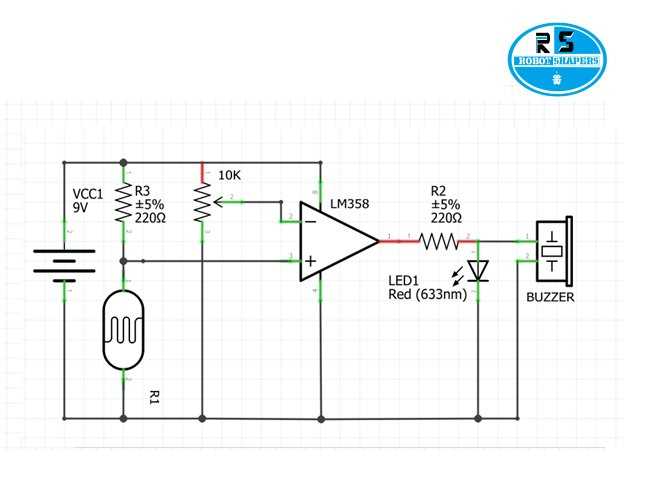
Connect the positive input to the reference voltage and the negative input to the signal source for immediate threshold detection. Use resistors between 1kΩ and 10kΩ to stabilize input levels and prevent oscillation.
Power the operational amplifier with a dual supply of ±5V to ±15V for optimal swing. Ensure bypass capacitors of 0.1µF close to the pins to reduce high-frequency noise and improve response time.
Output can drive LEDs, buzzers, or logic gates directly when load current stays below 20mA. Include a small series resistor with LEDs to prevent overcurrent and maintain consistent brightness across varying input voltages.
Op-Amp Setup with Wiring and Component Connections
Connect the non-inverting input to a stable reference voltage while feeding the inverting input with the measured signal for immediate threshold comparison. Use 1kΩ to 10kΩ resistors on input lines to limit current and avoid signal distortion.
Power the operational amplifier with a ±12V supply to ensure full output swing. Place 0.1µF ceramic capacitors close to the power pins to filter high-frequency noise and improve response stability.
For visual indicators, connect LEDs directly to the output with a series resistor of 330Ω to 1kΩ depending on supply voltage. This ensures the LED lights consistently without overloading the amplifier.
Optimizing Feedback and Hysteresis
Add a small resistor between output and positive input to introduce hysteresis, preventing rapid toggling when the input signal hovers near the threshold. Start with 10kΩ and adjust to tune switching behavior.
Practical Tips for Signal Sources
Use shielded wires for input signals longer than 30cm to reduce interference. Keep the signal path away from high-current traces to avoid false triggering, especially in mixed-voltage setups.
Step by Step Op-Amp Wiring and Pin Setup
Start by connecting the positive input to a stable reference voltage and the negative input to the signal line. Follow these steps for proper pin configuration:
- Pin 4 to negative supply (ground or -V).
- Pin 8 to positive supply (+V, typically 5V–15V).
- Pin 3 as non-inverting input for reference voltage.
- Pin 2 as inverting input for measured signal.
- Pin 1 as output, optionally with a series resistor for LED or logic load.
Include bypass capacitors (0.1µF) near the supply pins to reduce noise and prevent oscillations. Use short, direct connections to minimize voltage drops and improve response speed.
Tips for Stable Operation
- Use shielded or twisted wires for long input lines.
- Keep input traces away from high-current paths to avoid false switching.
- Add a small feedback resistor (10kΩ–50kΩ) between output and positive input to introduce hysteresis and reduce chatter when the signal is near threshold.