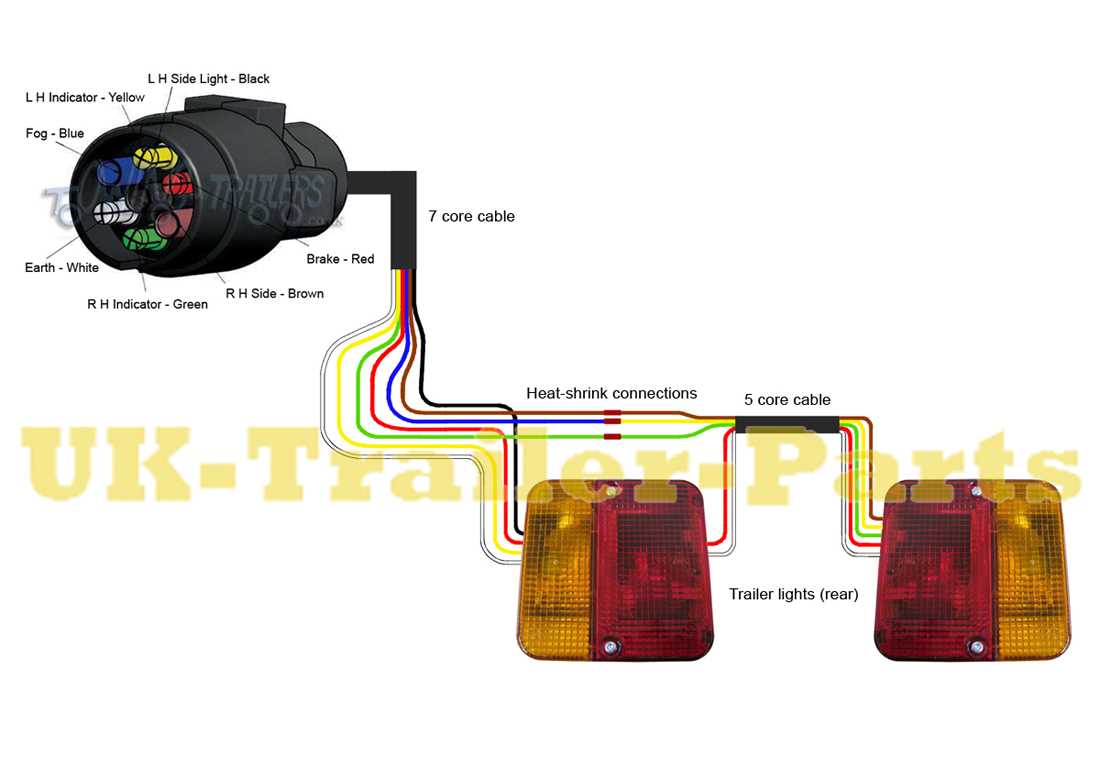
Use a 4-pin harness layout for most small cargo carriers under 750 kg: one conductor for ground, one for tail illumination, one for left turn/brake, and one for right turn/brake. Attach the ground lead directly to bare metal on the chassis with a ring terminal and stainless bolt; resistance should stay below 0.3 Ω. This single step prevents flicker and dim output that often appear when corrosion builds between frame sections.
Color coding helps avoid crossed conductors. In common North American harness sets, white connects to ground, brown feeds rear position illumination, yellow controls the left turn/brake circuit, and green controls the right turn/brake circuit. European 7-pin connectors follow a different pattern: pin 3 for ground, pin 5 for right indicator, pin 6 for brake, and pin 7 for rear position illumination. Matching the connector standard used on the towing vehicle prevents signal conflicts.
Solid-state illumination modules draw far less current than filament bulbs. A typical unit consumes 0.1–0.3 A per function compared with 2–2.5 A for traditional bulbs. Some vehicles interpret the low draw as a failed bulb and trigger a dashboard warning. Install a 6 Ω, 25 W load resistor across the indicator circuits when this happens; mount it on metal because surface temperature can exceed 150 °C during operation.
Route the cable bundle along the inside edge of the frame using UV-resistant clips spaced every 30–40 cm. Keep the harness at least 10 cm away from exhaust pipes and suspension pivots. Where the cable passes through drilled metal, insert a rubber grommet to prevent insulation damage. After final connection, verify each signal with a multimeter: tail illumination near 12–13.8 V, brake and indicator circuits pulsing between 0 and system voltage.
Connection Scheme for Towable Rear Signal Lamps
Use a 4-core or 7-core automotive cable rated for outdoor use and connect each conductor to the corresponding vehicle signal circuit: left indicator, right indicator, stop signal, tail illumination, and ground. Copper conductors with a cross-section of 0.75–1.5 mm² handle typical current drawn by modern semiconductor emitters while reducing voltage drop across the rear assembly.
Place the ground conductor directly on a cleaned metal point of the frame using a stainless bolt and star washer. Poor grounding causes dim rear indicators and irregular blinking. Measure resistance between the frame and vehicle chassis; a reading below 0.3 Ω indicates a stable return path.
Typical Color Allocation
Manufacturers often assign yellow for the left turn indicator, green for the right turn indicator, brown for tail illumination, red for stop signal, and white for ground. A seven-pin connector usually adds blue for electric brake control and black for auxiliary power. Verify colors with a multimeter because aftermarket harness sets sometimes deviate from common coding.
Route the cable along the drawbar and frame rails using rubber-lined metal clamps every 30–40 cm. This spacing prevents insulation wear caused by vibration. Avoid sharp edges; pass conductors through plastic grommets wherever the cable crosses steel panels.
Connector Pin Arrangement
A flat four-pin plug typically places ground on the exposed pin, tail illumination next, left indicator on the third, and right indicator on the final contact. Round seven-pin sockets distribute signals differently: ground at pin 1, tail illumination at pin 3, left indicator at pin 5, right indicator at pin 6, stop signal often shared with indicators depending on regional standard.
Test each circuit with a 12-volt probe before sealing connectors. Activate the vehicle’s indicator lever, brake pedal, and parking illumination while observing the probe. Each conductor should energize only during its intended signal event.
Seal joints using adhesive heat-shrink tubing rather than electrical tape. Heat-activated adhesive forms a waterproof sleeve around the splice, preventing corrosion caused by road spray and winter salt.
After assembly, attach the rear lamp modules and verify brightness at a distance of at least 15 m in daylight. Balanced intensity between left and right sides confirms proper conductor routing and stable ground contact.
How to Read a Standard 4-Pin LED Trailer Lights Wiring Diagram and Identify Each Wire Function
Check the color key first and match each conductor with its electrical role before connecting anything. A common 4-pin layout uses four color-coded conductors: white, brown, yellow, and green. White normally links to chassis ground, brown carries the tail and marker signal, yellow operates the left indicator with brake signal, and green handles the right indicator with brake signal. Identifying these functions at the beginning prevents reversed turn signals or inactive rear markers.
The white conductor always serves as the return path. Attach it directly to bare metal on the frame using a corrosion-resistant bolt or grounding screw. Poor grounding causes dim illumination, flickering indicators, or signals that activate together. Clean paint and oxidation from the contact point before fastening the terminal ring.
Color Functions in a Typical 4-Pin System
- White: chassis ground connection.
- Brown: rear position markers and side markers.
- Yellow: left turn signal combined with stop signal.
- Green: right turn signal combined with stop signal.
Trace each conductor visually along the harness. Brown usually splits near the rear to feed both sides because position markers must illuminate simultaneously. Yellow and green stay separated so each side can blink independently during turns.
Use a multimeter or test probe while activating vehicle signals. When the parking circuit is switched on, the brown conductor should show around 12–14 volts. Activating the left indicator should produce a pulsing voltage on the yellow line, while the right indicator produces the same pulsing signal on the green line.
Quick Identification Procedure
- Locate the four-pin plug and observe the color pattern.
- Confirm the white conductor is attached to frame metal.
- Activate vehicle parking markers and verify voltage on the brown line.
- Switch on the left indicator and test the yellow conductor.
- Switch on the right indicator and test the green conductor.
If colors differ due to aftermarket harnesses, rely on voltage behavior instead of insulation color. A constant voltage during marker activation identifies the tail circuit, while rhythmic voltage reveals indicator lines. Ground remains the conductor with zero voltage relative to the frame.