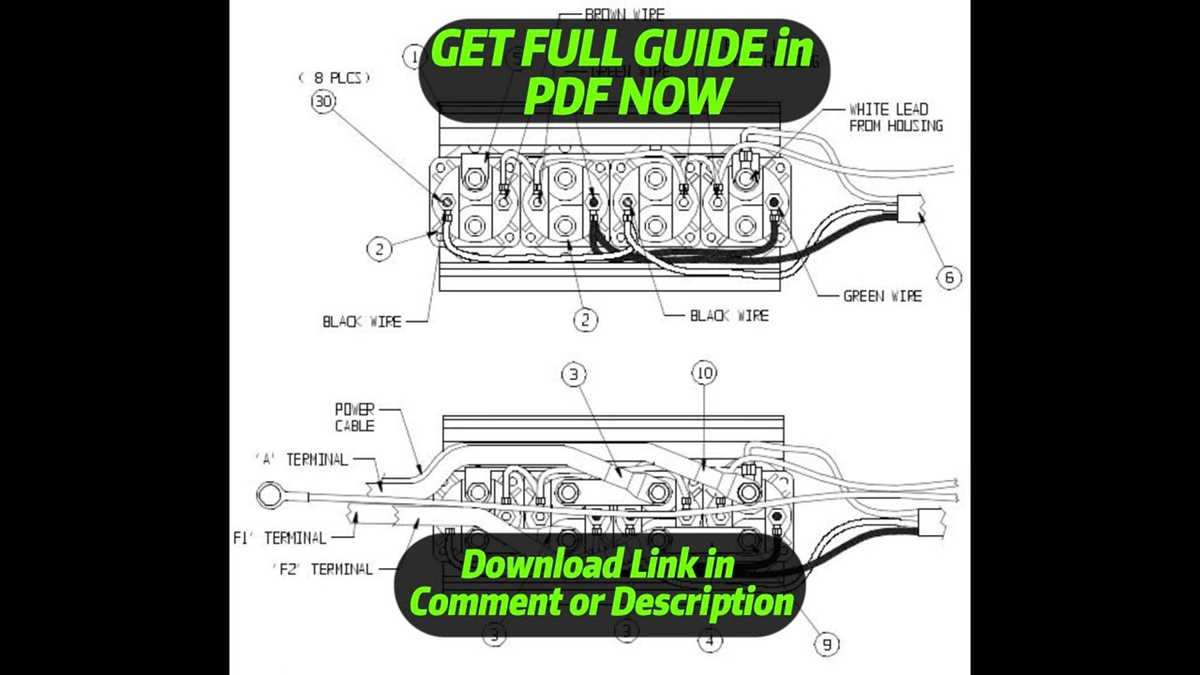
Connect the battery’s positive terminal directly to the main contact posts of the four-relay control pack using thick copper leads rated for high current, typically 2–4 AWG. The negative line should run straight to the motor housing or chassis ground point with minimal resistance. Short cable routes and corrosion-free terminals reduce voltage drop and prevent overheating during heavy pulling loads that may exceed 300–400 amps.
Each relay inside the control module manages the direction of the motor shaft. Two units handle forward rotation, while the remaining pair switches polarity for reverse movement. The small control leads from the handlebar or handheld switch connect to the relay coils through low-current wires, usually 16–18 AWG. Pressing the “in” button energizes one pair of relays, sending current to the armature in a specific polarity; pressing “out” activates the opposite pair, reversing motor direction.
Install a 500 A fuse or manual breaker between the battery and the control pack to guard against short circuits. Position the protection device within 30–40 cm of the battery terminal. Secure every connection with crimped copper lugs and heat-shrink insulation. Loose terminals create heat under high load and may weld contact surfaces inside the relay block.
The motor normally has three posts: one ground and two power terminals. The relay assembly alternates current between these terminals, which changes the rotation direction. Verify that the ground strap between the battery, frame, and motor casing shows less than 0.1 ohm resistance. A stable ground path prevents erratic relay activation and protects the control switch from voltage spikes.
4-Relay Control Layout for an Electric Recovery Hoist
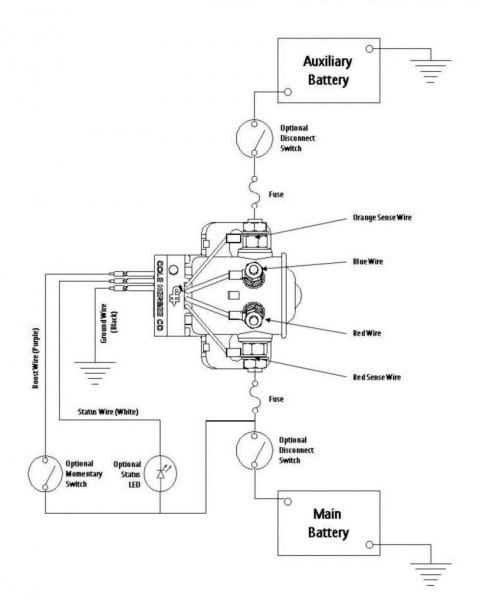
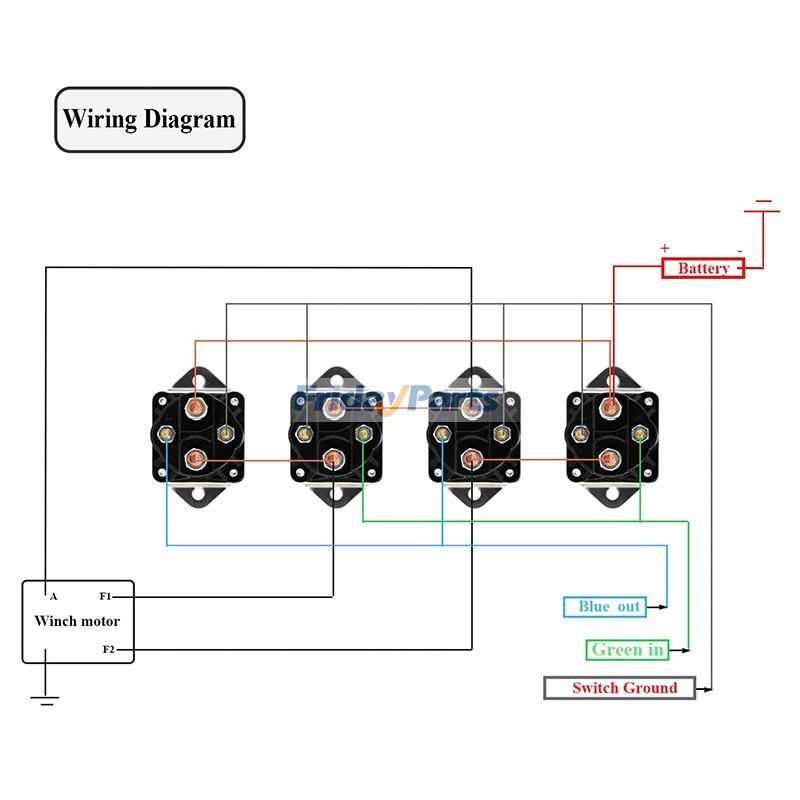
Connect the battery positive terminal directly to the high-current relay block using copper cable rated at least 35–50 mm². Mount the relay cluster within 60–80 cm of the motor housing to reduce voltage drop. Ground the negative terminal with an equally thick conductor attached to a clean chassis point or directly to the motor casing. A typical control pack uses four heavy contactors arranged to reverse motor polarity: two handle forward rotation and two handle reverse. Control leads from the handheld switch carry only low current and trigger the relay coils rather than feeding the motor itself.
Relay terminals usually follow a simple pattern. Two large studs handle motor power, while two smaller posts energize the coil. Identify them before assembly and mark each cable using heat-resistant labels. The motor normally has three terminals: A, F1, and F2. A connects to battery positive through the relay pair responsible for forward motion, while F1 and F2 swap polarity through the opposite pair during reverse rotation. Incorrect placement leads to motor spin without drum movement or immediate fuse failure.
- Battery (+) → 400–500 A fuse → relay block input stud
- Battery (−) → motor housing or heavy ground bar
- Motor terminal A → common output of forward relay pair
- Motor terminal F1 → switching relay #3 output
- Motor terminal F2 → switching relay #4 output
- Control switch → coil terminals via 16–18 AWG leads
Check continuity before applying power. With a multimeter, confirm that each relay closes only when the control switch is pressed. Measure resistance between motor terminals while activating forward and reverse commands; values should shift as the polarity routing changes through the contactor group. Secure all high-current cables with crimped copper lugs and heat-shrink tubing. Loose connections generate heat above 120 °C during heavy pulling loads, which melts insulation and damages the relay assembly.
How to Connect Battery Cables to a 4-Contactor Control Pack
Attach the positive battery lead directly to the main power stud on the control box that feeds the contactor group. Use a copper lug sized for the cable gauge (commonly 2 AWG or 0 AWG) and tighten the nut to about 12–15 Nm so the lug cannot rotate. Place the cable so it reaches the terminal without tension; stretched conductors heat up and loosen over time.
Route the negative battery lead straight to the motor housing ground point or to the dedicated negative stud on the control assembly if one exists. Many recovery units ground through the motor frame, so the cable must be attached to clean bare metal. Remove paint with fine abrasive paper and secure the lug using a stainless bolt and star washer.
Two heavy power lines must link the battery input terminal to the relay block. The incoming positive cable feeds a shared bus that distributes current to the four switching units. If the pack has a copper bridge plate, check that it sits flat and that insulating spacers remain intact; damaged spacers allow the bus to touch the enclosure and short the system.
Keep the battery cables separated from the motor output leads by at least 15–20 mm inside the enclosure. Tight bends near terminals should be avoided; maintain a curve radius roughly five times the cable diameter. This prevents internal strand fatigue during vibration on rough terrain.
Each terminal connection benefits from dielectric grease applied after tightening. The compound blocks moisture and slows oxidation on copper surfaces, particularly on vehicles used in mud, road salt, or coastal air. A thin layer across the lug face and threads is sufficient.
Secure the cables with rubber-lined clamps along the vehicle frame so the conductors cannot rub against sharp steel edges. Abrasion through insulation quickly exposes the copper core and may cause a high-current short capable of melting the conductor jacket within seconds.
Install a high-amperage fuse or manual disconnect switch within 30–40 cm of the battery positive terminal. Ratings between 400 A and 500 A suit most recovery motors. This protective device isolates the electrical system during maintenance and reduces fire risk if the cable insulation becomes damaged.
After completing all connections, measure voltage at the control pack input with a multimeter while the motor is briefly engaged. The drop between battery terminals and the pack should remain below 0.5 V under load; higher loss indicates loose terminals, undersized cable, or corrosion in the power path.