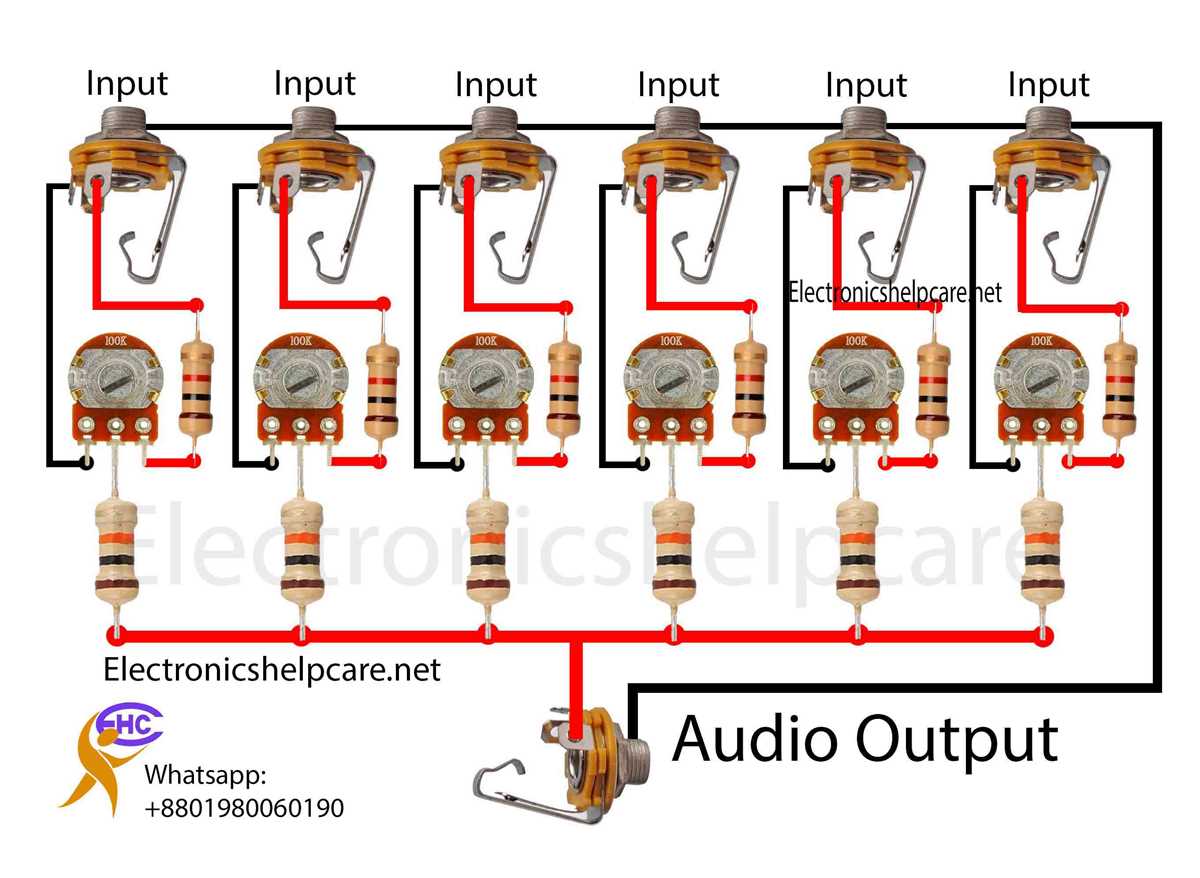
Place the input preamplifier stage at the beginning of the signal path. Microphone and line sources produce very small voltage levels, often between 1 mV and 100 mV. A preamplifier raises this level to roughly 0.5–1 V so the signal can pass through tone control networks and summing amplifiers without noise dominating the output.
Each input channel usually contains several sections connected in sequence. A gain stage based on an operational amplifier increases the signal level. After that, a tone control network shapes low, mid, and high frequency ranges. Passive RC filters or active op-amp filters perform this task while maintaining stable signal levels across the channel strip.
Summing stages combine signals from multiple channels. Each channel sends its output through a resistor network into a summing amplifier. This amplifier adds the voltages from all channels and produces a combined output signal. Typical resistor values range from 10 kΩ to 47 kΩ, chosen to balance channel isolation and noise performance.
Power supply stability directly affects sound clarity. Dual supply rails such as +15 V and −15 V allow operational amplifiers to process both positive and negative waveform peaks without clipping. Voltage regulators and filter capacitors stabilize these rails and reduce hum from the mains supply.
Signal routing also includes auxiliary send paths and master output stages. Auxiliary sends route selected channel signals to effects processors, while the master stage drives power amplifiers or recording interfaces. Clear electrical layouts showing these paths help engineers troubleshoot distortion, imbalance between channels, or missing signal output.
Professional Audio Mixer Circuit Diagram with Channel Routing and Preamp Stages
Place a low-noise preamplifier directly after each input connector. Microphone sources often produce signals between 1 mV and 10 mV, which are too weak for later processing stages. An operational amplifier configured with a gain of 20–60 dB raises this level so it can move through the channel strip without excessive background noise.
Use balanced input lines with differential amplifier topology. This arrangement rejects external interference picked up by long microphone cables. A typical stage uses a dual operational amplifier with matched resistors, often around 10 kΩ to 22 kΩ, providing common-mode noise rejection while maintaining stable signal amplification.
Gain control usually appears after the first amplification stage. A rotary potentiometer placed in the feedback path adjusts amplification from low gain for line sources up to higher gain for microphones. Values between 10 kΩ and 50 kΩ are common depending on the design.
Channel routing directs the signal through tone shaping stages and auxiliary paths. After amplification, the signal may pass through low-frequency, mid-range, and high-frequency filters. Active filter sections built around operational amplifiers allow boost or cut adjustment for each frequency band.
Each channel then feeds a level fader that controls the amount of signal sent to the summing network. Linear or logarithmic slide potentiometers between 10 kΩ and 100 kΩ are widely used for this control because they provide smooth level adjustment during mixing operations.
The summing amplifier receives signals from multiple channels through individual resistors. Each resistor isolates the channels while allowing their voltages to combine at the amplifier input node. Typical resistor values fall near 22 kΩ to balance signal level and noise performance.
Power rails often use symmetrical supplies such as +15 V and −15 V. Operational amplifiers connected to these rails handle both halves of the waveform without clipping. Large electrolytic capacitors near the regulators reduce ripple and stabilize voltage.
Final output stages drive external equipment such as power amplifiers, recording interfaces, or monitoring systems. Buffer amplifiers placed after the summing stage provide low output impedance so long cables can carry the signal without loss or distortion.
Input Channel Structure with Microphone Preamplifier and Gain Control
Place a low-noise microphone preamplifier immediately after the input connector. Typical microphone outputs range from 1 mV to 10 mV, which is too small for later processing stages. An operational amplifier stage raises this level to roughly 0.5 V or higher so the signal can move through filters, level controls, and summing amplifiers without heavy noise contamination.
The input stage normally uses a balanced configuration. Two signal lines from the microphone feed a differential amplifier that cancels interference picked up along the cable. This design improves rejection of electromagnetic noise from lighting equipment, power transformers, and nearby electronics.
Typical Input Stage Components
Many channel strips use a similar group of elements:
- XLR input connector for balanced microphone connection
- Differential amplifier built around a dual operational amplifier
- Input resistors between 1 kΩ and 10 kΩ for impedance matching
- Coupling capacitors between 1 µF and 10 µF to block DC
- Feedback resistors that define the gain of the amplifier
Gain control normally sits in the feedback network of the preamplifier. A rotary potentiometer adjusts amplification between roughly 20 dB and 60 dB depending on the source. Low settings suit line-level equipment, while higher settings handle microphones or other low-level signals.
Signal Path Through the Channel
After amplification, the signal flows through several stages in sequence:
- Input preamplifier raises the signal level
- Gain control adjusts amplification
- Coupling capacitor removes DC offset
- Tone shaping filters modify frequency response
- Level fader sends the signal toward the summing stage
Impedance matching helps maintain signal quality at the input. Microphones typically expect input impedance between 1 kΩ and 2 kΩ. Values much lower reduce signal level, while much higher values may increase susceptibility to noise pickup.
Power supply filtering also influences the input stage. Operational amplifiers often run on symmetrical rails such as +15 V and −15 V. Electrolytic capacitors placed near the amplifier pins reduce ripple and prevent oscillation during high gain operation.
Careful layout of the input section reduces unwanted hum. Keep signal traces short, separate them from power lines, and place grounding points close to the preamplifier. These practices help maintain a clean signal before it enters later processing stages.