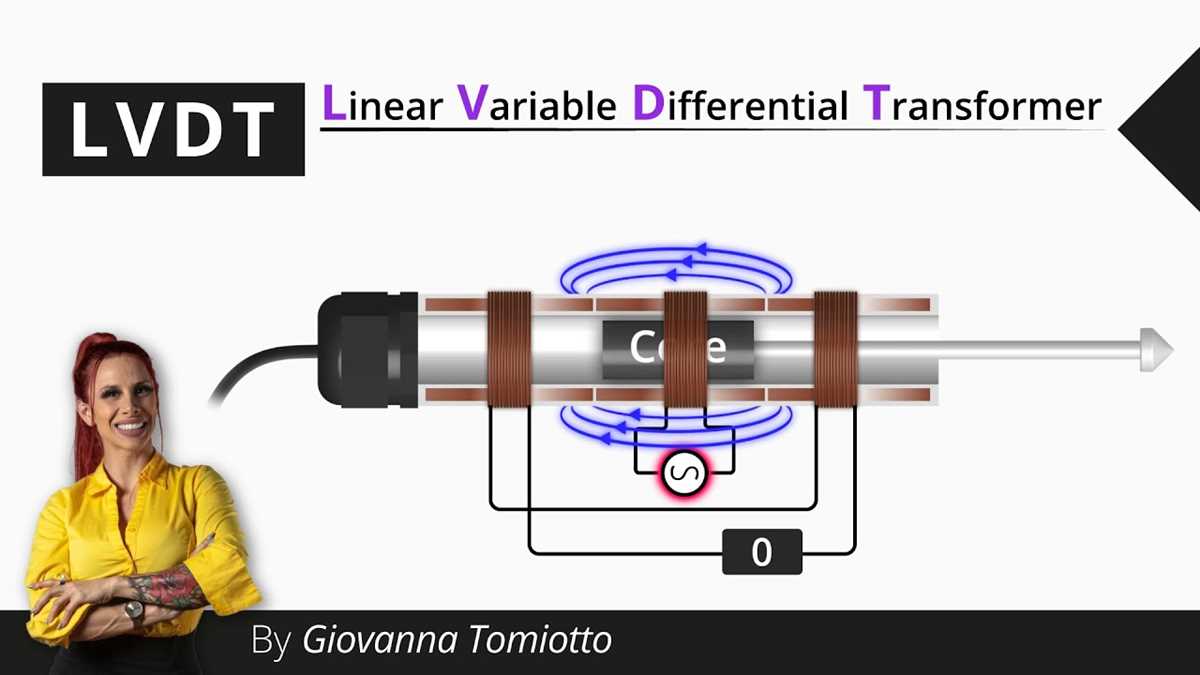
For precise measurement of displacement, the key to proper operation lies in the accurate connection of components. Pay attention to the way the sensor’s primary and secondary windings are configured, as well as how the output is wired to the amplifier. Incorrect wiring can result in distorted or unreliable measurements.
When connecting the primary coil, ensure it is fed by an AC signal from the excitation source. The secondary windings must be properly aligned with the sensing element to detect the displacement accurately. If the signal is not balanced, calibration will be required to maintain measurement accuracy.
If you’re troubleshooting issues in the setup, check the power supply, as inconsistent voltages can cause irregular outputs. In addition, ensure that the wiring for the output is shielded properly to prevent interference from external signals, which could distort the reading.
Understanding the Sensor’s Electrical Setup
To build a proper setup, the key components include the excitation source, the primary coil, and the secondary coil. The excitation signal, typically an AC voltage, drives the primary coil. Ensure the frequency of this signal is stable to avoid measurement errors.
Primary Coil Wiring
The primary coil should be fed by an alternating current (AC) from the excitation source. The power supply must provide a consistent AC signal within the specified frequency range for the sensor’s optimal performance. If the input frequency fluctuates, the output signal will also show distortion.
Secondary Coil Connections
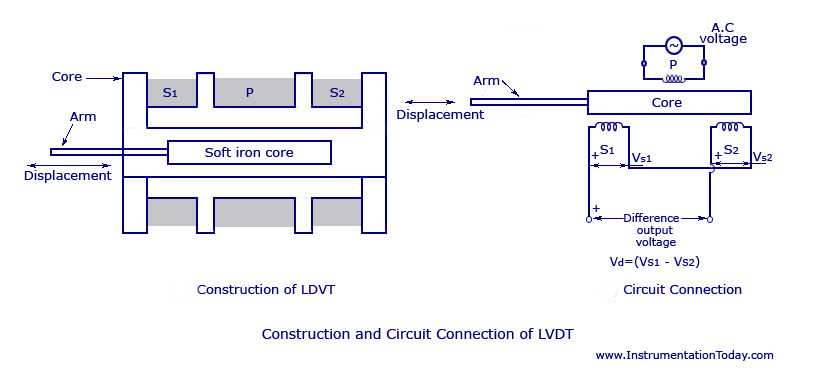
The secondary coil is responsible for detecting the displacement. It has two output windings that provide the differential signal. These outputs need to be connected to the signal conditioning electronics, which amplify and process the voltage to reflect the exact position.
- Check that the secondary coils are aligned symmetrically for accurate readings.
- Ensure the output terminals are properly shielded to avoid electrical noise interference.
In any setup, proper grounding is critical. A poor ground connection can lead to noisy signals, affecting the accuracy of the displacement measurement. Additionally, ensure the output is connected to a signal processing unit or amplifier to convert the raw signal into a usable measurement for your system.
How to Read and Interpret an Lvdt Circuit Diagram
Begin by identifying the excitation source in the schematic. This is typically represented by a symbol for a voltage source connected to the primary coil. The source will provide the alternating current needed to energize the sensor. Make sure the frequency and amplitude of this signal are indicated clearly on the diagram, as this affects the performance.
Next, locate the primary and secondary coils. The primary coil will be connected to the excitation source, while the secondary coil will have its two output terminals. These output terminals are used to detect the displacement of the sensor’s core. In the diagram, these connections should be shown clearly with labels for ease of identification.
The next step is to look for the signal conditioning block. This is typically shown as a box or a series of components such as resistors, capacitors, and operational amplifiers. These elements are responsible for processing the raw signal from the secondary coil and converting it into a usable form. Understanding this section helps ensure that the output is in the correct voltage range for your system.
Pay attention to the ground connections. These are usually represented by a symbol for ground, and it’s crucial that all components are properly grounded. Improper grounding can introduce noise into the signal, resulting in inaccurate readings. Ensure that every component with a ground reference is connected properly.
Finally, check for any external connections such as feedback loops or additional sensors that might be part of the setup. These are often used for calibration or to provide additional input signals to the system. The diagram should clearly show how these components are integrated, ensuring that the system works as intended without interference.