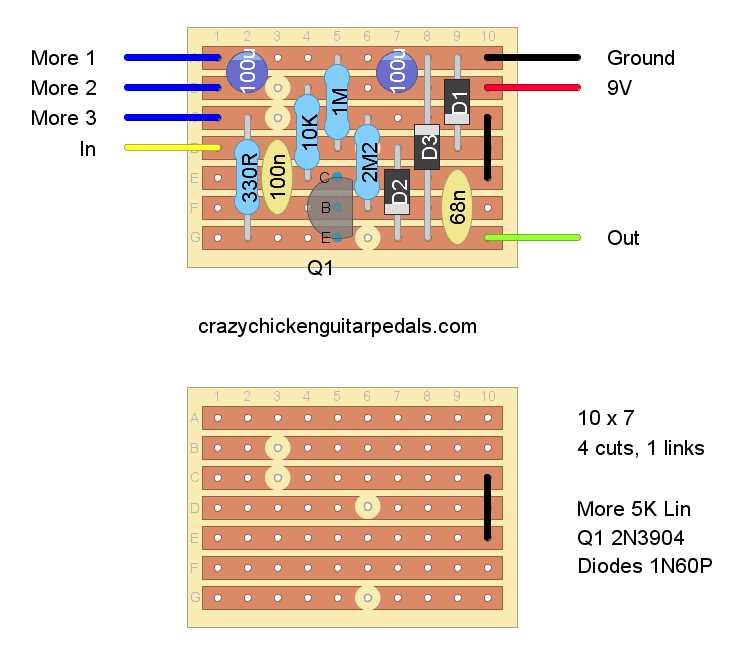
Use a clear schematic layout with labeled components and voltage points before assembling any stomp-activated sound box. A practical plan normally begins with an input buffer based on a low-noise transistor or an operational amplifier such as TL071 or JRC4558. Place the buffer directly after the input jack to stabilize impedance near 1 MΩ; this prevents tone loss from passive pickups and keeps high frequencies intact.
The next stage usually shapes the signal through clipping or gain amplification. Silicon diodes (1N4148) create tight distortion, while germanium parts like 1N34A produce softer saturation. Resistor values between 4.7 kΩ and 470 kΩ define gain limits, while capacitors from 10 nF to 220 nF regulate low-frequency roll-off. Position tone-shaping networks after the gain block: a simple RC filter using a 22 nF capacitor and a 10 kΩ potentiometer allows smooth high-end adjustment.
Switching logic must isolate the effect path from the bypass path. Most floor units apply a 3PDT foot switch so the signal can route directly from input to output when the effect stage is disengaged. The third pole typically controls an LED indicator through a resistor between 2.2 kΩ and 4.7 kΩ, matched to a 9-volt supply.
Power filtering should never be ignored. Place a 100 µF electrolytic capacitor across the supply rails and add a 100 nF ceramic capacitor near active components. This pair suppresses ripple and switching noise, preventing hiss or oscillation when the unit shares a power adapter with several other stage devices.
Signal Layout for a Six-String Effects Unit
Use a simple transistor gain stage with a 9 V supply, a 100 kΩ collector resistor, 1 kΩ emitter resistor, and a 0.047 µF input capacitor to shape the incoming signal from a six-string instrument. The input path should include a 1 MΩ bias resistor connected to ground to stabilize the signal level. Place a 10 µF electrolytic capacitor between the emitter and ground to increase amplification at lower frequencies. Output should pass through a 0.1 µF capacitor toward the volume control (typically 100 kΩ logarithmic potentiometer), which regulates signal intensity before it reaches the amplifier input.
Component Placement and Noise Control
Arrange resistors and capacitors close to the amplification transistor to shorten conductive paths. Keep the input jack line separate from the output line by at least 15–20 mm on the board to reduce interference. Shielded wire between the instrument jack and the first gain stage reduces hum produced by nearby power sources. Ground traces should converge at a single point near the power supply connection; scattered grounding increases background noise and oscillation. Electrolytic capacitors must respect polarity: reversed orientation may lead to leakage and unstable signal behavior.
Typical Variations for Tone Shaping
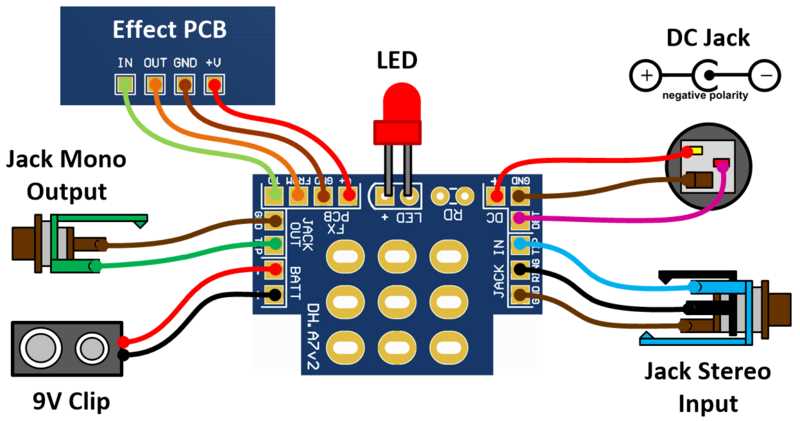
Altering capacitor values modifies frequency emphasis. For example, replacing the 0.047 µF input capacitor with 0.01 µF attenuates bass response, producing a sharper tone suited for rhythmic parts. Increasing the emitter bypass capacitor from 10 µF to 47 µF boosts low-frequency gain. A clipping stage can be added after the amplification block by inserting two silicon diodes (1N4148) connected in opposite directions across the signal path; this limits waveform peaks and produces distortion. Silicon devices clip at roughly 0.7 V, while germanium types reduce the threshold to around 0.3 V, yielding softer saturation.
How to Read a Schematic for an Effects Box: Symbols, Signal Path, and Component Roles
Trace the signal route from the input jack toward the output stage on the schematic sheet. Audio normally flows left-to-right. Follow each connection line and note where the path splits, joins, or passes through gain stages. A typical chain includes an input buffer, shaping network, amplification block, tone shaping elements, and an output buffer. Mark the path with a pencil or digital highlight to separate audio flow from power distribution lines.
Recognize standard electronic symbols before analyzing behavior. Most sheets rely on conventional notation shared across analog electronics documentation.
- Resistor – zigzag or rectangular block; restricts current and sets bias levels.
- Capacitor – two parallel plates; stores charge and passes alternating audio depending on value.
- Diode – triangle pointing to a bar; allows current in one direction and forms clipping stages.
- Transistor – three-terminal device used for gain and switching.
- Operational amplifier – triangle with two inputs and one output.
- Ground symbol – reference point for voltage measurements.
Separate the audio path from the power network. Lines feeding voltage rails often run vertically and connect to many parts through resistors or filtering capacitors. These elements stabilize supply levels and suppress noise. Electrolytic capacitors placed between the supply rail and ground indicate filtering stages. If a voltage divider appears (two resistors between supply and ground), the midpoint often creates a virtual reference used by amplification stages.
Study component values carefully because they reveal how frequencies are shaped. A small capacitor such as 100 pF placed across a gain stage usually suppresses high-frequency oscillation. Larger values like 10 µF handle low-frequency coupling. Resistors paired with capacitors create filters:
- High-pass network: capacitor followed by resistor to ground.
- Low-pass network: resistor feeding a capacitor connected to ground.
- Band shaping: several RC stages linked sequentially.
Identify gain stages by locating active devices. Transistors or op-amp blocks amplify the incoming waveform. Around each active device there is a bias network that sets operating voltage. Look for:
- Input coupling capacitor
- Bias resistors forming a midpoint voltage
- Feedback resistor controlling amplification level
- Output coupling capacitor sending the processed signal forward
Clipping sections appear where diodes connect either to ground, to a reference node, or in opposite directions across an amplification stage. Symmetrical diode pairs produce balanced distortion. Asymmetrical arrangements shift the waveform and generate additional harmonics. When several diodes appear in series, the clipping threshold increases because each junction adds roughly 0.6–0.7 V.
Switches and potentiometers modify behavior without altering the main signal route. A potentiometer symbol with three terminals typically adjusts gain, tone filtering, or output level. When a switch connects different capacitor values into the path, it changes frequency response. Multi-pole switches redirect the audio to alternate shaping networks, creating multiple tonal modes.
Interpret reference labels and node numbers to understand connectivity across the sheet. When two points share the same label, they are electrically connected even if no visible line links them. This method reduces clutter in complex layouts. Review each labeled node and verify whether it belongs to the audio chain, power rail, or control section; doing so prevents misreading the schematic structure.