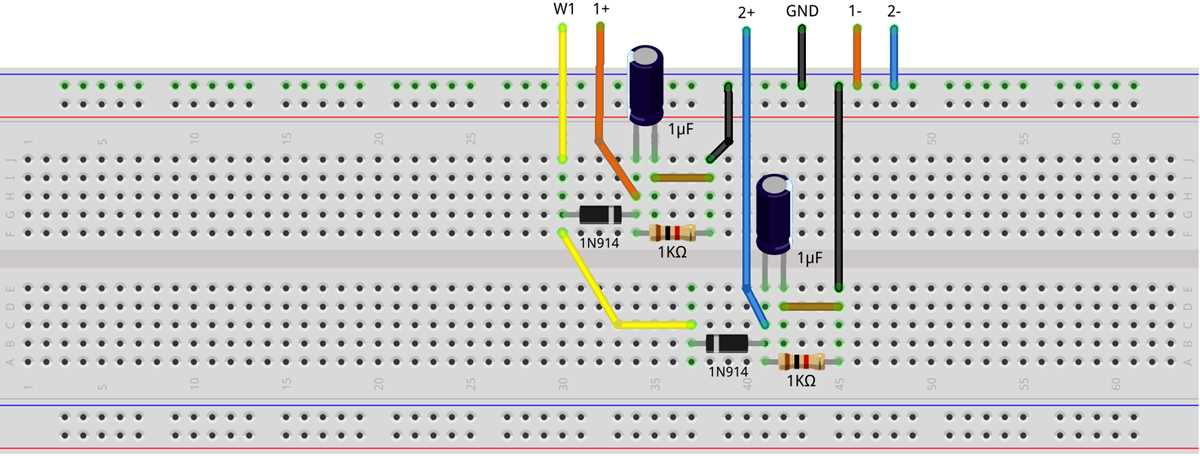
Use a diode rectifier followed by an RC smoothing stage to recover the amplitude variation of an AM radio signal. The diode conducts during positive peaks of the carrier wave, while the capacitor stores charge that tracks the signal amplitude.
The basic stage contains three components: a signal diode, a capacitor, and a load resistor. During each carrier peak the diode charges the capacitor. Between peaks the capacitor slowly discharges through the resistor, producing a voltage that follows the modulation pattern.
Select a diode with a low forward voltage drop such as 1N34A germanium or a Schottky type like BAT54. These devices conduct with small signal levels and preserve weak RF information commonly present in broadcast receivers.
The RC time constant determines how well the output follows the modulation waveform. Choose component values so that R × C remains much larger than the carrier period but smaller than the audio modulation period. For example, with a 455 kHz intermediate frequency, a capacitor around 10 nF and a resistor near 100 kΩ provide suitable tracking.
The recovered signal from this stage feeds an audio amplifier input. A coupling capacitor isolates the DC level while passing the recovered audio frequencies, typically within the 300 Hz to 3 kHz range used in standard AM broadcasting.
Envelope Detector Circuit Diagram with Diode Rectifier and RC Filter Network
Place a signal diode directly after the RF input stage and connect a capacitor to ground through a load resistor. The diode passes positive carrier peaks, charging the capacitor, while the resistor provides a discharge path that shapes the recovered modulation waveform.
RC network behavior
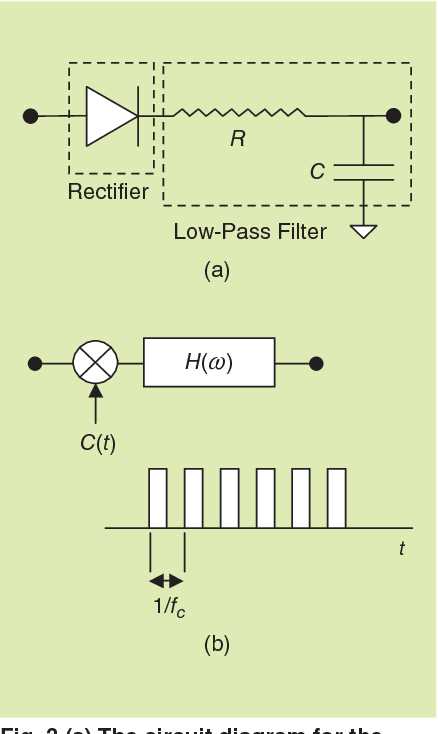
The capacitor should charge rapidly during each carrier peak and release energy slowly through the resistor. Choose component values so that the time constant R × C remains larger than the carrier period but smaller than the modulation period. For an intermediate frequency around 455 kHz, values near 10 nF for the capacitor and 100 kΩ for the resistor often produce stable tracking of the audio signal.
Use a diode with low forward voltage such as 1N34A or a Schottky type like BAT54. These devices respond well to small RF amplitudes, which improves recovery of weak broadcast signals before the audio stage receives the demodulated output.
Envelope Detector Circuit Diagram Using Diode Rectifier and RC Low Pass Filter
Use a single RF diode followed by an RC smoothing stage to recover the modulation waveform from an AM carrier. The diode performs half-wave rectification, while the resistor–capacitor pair suppresses the high-frequency carrier component and leaves the slower audio variation. Connect the diode anode to the incoming RF line and place the capacitor directly after the diode with its second terminal tied to ground.
Select RC values according to carrier frequency and expected audio bandwidth. For medium-wave receivers operating near 455 kHz intermediate frequency, a typical configuration uses a 4.7–22 nF capacitor with a 47–220 kΩ resistor. This combination maintains charge between adjacent carrier peaks while allowing the voltage to track modulation changes.
- Use germanium parts such as 1N34A for weak RF signals below 200 mV
- Choose Schottky devices like BAT85 or 1N5711 for modern low-loss RF stages
- Keep the RC time constant between 5× carrier period and 1/10 of the audio period
- Place the capacitor physically close to the diode to reduce stray inductance
- Feed the recovered audio through a coupling capacitor of 1–10 µF toward the amplifier stage
After smoothing, the recovered waveform appears across the load resistor. A coupling capacitor then passes the audio component while blocking the DC level created during rectification. This arrangement produces a clean modulation signal ready for the next amplification stage.