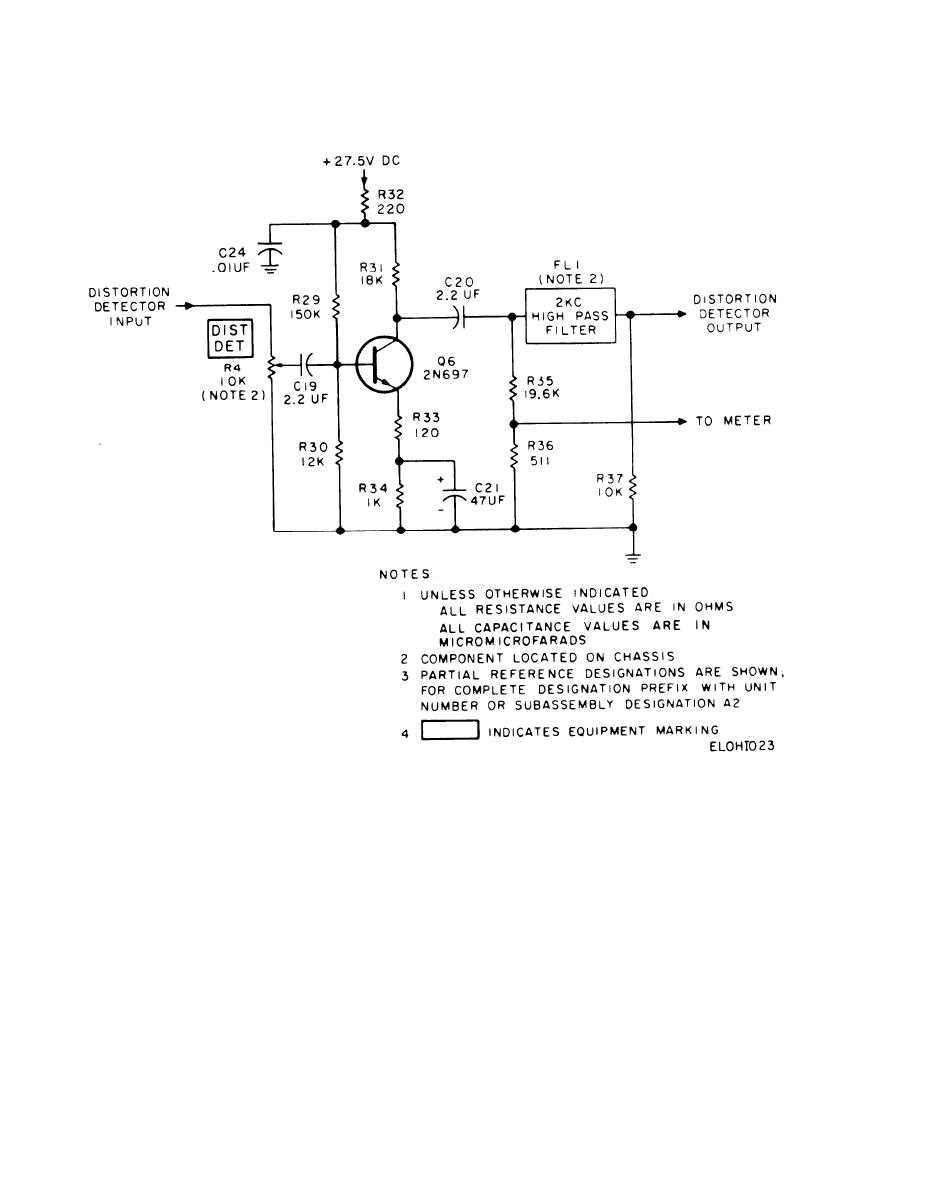
Check the signal path first. A typical guitar clipping stage uses an input resistor between 100 kΩ and 1 MΩ, followed by a gain block built around an operational amplifier or a small signal transistor. The amplified waveform is then limited by a pair of silicon or germanium diodes placed in opposite directions. This arrangement shapes the waveform and produces the familiar saturated tone used in many guitar pedals.
Choose component values based on the gain level required. A common amplifier stage uses feedback resistors such as 470 kΩ with 4.7 kΩ, producing a gain close to 100. Lower ratios reduce clipping intensity and keep more of the original guitar signal. Coupling capacitors between 10 nF and 100 nF filter low frequencies before the amplification stage, preventing muddy sound and reducing unwanted noise.
Power supply layout also affects the final sound. Most pedal designs operate from a 9 V supply with a bias network that sets the signal reference near 4.5 V. Two resistors of equal value, often 100 kΩ each, create this midpoint. A bypass capacitor from 10 µF to 47 µF stabilizes the reference node and prevents hum from entering the signal chain.
For predictable results, keep signal wiring short and place clipping diodes close to the gain stage. Shielded input wiring reduces interference from power adapters and stage lighting. Breadboard testing before soldering allows quick adjustment of resistor ratios, diode types, and capacitor values until the desired guitar tone is reached.
Distortion Circuit Diagram With Component Values and Signal Path for Guitar Pedals
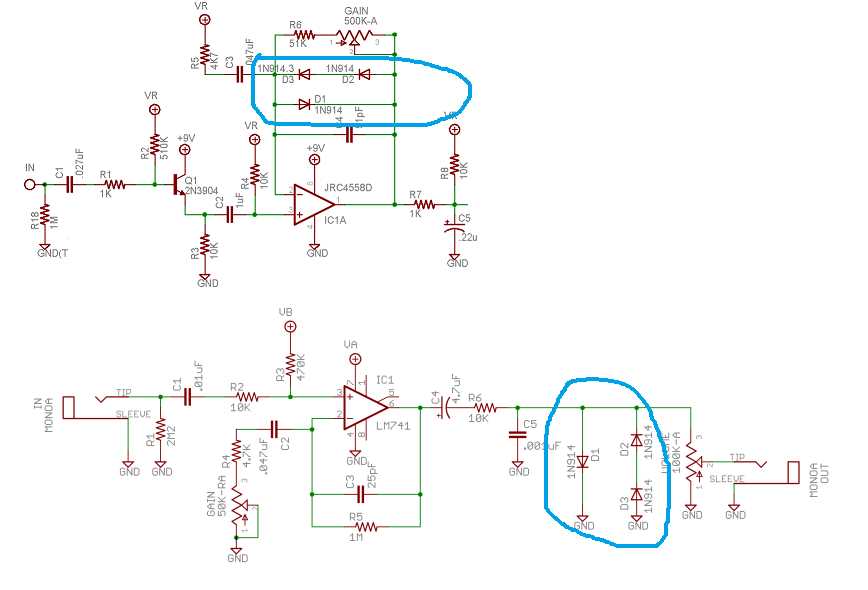
Use a gain stage based on an operational amplifier such as LM741, TL071, or JRC4558 with a feedback network that raises the guitar signal by 40–100 times. Place a resistor of 470 kΩ in the feedback path and 4.7 kΩ between the inverting input and ground. This ratio produces strong waveform clipping once limiter diodes conduct. Insert a coupling capacitor of 22 nF at the input so very low frequencies from pickups do not overload the amplifier stage.
Arrange the signal flow in a simple chain where each stage performs a clear task:
- Input stage – 1 MΩ resistor to ground keeps the guitar pickup loaded correctly
- Pre-amplification block – operational amplifier or transistor boosts the signal
- Wave limiter section – two diodes in opposite direction shape the waveform
- Output filter – capacitor and resistor remove harsh high-frequency noise
- Level control – 10 kΩ to 100 kΩ potentiometer sets pedal output volume
Choose limiter components carefully because they strongly affect tone. Silicon parts such as 1N4148 clip around 0.7 V and produce a sharp edge, while germanium parts such as 1N34A conduct near 0.3 V, giving softer saturation. LED limiters raise the threshold close to 1.6–2.0 V, allowing higher headroom before waveform flattening occurs.
Reading a distortion circuit diagram and identifying input gain and clipping stages
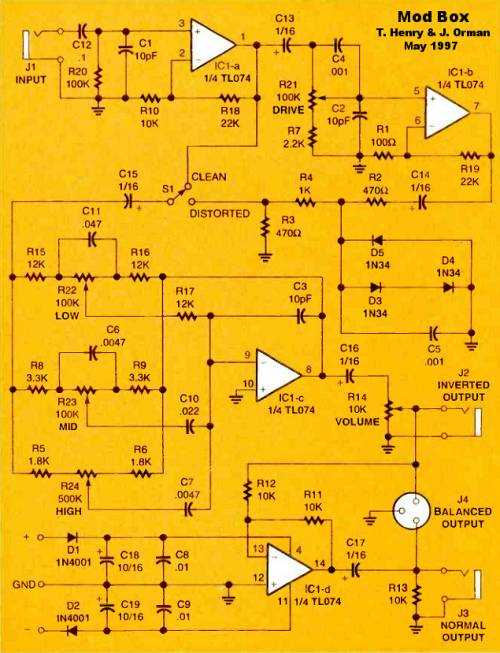
Locate the signal entry point first. The guitar input usually passes through a 1 MΩ resistor connected to ground. This resistor sets pickup load and prevents high-frequency loss. A coupling capacitor between 10 nF and 47 nF often follows, blocking DC while allowing the audio waveform to move into the amplification stage.
Trace the line from the input capacitor to the first active component. In many pedal layouts this device is an operational amplifier such as JRC4558, TL072, or LM358. The inverting configuration is common because it allows precise gain control through the feedback network.
Identify the gain ratio by reading the resistor pair connected around the amplifier block. One resistor connects from output to the inverting input, while another links that node to ground. A pair such as 470 kΩ and 4.7 kΩ produces a gain close to 100. Lower ratios such as 220 kΩ and 4.7 kΩ generate milder saturation.
Look for limiter components immediately after the gain stage. These are usually two diodes placed in opposite directions. Their function is to flatten the amplified waveform once voltage exceeds the conduction threshold. Silicon parts clip around 0.6–0.7 V, germanium around 0.25–0.35 V, while LEDs allow higher amplitude before flattening.
Typical signal path sections
Separate the drawing into small functional blocks. Most guitar pedals follow a repeatable structure that becomes easy to recognize with practice.
Common order of stages:
Input filter → amplification block → diode limiter → tone shaping network → output level control
The tone shaping section usually contains a capacitor and resistor network that cuts high frequencies generated during clipping. A capacitor between 1 nF and 4.7 nF connected across the feedback resistor reduces harsh treble by limiting bandwidth.
Visual markers of clipping stages
Search for diode pairs connected either to ground or inside the feedback path of the amplifier stage. Placement determines behavior. Ground-referenced pairs create hard waveform flattening, while diodes inside the feedback loop generate smoother saturation because conduction begins gradually as gain increases.