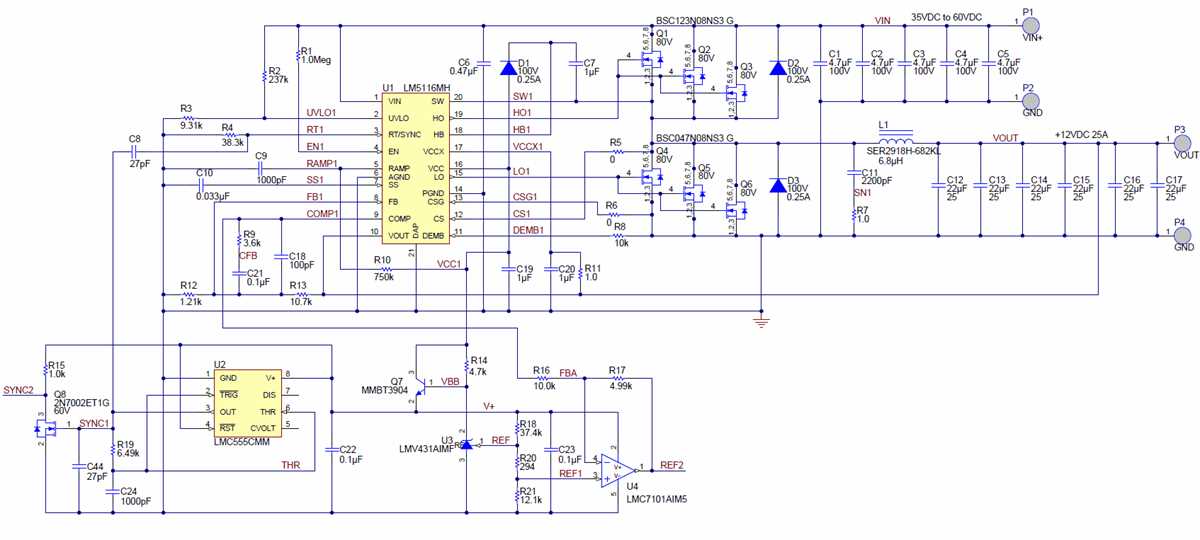
Check the switching regulator layout before assembling a step-down power supply. A typical design includes a switching transistor, fast diode, inductor, output capacitor, and a PWM controller. Input voltage commonly ranges from 12 V to 48 V, while regulated output may drop to 3.3 V, 5 V, or 12 V depending on component selection.
The switching transistor rapidly connects and disconnects the input source at frequencies between 50 kHz and 500 kHz. This pulsed energy flows through an inductor that stores magnetic energy during the ON phase and releases it during the OFF phase. A fast recovery diode provides a path for current when the transistor turns off.
Output smoothing relies on an inductor and capacitor pair. Inductor values typically range from 10 µH to 220 µH, while electrolytic or ceramic capacitors from 47 µF to 470 µF stabilize the output rail. These components reduce ripple and maintain steady voltage under varying load conditions.
A PWM controller regulates the switching transistor by adjusting duty cycle according to feedback from the output voltage divider. When output rises above the target level, the controller shortens the ON time. When voltage drops under load, the controller increases pulse width to restore the required level.
DC DC Buck Converter Circuit Diagram
Use a switching regulator layout when a lower voltage rail is required from a higher supply. A typical step-down design accepts input between 9 V and 48 V and produces stable outputs such as 5 V, 12 V, or 3.3 V. The layout normally includes a switching transistor, freewheel diode, inductor, output capacitor, and PWM controller.
The switching transistor connects the input source to the inductor in rapid pulses. Frequencies usually range from 100 kHz to 600 kHz. During the ON phase, current builds inside the inductor. During the OFF phase, stored magnetic energy continues to supply the load through the freewheel diode.
Main components used in a typical step-down switching regulator include:
- Power transistor or MOSFET switching element
- Fast recovery diode or synchronous MOSFET
- Inductor between 10 µH and 220 µH
- Output capacitor from 47 µF to 470 µF
- PWM control chip with feedback input
Inductor selection strongly affects ripple current. A larger inductance value lowers ripple but increases physical size. For example, a 47 µH inductor may be used in a 24 V to 12 V regulator running near 200 kHz with load currents around 2–3 A.
The output capacitor stabilizes voltage during load changes. Ceramic capacitors between 22 µF and 100 µF often appear in parallel with electrolytic capacitors to reduce high-frequency ripple. Low ESR values improve voltage stability.
The controller regulates switching duty cycle using a feedback network made from two resistors. Output voltage follows the formula:
- Vout = Vref × (1 + R1 / R2)
Typical reference voltage in many PWM chips is around 1.23 V.
Check layout traces carefully during assembly. Keep the loop formed by the transistor, diode, and input capacitor as short as possible. Short current paths reduce switching noise, heat buildup, and voltage spikes that may damage semiconductor components.
Main Components in a DC Step Down Switching Converter and Their Functions
Select a switching transistor rated above the maximum input voltage and load current. This component connects and disconnects the input source at high speed, usually between 100 kHz and 500 kHz. Power MOSFET devices are commonly used because they handle high current with low switching losses.
Energy Storage and Current Flow Components
The inductor stores energy while the transistor is ON and releases it when the transistor turns OFF. Typical inductance values range from 10 µH to 220 µH, depending on switching frequency and load current. Higher inductance reduces ripple current but increases physical size and cost.
A fast recovery diode or synchronous MOSFET provides a path for current when the switching transistor stops conducting. Without this component, the stored magnetic energy inside the inductor would create damaging voltage spikes. Diodes used in this position normally support reverse voltages above 40 V to 100 V and current ratings matching the load.
Filtering and Control Components
An output capacitor smooths voltage fluctuations created by switching pulses. Electrolytic capacitors between 47 µF and 470 µF are commonly combined with ceramic capacitors between 10 µF and 47 µF. This combination reduces both low-frequency ripple and high-frequency noise.
The control chip manages switching behavior using pulse width modulation. A feedback network made from two resistors samples the output voltage and sends the signal to the controller reference input. When output voltage drops under load, the controller increases the ON time of the transistor to restore the desired level.
An input capacitor placed near the switching transistor stabilizes the supply line and reduces voltage spikes. Typical values range from 100 µF to 470 µF depending on load current. Position this capacitor close to the transistor and ground path to minimize parasitic inductance and switching noise.