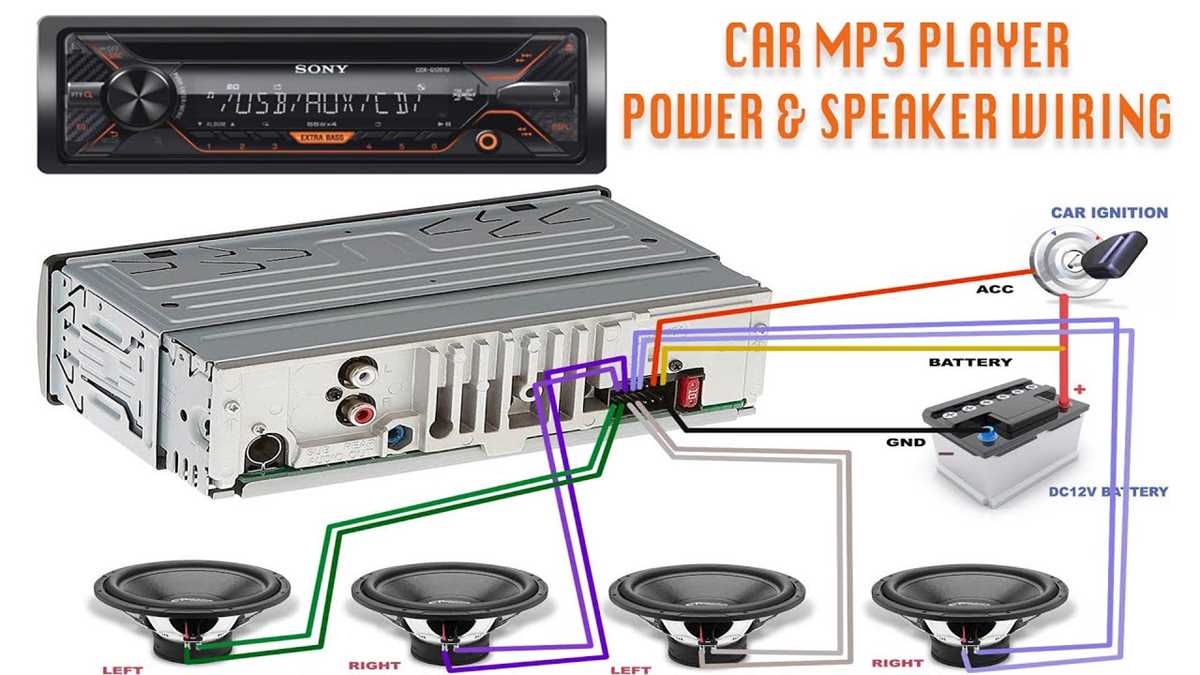
Route positive and negative lines along separate channels to minimize interference and maintain consistent output. Use oxygen-free copper conductors with a minimum cross-section of 1.5 mm² for standard systems and increase to 4 mm² for high-power amplifiers to prevent voltage drop and heat buildup.
Label each terminal at the amplifier and transducer ends with heat-resistant markers. Assign numeric codes for front and rear channels and letter codes for tweeters and subwoofers to simplify future adjustments or troubleshooting.
Apply insulation sleeves to exposed connectors and maintain at least 10 mm spacing from metal mounts to avoid accidental shorts. Color-code positive lines red and negative lines black, with optional green for ground loops, to maintain clarity under tight panel arrangements.
Test signal continuity with a low-voltage meter before final mounting. Record resistance values across each path to identify high-resistance joints, ensuring consistent audio levels and preventing distortion during high-volume playback.
Secure connections using crimped terminals and spring-loaded clamps rather than simple twist-ons. This provides long-term stability under vibration and thermal cycling commonly experienced in vehicle interiors.
Car Speaker Connection Guide
Separate signal and power lines along dedicated routes to reduce interference. Use oxygen-free copper conductors, 1.5 mm² for standard outputs and 4 mm² for high-power amplifiers. Maintain at least 10 mm distance from metal surfaces to prevent shorts and apply heat-resistant insulation sleeves at all terminals.
Follow consistent labeling for each channel and terminal. Recommended approach:
- Front left – FL
- Front right – FR
- Rear left – RL
- Rear right – RR
- Subwoofer – SW
This ensures quick identification during maintenance or upgrades and prevents misconnection that can damage components.
Connection Security and Testing

Use crimped terminals or spring clamps for all connections to maintain stability under vibration. Test each line with a low-voltage meter for continuity and record resistance values. Ensure positive and negative paths are not reversed, and verify grounding loops are connected using 16 AWG braided wire to minimize hum and signal loss.
Selecting Proper Terminals and Connectors for Car Audio
Use crimped terminals with heat-shrink insulation for all connections exposed to vibration. Select gauge-matched connectors: 1.5–2.5 mm² for standard channels and 4–6 mm² for subwoofer or amplifier feeds. Ensure terminals fit tightly to prevent resistance buildup and intermittent contact.
Opt for gold-plated or tin-coated contacts on signal lines to reduce oxidation and maintain low-resistance paths. For high-current feeds, choose fully tinned copper connectors with double-locking mechanisms to handle thermal cycling and prevent loosening under load.
Standardize connector types across all channels to simplify maintenance. Use spade terminals for easy removal, ring terminals for secure grounding, and bullet connectors for modular subwoofer or amplifier interfaces. Maintain a consistent polarity color scheme to avoid reversed connections.
Inspect and torque all connections after installation. Positive and negative lines should be tightened to manufacturer specifications, typically 2–3 Nm for 2.5 mm² conductors and 10–12 Nm for larger gauges. Recheck after initial power-up to compensate for settling and thermal expansion.