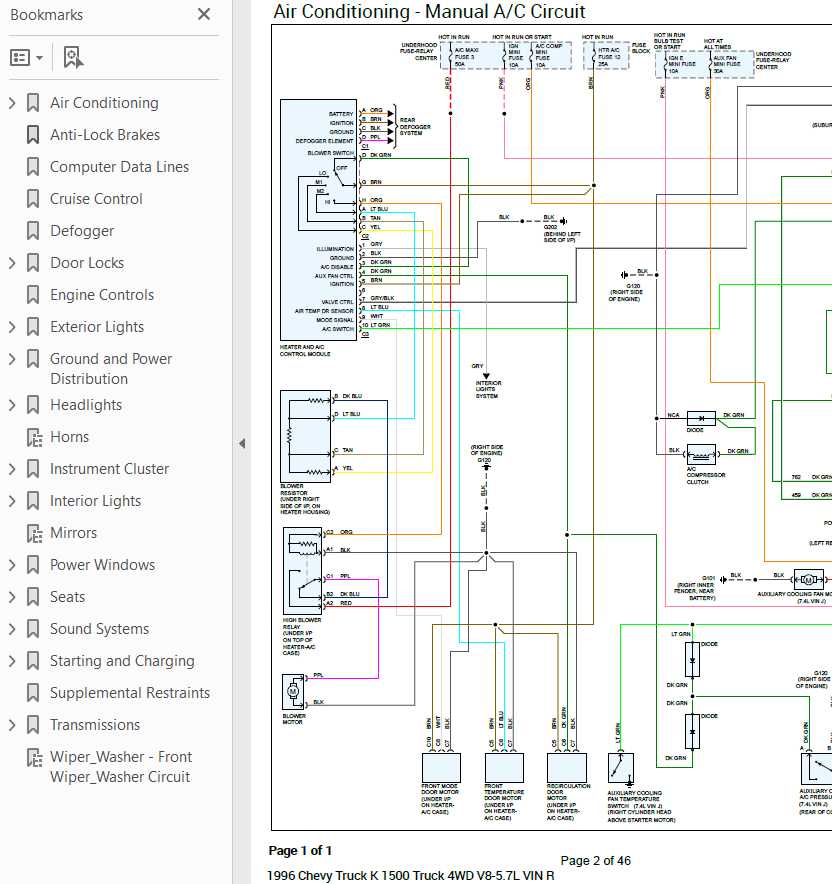
Use a detailed circuit layout for the mid-90s GM C/K pickup before touching any harness under the hood or behind the dashboard. This truck uses color-coded conductors that connect the battery distribution block, ignition switch, instrument cluster, and engine control unit. For example, a red feed line commonly carries constant battery voltage from the power distribution center to interior fuse positions, while pink conductors frequently supply switched ignition power to sensors and control modules.
The engine bay harness routes several critical circuits through the firewall bulk connector. One branch leads to the alternator charge terminal, another to the starter solenoid trigger line. Pay close attention to the grounding network: black leads attached to the intake manifold and frame rail stabilize voltage reference for the control module and fuel injection components. Corrosion at these grounding points often causes erratic gauge readings and intermittent starting problems.
Inside the cabin, the fuse panel distributes current to lighting, climate control, and audio circuits. Each fuse position corresponds to a specific amperage path; for instance, a 20-amp slot often protects the brake light circuit and cruise control switch feed. Connector pin charts reveal which cavity routes current toward rear lamp assemblies, trailer connectors, and the high-mounted stop lamp located above the cargo bed.
A precise electrical schematic map for this generation of GM pickup also shows sensor signal routes between the throttle position sensor, coolant temperature sensor, and the engine control computer. These signal paths use low-voltage reference lines, usually gray or tan with stripe markings. Tracing these paths through the harness allows quick identification of open circuits, damaged insulation, or incorrectly spliced conductors during repair work.
Electrical Schematic Guide for a Mid-90s GM C/K Pickup
Use the factory circuit map for the mid-90s GM C/K pickup to trace power paths before touching any harness. Battery feed enters the under-hood fuse block through a 10-gauge red lead, then branches toward ignition, lighting, and charging circuits. Verify continuity with a multimeter between the fuse output and the component connector; resistance above 0.3 ohm usually signals corrosion inside the loom or a partially broken conductor.
The ignition circuit is organized around a column-mounted switch feeding several color-coded lines. A thick pink conductor carries switched power to engine management sensors and the instrument cluster, while an orange lead supplies constant voltage for memory functions. If the starter does not engage, inspect the purple lead running from the neutral safety switch to the starter solenoid; voltage should appear only when the key reaches the crank position.
Lighting Circuit Layout
Headlamp operation relies on a relay and a dashboard switch feeding two separate paths for high and low beams. A light-green conductor usually routes high-beam current toward the front lamp assemblies, while tan insulation marks the low-beam path. Ground points near the radiator support frequently accumulate rust; cleaning them often restores dim or flickering headlights.
Rear illumination and brake lamps travel through a harness that runs along the left frame rail toward the tail section. Yellow insulation indicates the left stop/turn circuit, while dark green marks the right side. If trailer connectors were added by previous owners, inspect splice points carefully; poorly crimped taps cause voltage drops that reduce lamp brightness.
Instrument Panel and Sensor Network
The dashboard cluster communicates with engine sensors through multiple thin conductors grouped behind the firewall. Oil pressure uses a tan line, coolant temperature typically runs through dark green with white tracer, and fuel level data returns on a purple lead from the tank sending unit. A fluctuating gauge often points to a worn sender or a ground fault near the frame crossmember above the fuel tank.
Accessory circuits such as power windows and door locks receive current through a dedicated breaker instead of a standard fuse. The feed wire, usually orange with a black stripe, runs from the interior panel toward the driver-side door harness. If switches fail intermittently, inspect the rubber conduit between door and pillar where repeated bending damages copper strands.
How to Identify Color Codes and Connector Locations in the 1996 Chevy Silverado Wiring Diagram
Locate the color legend on the circuit chart and match each abbreviated code to the insulation shade printed beside the line representing a conductor. GM service sheets from the mid-90s C/K pickup platform typically mark conductors with two-letter abbreviations such as BK (black), RD (red), YL (yellow), GN (green), or TN (tan). A stripe appears after the base shade using a slash format like YL/BK or RD/WH. The first part shows the main insulation color; the second indicates the tracer stripe molded along the insulation.
Trace the conductor visually from its origin to the termination symbol while checking every color label printed along the line. Many factory electrical charts repeat the color abbreviation near junction points so the reader can confirm continuity across the page. If a line changes shade marking between two segments, it signals a splice where a new conductor continues the path.
Connector positions are marked by boxed labels such as C100, C203, or C305 placed next to the termination point. Each label corresponds to a physical plug in the truck. Use the connector index usually placed in a separate page of the service manual to match the identifier with its mounting area.
- C100 – bulkhead plug at the firewall separating engine bay circuits from cabin harnesses
- C203 – junction plug near the steering column support bracket
- C305 – rear body harness connector above the spare tire crossmember
- C450 – tail lamp harness plug behind the left rear frame rail
Pin numbering inside each connector symbol follows a grid layout. Small numbers appear beside the cavity symbol, showing the exact terminal location. When diagnosing a circuit, match the conductor color code with the cavity number printed inside the connector outline.
Use this quick method to confirm a conductor path across multiple pages of the electrical chart:
- Note the color abbreviation and stripe marking.
- Write down the connector identifier next to the line.
- Find the same connector label in the connector location index.
- Check the cavity number printed inside the connector graphic.
- Verify the same color code entering or leaving that cavity on the next sheet.
Ground points are easier to recognize because they use a solid black conductor labeled BK and terminate at symbols marked G101, G103, or similar codes. The ground index page in the service documentation lists each ground stud location, often describing frame rail positions, intake manifold bolts, or inner fender mounts.
If two conductors share the same shade code yet feed different components, compare connector identifiers and cavity numbers rather than color alone. Mid-90s GM pickup electrical layouts frequently reuse RD or OR leads for multiple circuits, so the connector tag and terminal position provide the reliable way to distinguish the correct path.