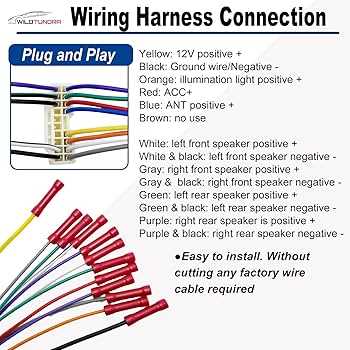
Check the color codes and pin positions before connecting any head unit. Most installation errors happen because power, ground, and speaker lines are confused. A typical audio receiver installed in a vehicle uses separate conductors for constant 12-volt supply, ignition power, ground, illumination, antenna control, and four speaker channels. Matching each lead correctly prevents blown fuses, damaged amplifiers, or silent speakers.
Factory audio connectors usually follow a recognizable color pattern. For example, yellow commonly carries constant 12 V from the battery, red receives switched power from the ignition, and black connects to ground. Speaker pairs often use a base color with a striped negative lead: white for front left, gray for front right, green for rear left, and purple for rear right. The striped wire in each pair normally marks the negative terminal.
A connector layout chart helps identify where each conductor sits in the plug. Many vehicles use a 16-pin or 20-pin block behind the dashboard audio unit. Pin rows typically separate power lines from speaker outputs. Using an adapter plug rather than cutting factory leads keeps the original electrical system intact and allows quick replacement of the receiver later.
Before attaching any lead, measure voltage with a multimeter. Constant battery supply should read around 12–12.6 V with the ignition off, while the switched line shows voltage only after the key turns. Confirm speaker polarity by tracing paired conductors from the plug to the door speakers. This simple verification prevents reversed phase and weak bass response.
Car Stereo Wiring Harness Diagram With Wire Color Codes and Connector Pin Layout
Verify the color code before attaching any lead to the head unit. A typical vehicle audio connector separates power supply lines, speaker outputs, and signal controls into clearly marked positions. Identifying these conductors first prevents short circuits and silent channels.
Most aftermarket receivers follow a consistent color convention. Matching these conductors to the vehicle connector adapter allows quick installation without cutting factory leads.
- Yellow – constant 12-volt supply from battery
- Red – ignition switched 12-volt line
- Black – chassis ground
- Blue – antenna or amplifier control
- Orange or orange-white – dashboard illumination
Speaker outputs appear as paired conductors with a solid color for positive and the same color with a stripe for negative. Maintaining polarity prevents phase issues that weaken bass response.
- White pair – front left speaker
- Gray pair – front right speaker
- Green pair – rear left speaker
- Purple pair – rear right speaker
A typical dashboard audio plug contains between 16 and 20 pins arranged in two horizontal rows. Upper positions usually carry power and control lines, while the lower row routes sound output channels. Adapter kits often label each pin number, which speeds up identification.
Check voltage with a multimeter before attaching the receiver. Battery supply should measure around 12–12.6 volts with ignition off. The switched lead shows voltage only after the key is turned. If both lines stay live constantly, the memory circuit may drain the battery.
Pin orientation also matters. Some connectors place pin 1 at the upper left corner, while others begin at the lower edge. Use the plug locking tab as a reference point so the numbering matches the connector layout chart.
Use an adapter plug rather than cutting factory conductors. This method keeps the original electrical system intact and simplifies future replacement of the dashboard receiver. Many adapter kits include pre-crimped connectors that match the vehicle plug directly.
Standard car stereo wiring harness color codes for power ground and speaker wires
Match each colored lead to its function before connecting the dashboard audio receiver. Manufacturers of aftermarket head units follow a widely accepted color scheme that separates power supply, grounding, lighting, and speaker outputs. Recognizing these colors allows fast installation without tracing every conductor behind the dashboard.
Power and control leads
The constant battery supply usually appears as a yellow conductor that maintains memory for clock settings and radio presets. The red lead carries switched 12-volt power from the ignition circuit and activates the receiver when the key is turned. Ground typically uses a black conductor connected to the vehicle chassis. Additional control lines include blue for antenna or amplifier activation and orange or orange-white for dashboard illumination.
Speaker channel color pairs
Each speaker channel uses a pair of conductors where the solid color marks positive and the striped version marks negative. Four common pairs appear in most installations: white for front left, gray for front right, green for rear left, and purple for rear right. Keeping polarity correct prevents phase cancellation that reduces bass output.
Check polarity using a multimeter or a small 1.5-volt battery test. When the positive terminal briefly touches the solid conductor, the speaker cone should move outward. Reverse movement indicates the pair is connected backward.
Use an adapter connector that matches the vehicle plug. This approach keeps the factory electrical system intact and allows removal of the audio receiver without cutting or repairing original conductors.