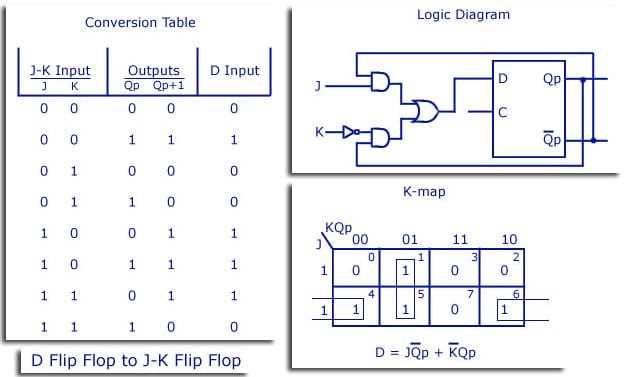
Identify the clock input, J input, K input, and output nodes Q and Q̅ before studying the logic drawing of this bistable memory cell. These five points define how the storage element behaves during each clock pulse. Without locating them first, interpreting gate connections becomes confusing.
This memory element stores a single binary state using cross-connected logic gates. A common implementation uses NAND gate pairs with feedback paths. Feedback maintains the stored value after the clock pulse ends. When both control inputs remain low, the stored state does not change, allowing the device to act as a one-bit memory unit.
The two control terminals labeled J and K determine how the stored state reacts during the clock transition. When J equals 1 and K equals 0, the output becomes high. When J equals 0 and K equals 1, the output becomes low. A condition where both inputs equal 1 causes the device to toggle its stored value on each clock trigger.
Logic drawings of this device usually place gate pairs in mirrored form. The upper path generates output Q, while the lower path produces the inverted signal Q̅. Cross connections between the gate outputs and opposite inputs maintain the stored state. This feedback arrangement distinguishes the JK storage element from simpler SR latch designs.
Understanding these structural details helps during digital system design and troubleshooting. Counters, registers, and frequency dividers frequently rely on this storage cell because it avoids the invalid input condition present in earlier latch designs.
Circuit Diagram for JK Flip Flop With NAND Gates Clock Input and Output States
Locate the clock terminal and the two control inputs J and K before tracing the logic drawing built with NAND gates. The structure usually contains two main latch gates connected through feedback plus two additional NAND gates that gate the control signals with the clock. During a clock pulse, these gates determine whether the stored bit holds, resets, sets, or toggles. The typical behavior follows this rule set:
- J = 0, K = 0 → stored value remains unchanged
- J = 1, K = 0 → output Q becomes 1
- J = 0, K = 1 → output Q becomes 0
- J = 1, K = 1 → output toggles during the clock transition
Trace signal flow from the clock-controlled NAND pair toward the cross-connected latch gates that produce Q and Q̅. Feedback lines route each output back into the opposite gate input, which maintains the stored bit after the clock pulse ends. This feedback structure removes the invalid state found in an SR latch and allows stable switching in registers, binary counters, and frequency division stages used in digital hardware.
Logic gate arrangement used to build a JK flip flop and signal connections between inputs and outputs
Identify the two cross-linked NAND gates that hold the stored bit. These gates create a bistable latch where each output feeds the opposite gate input. Output Q connects to the lower NAND input, while Q̅ returns to the upper NAND input. This feedback keeps the stored state stable until a new clock pulse modifies the inputs.
Observe the pair of control NAND gates placed before the latch stage. These gates combine the clock signal with the J and K inputs. Their outputs feed the two latch gates. The arrangement ensures that state changes occur only during an active clock level.
Input signal paths
The J input connects to the upper control NAND gate together with the clock signal. When both signals reach logic level 1, the resulting output becomes low, which drives the latch into the set condition. This path produces Q = 1 and Q̅ = 0.
The K input connects to the lower control NAND gate with the same clock signal. When both signals become high, the latch receives a reset command. This path drives the stored bit toward Q = 0 while the complementary output becomes 1.
Trace the feedback lines carefully. Each latch output returns to one of the control gates. These links prevent both set and reset actions from remaining active simultaneously after the clock period ends. Without these feedback paths the memory cell would lose stability.
Output behavior during clock transitions
During a clock pulse the control gates evaluate the J and K levels and drive the latch stage accordingly. Once the clock returns to low, the control stage stops influencing the latch and the stored bit remains unchanged until the next trigger event.
When J and K both hold logic level 1, the latch toggles its stored value during each active clock transition. This behavior allows the device to operate as a binary divider where each clock pulse reverses the output state.
This gate arrangement appears in registers, counters, and timing units because the feedback structure prevents invalid input combinations while maintaining predictable switching between stored states.