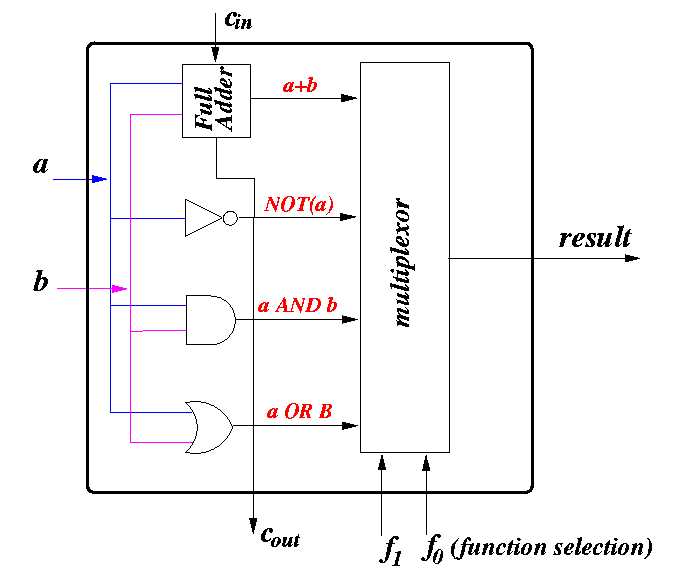
Build an arithmetic logic unit using eight parallel processing stages linked by a carry chain. Each stage receives one binary digit from two input buses and produces a result line plus a carry output that feeds the next stage. This arrangement allows operations such as addition, subtraction, AND, OR, and XOR within a single digital module.
Use full adder blocks as the arithmetic core. A full adder accepts three inputs: two data digits and a carry-in signal. The block generates a sum output and a carry-out signal. Connecting eight of these modules in sequence creates an arithmetic path capable of handling an entire byte at once.
Logical operations run through separate gate networks. Typical implementations include AND, OR, XOR, and NOT gates connected to the same input buses. Each network produces its own output line representing a specific logical function.
Select the final result through a multiplexer stage. Control signals determine which function output–arithmetic or logical–appears on the result bus. A small group of control lines, often three or four, defines the operation code that the processing unit executes.
Propagation delay depends on the carry chain length and the logic family used. With standard TTL devices such as 74LS83 adders, a full byte operation may take around 20–40 nanoseconds. Faster CMOS families reduce delay while lowering power consumption.
8 Bit ALU Circuit Diagram with Full Adder Blocks Logic Gates and Control Signals
Connect eight full adder units in series so the carry output of one stage feeds the carry input of the next stage. This cascade structure processes an entire byte from two input buses labeled A0–A7 and B0–B7. The lowest stage receives the initial carry signal, while the final stage produces the carry-out used for overflow detection.
Arithmetic stage using full adders
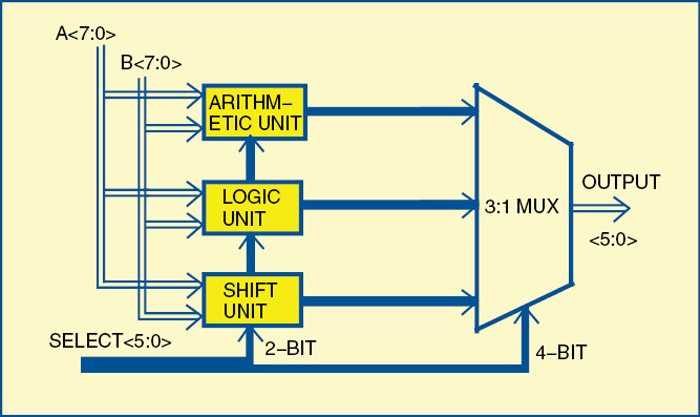
Each full adder block accepts three inputs: one digit from bus A, one from bus B, and the incoming carry line. The block produces a sum output and a carry output. Subtraction is achieved by inverting the B input through XOR gates and setting the initial carry line to logic 1, forming a two’s complement operation.
Logical functions run through parallel gate networks connected to the same input buses. Common functions include AND, OR, XOR, and NOT. Each network generates its own output vector representing the chosen logical operation for all eight positions.
Control signals and result selection
A multiplexer array selects which operation result appears on the output bus. Control lines such as S0, S1, and S2 define the function code. For example, one control combination routes the adder result, while another selects the AND or OR network.
Propagation delay depends mainly on the carry chain length. With TTL devices like 74LS83 adders, delay through the entire arithmetic path may reach about 30–40 nanoseconds. Faster CMOS families such as 74HC283 reduce delay and lower power usage.
Place bypass capacitors of about 0.1 µF near each integrated logic device. These capacitors stabilize supply voltage during switching events and help maintain reliable operation while multiple gates change state simultaneously.
Building an 8 Bit ALU Using Cascaded Full Adder Blocks and Carry Propagation
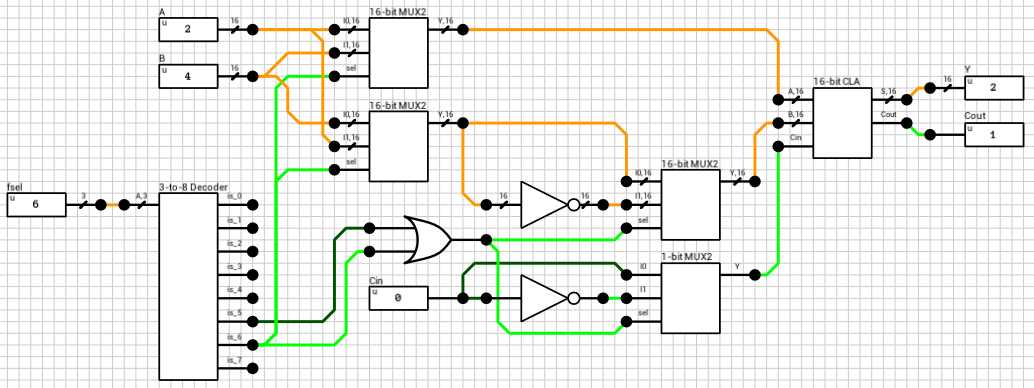
Connect eight full adder units sequentially so the carry output from one stage feeds the carry input of the next stage. This ripple structure allows two binary numbers on buses A0–A7 and B0–B7 to be processed as a complete byte.
Main hardware blocks
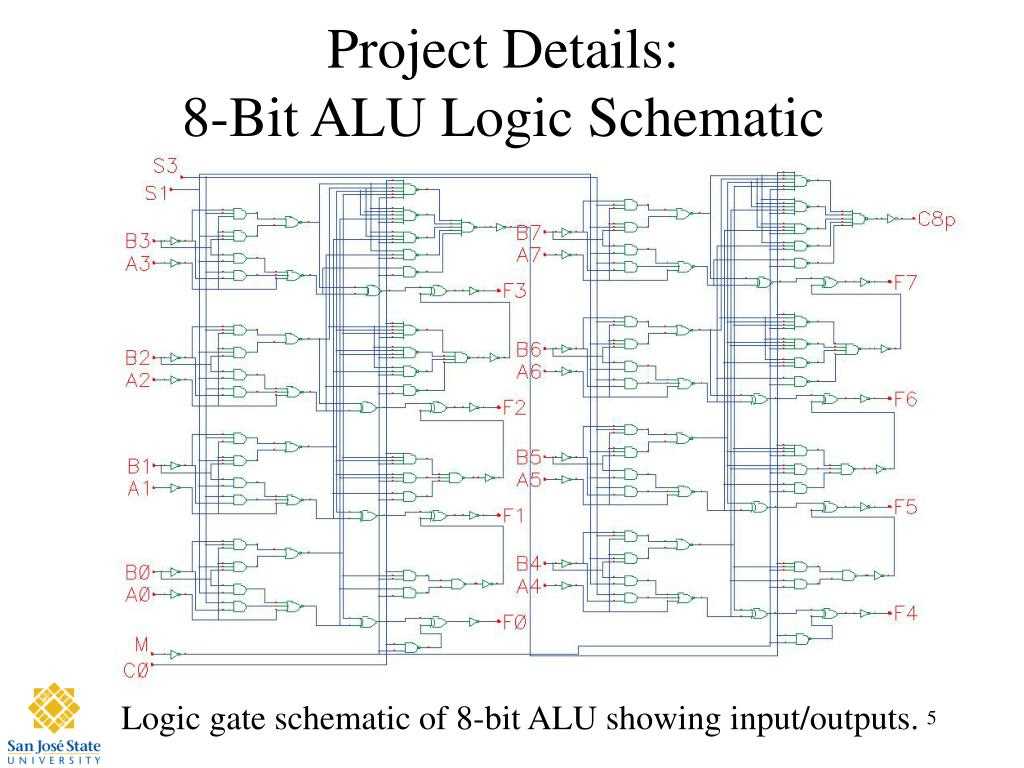
- Eight full adder modules handling individual binary positions
- Input buses for operand A and operand B
- Carry chain linking each stage
- Output bus delivering the resulting value
- Status lines for carry-out and overflow
The first stage receives an external carry-in signal. For addition this input is set to logic 0. For subtraction the design uses two’s complement arithmetic by inverting the B input through XOR gates and setting the initial carry line to logic 1.
Carry propagation sequence
- Stage 0 processes the least significant binary digit.
- Its carry output moves to stage 1.
- Each following stage repeats the same process.
- The final stage produces the global carry-out signal.
Propagation delay accumulates along the ripple path. With standard TTL adders such as 74LS83, the delay across all eight stages may reach about 30–40 ns. Designs that require faster arithmetic sometimes replace the ripple structure with carry-lookahead logic.
Place 0.1 µF decoupling capacitors near every logic IC. These components stabilize the supply rail during switching activity when multiple outputs change state simultaneously.