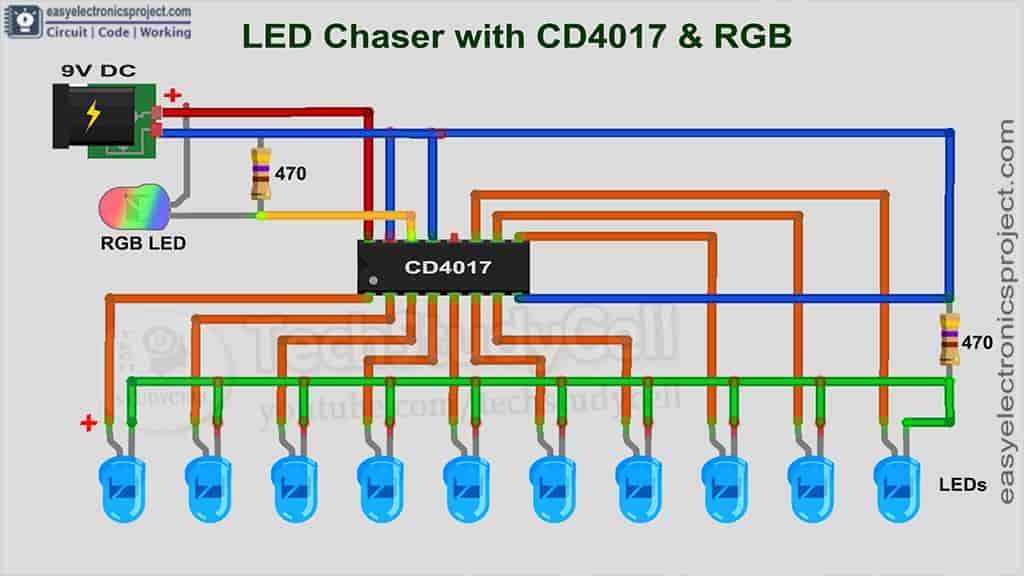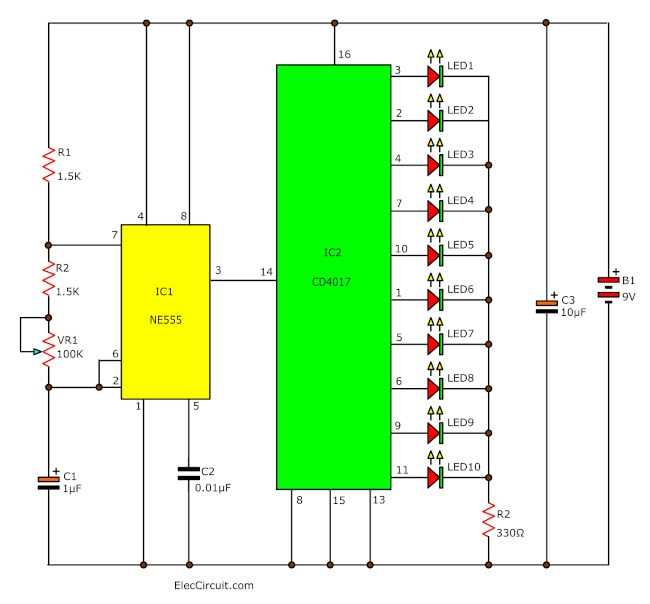
Use a decade counter IC paired with a series of small emitters to create a visually moving illumination pattern across a board. Connect the output pins of the counter to each emitter through current-limiting resistors of 220–330 Ω to prevent overload and ensure uniform brightness.
Opt for a stable 5V DC power source with a capacitor of 100 µF near the IC to smooth voltage fluctuations. This will maintain consistent timing and prevent flickering across the sequence.
Include a clock oscillator with a frequency between 1 Hz and 5 Hz to control the speed of progression. Adjusting the timing resistor or capacitor in the oscillator circuit changes the interval between each step, allowing precise customization of the illumination pace.
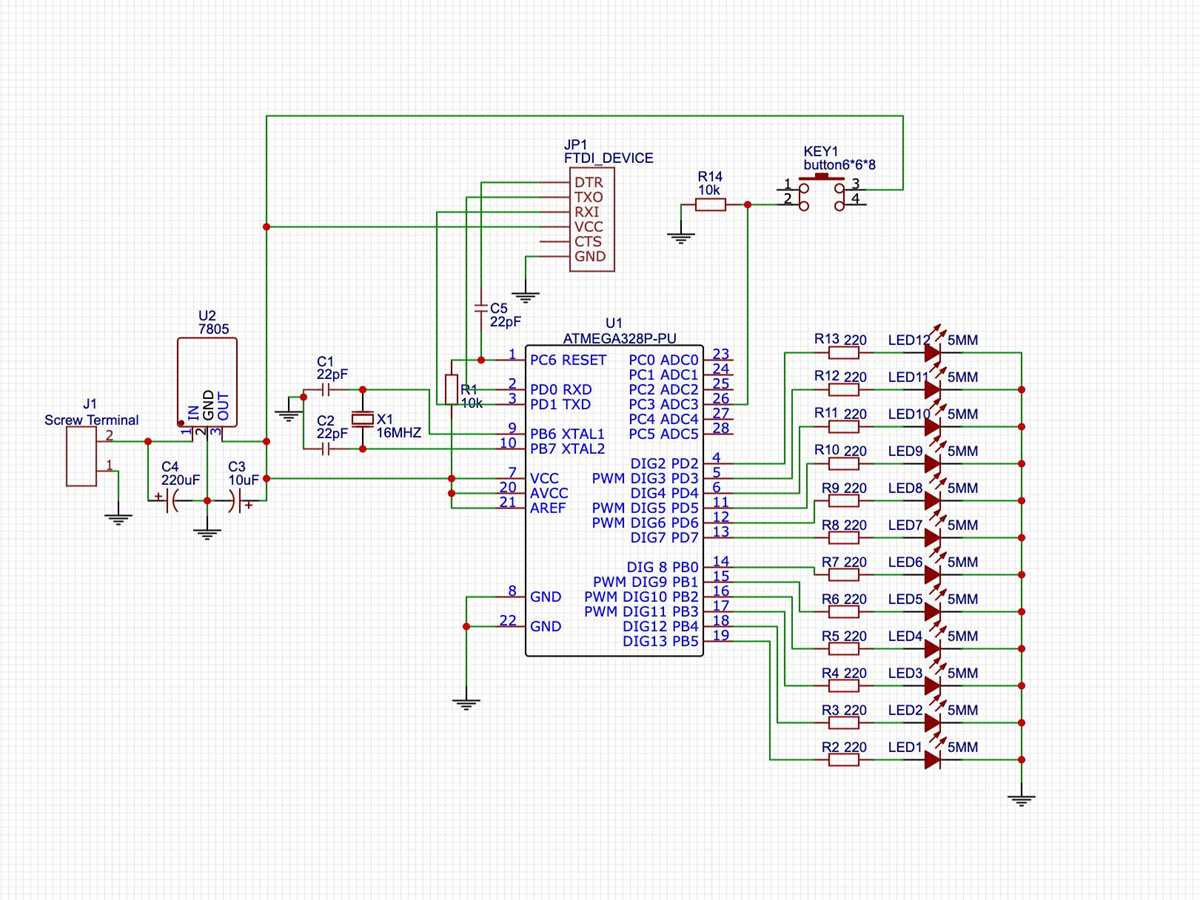
Arrange the emitters in a linear or circular pattern depending on the visual effect desired. Proper spacing of 1–2 cm between each unit helps avoid visual blending and highlights the sequential activation clearly.
Integrate a manual switch or jumper to reset the sequence instantly. This feature is particularly useful for testing and for scenarios where rapid repetition of the pattern is required without cycling through the entire count.
LED Sequencer Blueprint
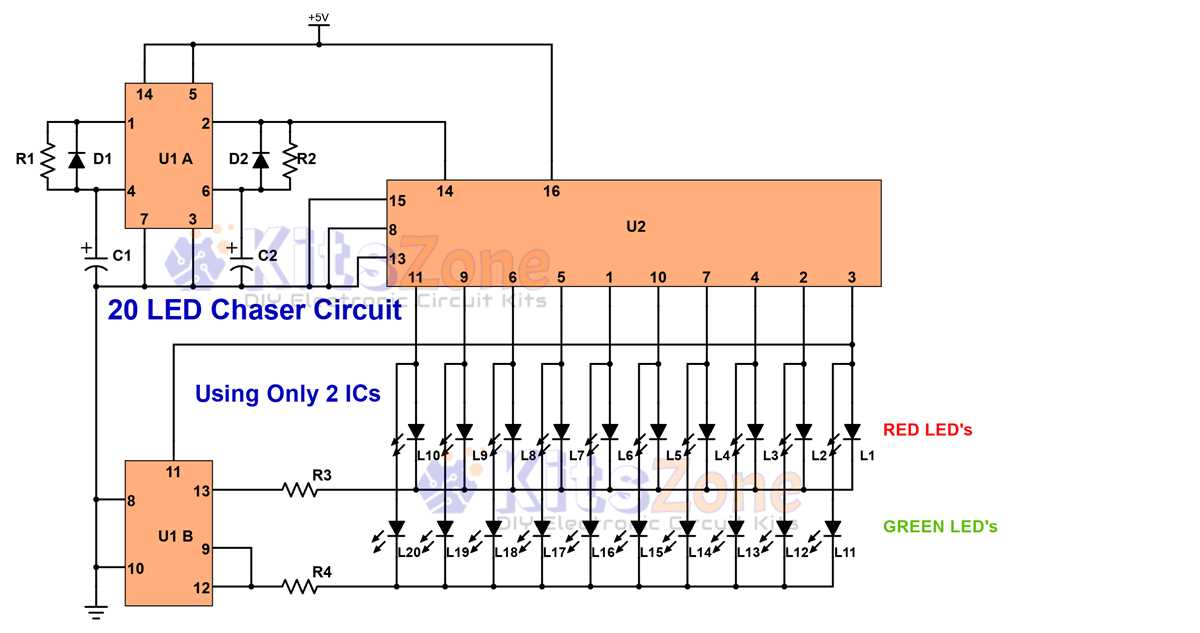
Use a 555 timer IC configured in astable mode to generate the clock pulses for sequential illumination. Connect pin 3 to a decade counter to manage the order of activation.
The arrangement requires resistors between 1kΩ and 10kΩ and a capacitor of 10µF to adjust the flashing rate. Smaller capacitance accelerates transitions, while higher resistance slows the sequence.
- Connect 4017 IC output pins to individual diodes or indicators.
- Include current-limiting resistors (220Ω–470Ω) to protect components.
- Use a 9V battery or regulated DC supply for stable operation.
For smoother transitions, add a small capacitor (0.01µF) between the reset pin and ground. This prevents erratic skipping of steps at startup.
Wire the final output back to the reset pin for continuous rotation. If only a finite run is desired, leave the reset open or control it with a manual switch.
- Place each indicator in a row or grid depending on the visual effect needed.
- Ensure all connections are soldered firmly to avoid flickering.
- Test each segment individually before powering the full arrangement.
Optional enhancements include using transistors as switches to handle higher currents, allowing multiple bright indicators without overloading the control IC. Consider heat dissipation for prolonged operation.
Choosing the Right IC and Components for a Sequential Display Setup
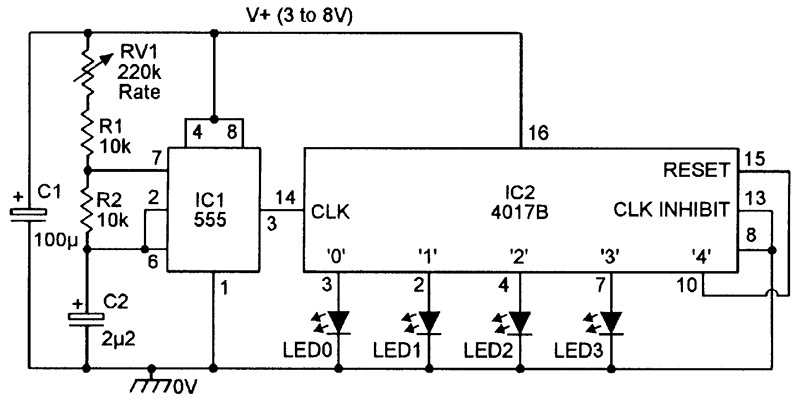
Use the 4017 decade counter for linear sequencing; its ten output pins allow direct connection to multiple indicators without extra transistors. Pair it with a 555 timer configured in astable mode to maintain precise pulse intervals between activations.
Resistors should match the intended supply voltage and current load. For a 5V supply, 220 Ω to 330 Ω series resistors protect each emitter without reducing brightness significantly. For 12V arrangements, calculate resistance using Ohm’s law to maintain safe levels.
Capacitors in the timing section determine the speed of transitions. A 10 µF electrolytic with a 10 kΩ resistor yields roughly 0.1 Hz frequency, while reducing the capacitor to 1 µF increases pace tenfold. Use ceramic caps for stability against voltage spikes.
For displays with multiple indicators, MOSFETs like IRF540 provide high-current switching without overheating. Low gate-threshold devices minimize voltage drop, ensuring uniform intensity across all points.
Diodes such as 1N4148 prevent backflow from shared power rails. This is crucial when outputs are wired in parallel to prevent cross-activation or flickering, particularly in dense sequences.
PCB layout should maintain short traces between timer IC, counter, and indicators. Avoid running high-current traces near signal lines to reduce electromagnetic interference that may cause skipping or erratic progression.
Power supply stability affects timing consistency. A regulated 7805 for 5 V setups or a 7812 for 12 V setups keeps the sequence steady, preventing flicker caused by voltage sag under load.
Consider heat dissipation for components handling continuous switching. Small aluminum heatsinks on MOSFETs or resistors dissipating more than 0.5 W prevent thermal drift, which could otherwise alter sequence timing or reduce the lifespan of indicators.