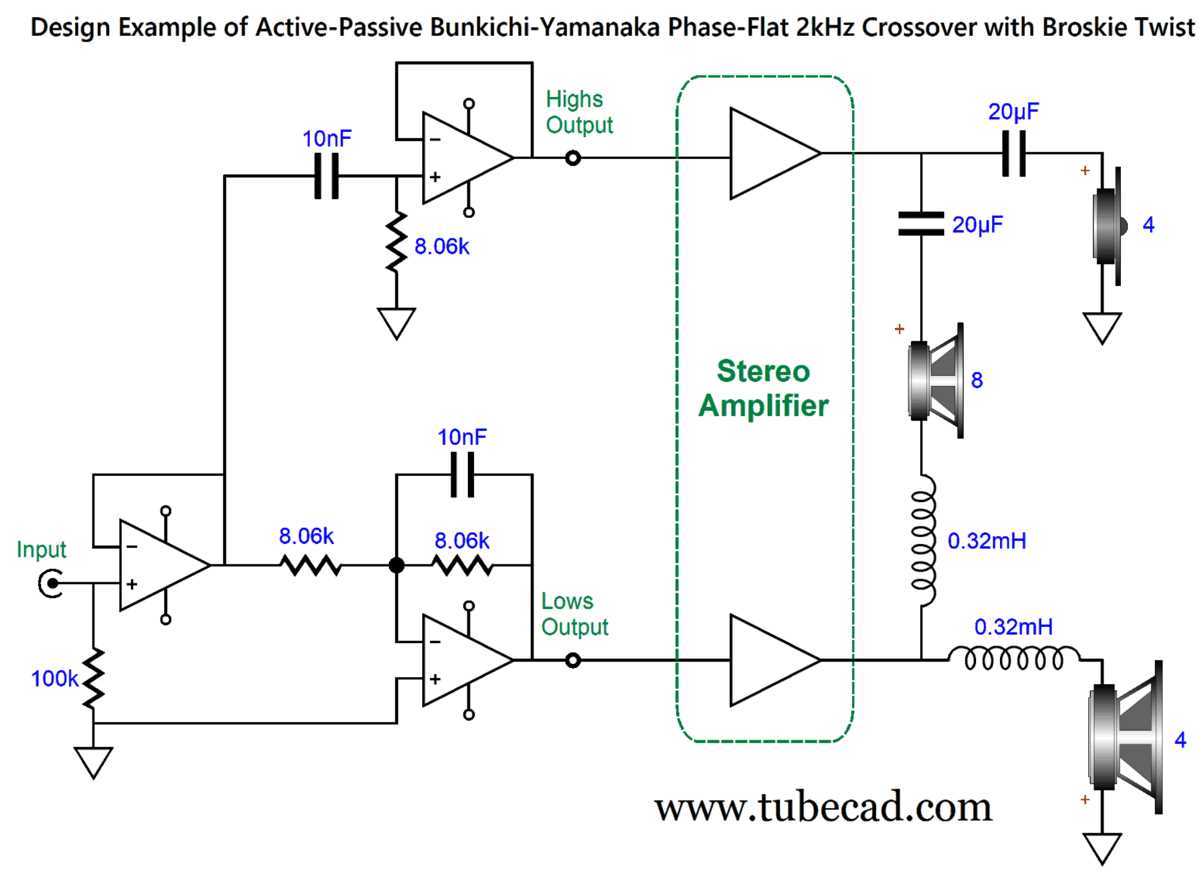
Use a capacitor for the high-frequency driver and an inductor for the low-frequency driver so each speaker receives only the frequency range it can reproduce without distortion. A simple two-driver setup often uses a capacitor between 3.3 µF and 6.8 µF for the tweeter and an inductor around 0.3–1.0 mH for the woofer when the impedance is 8 ohms.
The frequency split point depends on component values and speaker impedance. For example, a 4.7 µF capacitor connected in series with an 8-ohm tweeter produces a transition near 4200 Hz. A matching inductor on the woofer path limits higher frequencies from reaching the larger driver, preventing harsh sound and cone breakup.
Three-driver systems divide the signal into low, mid, and high ranges. This arrangement typically uses an inductor on the woofer path, a combination of capacitor and inductor for the midrange driver, and a capacitor on the tweeter path. A common configuration places transition points around 500 Hz and 4000 Hz, though exact values depend on driver specifications.
Component quality affects performance and reliability. Air-core inductors reduce magnetic distortion, while polypropylene capacitors handle high signal levels without noticeable loss. Matching the network to the speaker impedance rating keeps the amplifier load stable and prevents overheating during high volume playback.
Audio Crossover Circuit Diagram for 2 Way and 3 Way Speaker Systems
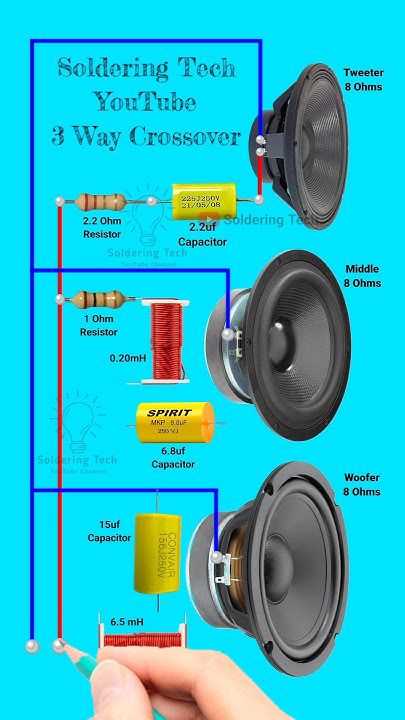
Place a series capacitor on the tweeter line and an inductor on the woofer line so high and low frequencies are separated before reaching each driver. This passive filter network protects small high-frequency drivers from low-frequency energy and keeps large woofers from reproducing upper ranges that cause distortion.
Two Driver Layout
A typical two-driver loudspeaker arrangement uses minimal components while still splitting the frequency range.
- Capacitor connected in series with the tweeter
- Inductor connected in series with the woofer
- Both drivers connected in parallel to the amplifier output
- Typical split points between 2500 Hz and 4500 Hz depending on driver specifications
Three Driver Layout
A system with woofer, midrange, and tweeter divides the signal into three bands using additional components.
- Inductor feeding the woofer for low frequencies
- Capacitor and inductor pair forming a band-pass path for the midrange driver
- Series capacitor feeding the tweeter for high frequencies
- Common split points around 400–600 Hz and 3500–4500 Hz
Component values depend on driver impedance. For an 8 ohm system, a tweeter filter may use a capacitor between 3.3 µF and 6.8 µF, while the woofer path may include an inductor between 0.4 mH and 1.2 mH. Air-core inductors and polypropylene capacitors reduce distortion and maintain stable frequency response at high volume.
3 Way Speaker Crossover Circuit Diagram With Woofer Midrange and Tweeter Connection Layout
Use a three-band filter network that splits the amplifier signal into low, middle, and high ranges before reaching each driver. The large bass driver connects through a series inductor that blocks upper frequencies; the mid driver receives signal through a band-pass network made from one capacitor and one coil; the high-frequency driver connects through a series capacitor that blocks bass energy. In many loudspeaker builds with 8-ohm drivers, bass filtering often uses coils around 1.0–2.5 mH, midrange paths combine parts such as 0.3–0.8 mH inductors with 8–20 µF capacitors, while the high driver commonly receives a capacitor between 3.3–6.8 µF. Split points frequently sit near 400–600 Hz for bass-to-mid transition and 3–5 kHz for mid-to-high transition.
Connection layout usually follows this order: amplifier output feeds three separate filter branches mounted on a board inside the cabinet; each branch then runs directly to its driver. Low branch → bass driver, band-pass branch → mid driver, high branch → small dome or horn unit. Mount inductors at least 3–5 cm apart and rotate coil axes 90 degrees relative to each other to reduce magnetic interaction. Use thicker copper wire for the bass path because current is higher, often 1.0–1.4 mm diameter, while mid and high branches can use thinner conductors. Keep signal polarity identical across all drivers unless measurement shows phase cancellation near the split frequencies.
Passive Audio Crossover Circuit With Component Values and Speaker Impedance Matching
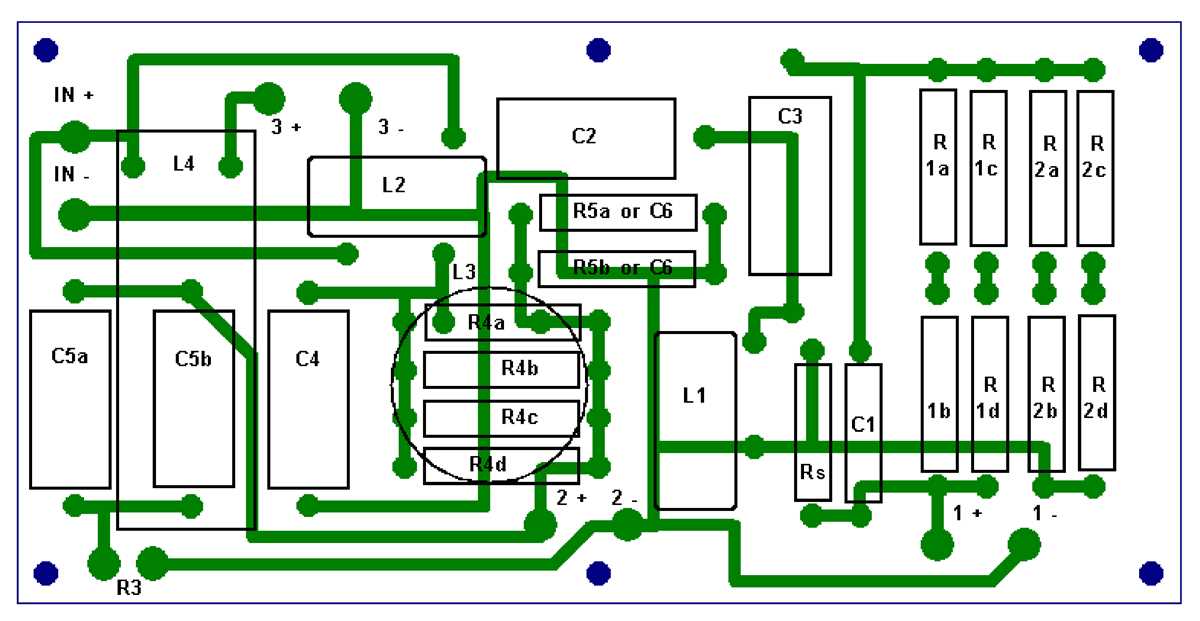
Use passive filter networks built from capacitors, inductors, and resistors placed between the amplifier and the drivers. These components split the signal spectrum so each loudspeaker unit receives only the frequency range it can reproduce cleanly. Correct value selection depends strongly on driver impedance, usually 4 Ω, 6 Ω, or 8 Ω. Lower impedance requires smaller inductance values and larger capacitance values for the same frequency split.
Calculate filter components using standard equations based on load resistance and the chosen cutoff frequency. For example, a first-order high-pass network uses a capacitor in series with the high-frequency driver. The value follows the relation C = 1 / (2π × R × f). A low-pass path for the bass driver uses a series inductor calculated from L = R / (2π × f). These formulas help determine approximate starting values before measurement and listening tests.
The table below lists typical capacitor and inductor values used with an 8-ohm loudspeaker load for common frequency split points.
| Split Frequency | Capacitor Value High Driver | Inductor Value Low Driver |
|---|---|---|
| 500 Hz | 39.8 µF | 2.54 mH |
| 1000 Hz | 19.9 µF | 1.27 mH |
| 3000 Hz | 6.6 µF | 0.42 mH |
| 5000 Hz | 4.0 µF | 0.25 mH |
Impedance matching across drivers prevents uneven output levels and unexpected frequency shifts. Many tweeters have higher sensitivity than woofers. A resistor network called an L-pad reduces the level of the high-frequency driver while maintaining a stable load for the amplifier. Typical combinations include series resistors between 2 Ω and 6 Ω paired with parallel resistors between 8 Ω and 20 Ω.
Driver impedance also varies with frequency because of voice-coil inductance and mechanical resonance. This behavior alters the filter response. A compensation network, often called a Zobel network, places a resistor and capacitor across the woofer terminals. A common pair uses 8 Ω with 8–10 µF, flattening impedance at higher frequencies and stabilizing the filter slope.
Mount coils away from steel surfaces and rotate them relative to each other to reduce magnetic interaction. Large bass inductors should use thicker copper wire, frequently 1.2 mm to 1.6 mm, because low-frequency drivers draw higher current from the amplifier.
Use polypropylene capacitors for high-frequency paths and air-core inductors for mid and high bands. These components maintain stable values under heat and high signal levels, preventing drift that would otherwise shift the frequency split points and alter driver balance.