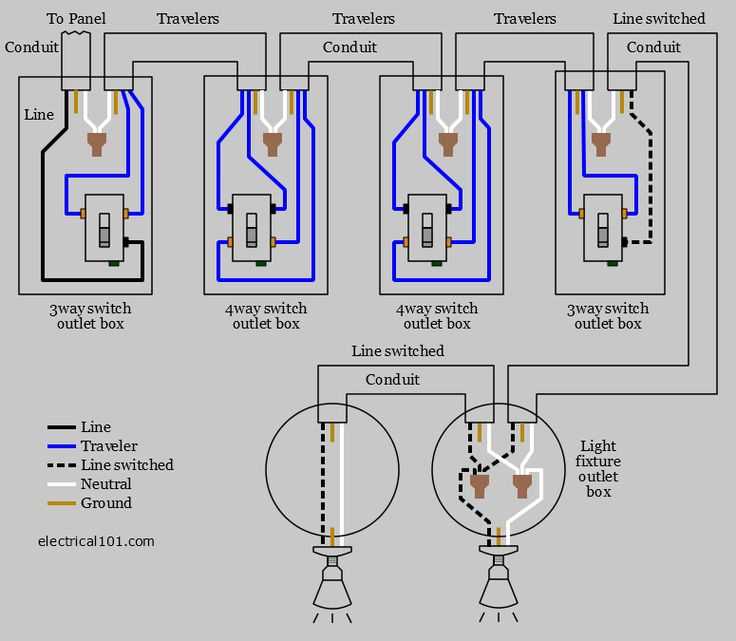
Install two three terminal control units at the ends of the lighting line and place a four terminal crossover device between them. This arrangement allows one lamp to be controlled from three or more positions such as staircases, corridors, or large rooms. The phase conductor enters the first control unit, travels through paired traveler conductors, passes the crossover device, and reaches the final control unit before feeding the lamp.
The crossover device contains four terminals arranged as two pairs. Inside the mechanism the contacts either connect the pairs straight through or cross them. This internal crossing changes the path of the traveler conductors, allowing the lamp to toggle state from any control point along the line.
Use a cable with at least four insulated conductors between the central crossover device and each end control unit. Common color combinations include black and red for traveler lines, white for neutral return, and green or bare copper for protective grounding. Correct color identification helps prevent mistakes during installation and maintenance.
The phase conductor from the electrical panel attaches to the common terminal of the first end control unit. The lamp lead connects to the common terminal of the second end control unit. The traveler conductors run between devices and never connect directly to the lamp or the supply neutral.
Residential installations usually operate at 120 V or 230 V AC. The conductor cross section should match the branch circuit rating, typically 1.5 mm² or 14 AWG. Proper conductor tightening at screw terminals prevents heating, voltage drop, and unstable lamp operation during repeated toggling.
Test the installation after energizing the line by toggling each control point individually. The lamp should change state every time any control unit is operated. Consistent operation across all positions confirms correct traveler routing, common terminal placement, and phase connection.
4 Way Switch Wiring Diagram for Controlling One Light from Three or More Locations
Place a four terminal crossover control unit between two three terminal control devices positioned at the ends of the lighting line. The phase conductor from the distribution panel connects to the common terminal of the first end unit, while the lamp lead attaches to the common terminal of the second end unit. Two traveler conductors run between the end devices and pass through the crossover unit, where internal contacts either maintain straight paths or swap the traveler lines.
Use cable containing at least four insulated conductors between the central crossover unit and each end device. Typical color identification follows this arrangement:
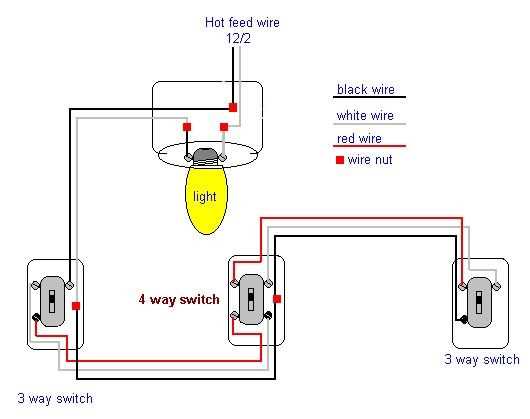
- Black conductor for incoming phase line
- Red and white conductors for traveler lines
- Green or bare copper for grounding
Operation relies on alternating traveler paths. Each control device changes the electrical path and toggles the lamp state. Correct installation follows these steps:
- Connect phase input to the common terminal of the first end device
- Route two traveler conductors from that device to the central crossover unit
- Continue the traveler pair from the crossover unit to the second end device
- Attach the lamp conductor to the common terminal of the second end device
- Connect neutral directly to the lighting fixture
Residential lighting networks usually operate at 120 V or 230 V AC. Conductor size typically equals 1.5 mm² or 14 AWG depending on regional electrical standards. Tight terminal connections and clear traveler identification prevent malfunction during repeated operation from multiple control points.
4 Way Switch Wiring Diagram with Traveler Wires Between Two 3 Way Switches
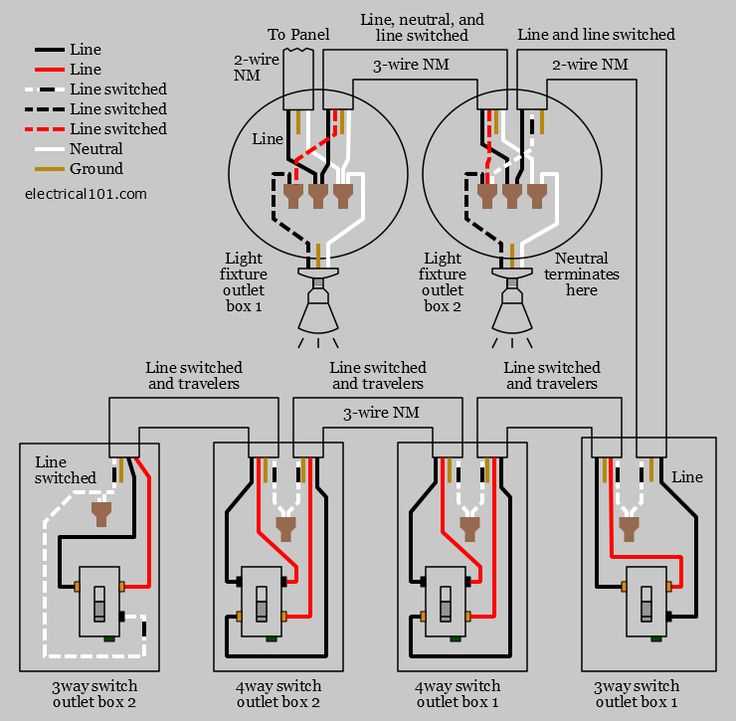
Install a four terminal crossover device between two three terminal control units and route a pair of traveler conductors through the center device. The phase line from the electrical panel connects to the common terminal of the first end unit, while the lamp lead connects to the common terminal of the second end unit. The traveler pair runs from the first end device to the center unit and continues to the second end device.
The central crossover device redirects the traveler conductors internally. Depending on its position, the internal contacts either keep the two travelers parallel or cross them. This change in conductor path determines whether the lamp receives phase voltage or remains disconnected.
Use a cable with at least four insulated conductors between devices. Typical installations apply 14 AWG or 1.5 mm² copper conductors for residential lighting lines. The traveler pair usually uses black and red insulation to simplify identification during installation and future maintenance.
The neutral conductor never passes through the control devices. It connects directly from the distribution box to the lamp holder. Only the phase line and the traveler pair move through the control chain, allowing any control unit along the line to toggle the lamp state.
Proper terminal tightening and correct traveler routing prevent intermittent lamp operation. After energizing the branch line, operate each control point sequentially; the lamp should change state every time any unit is toggled, confirming correct traveler connection and proper placement of the crossover device.