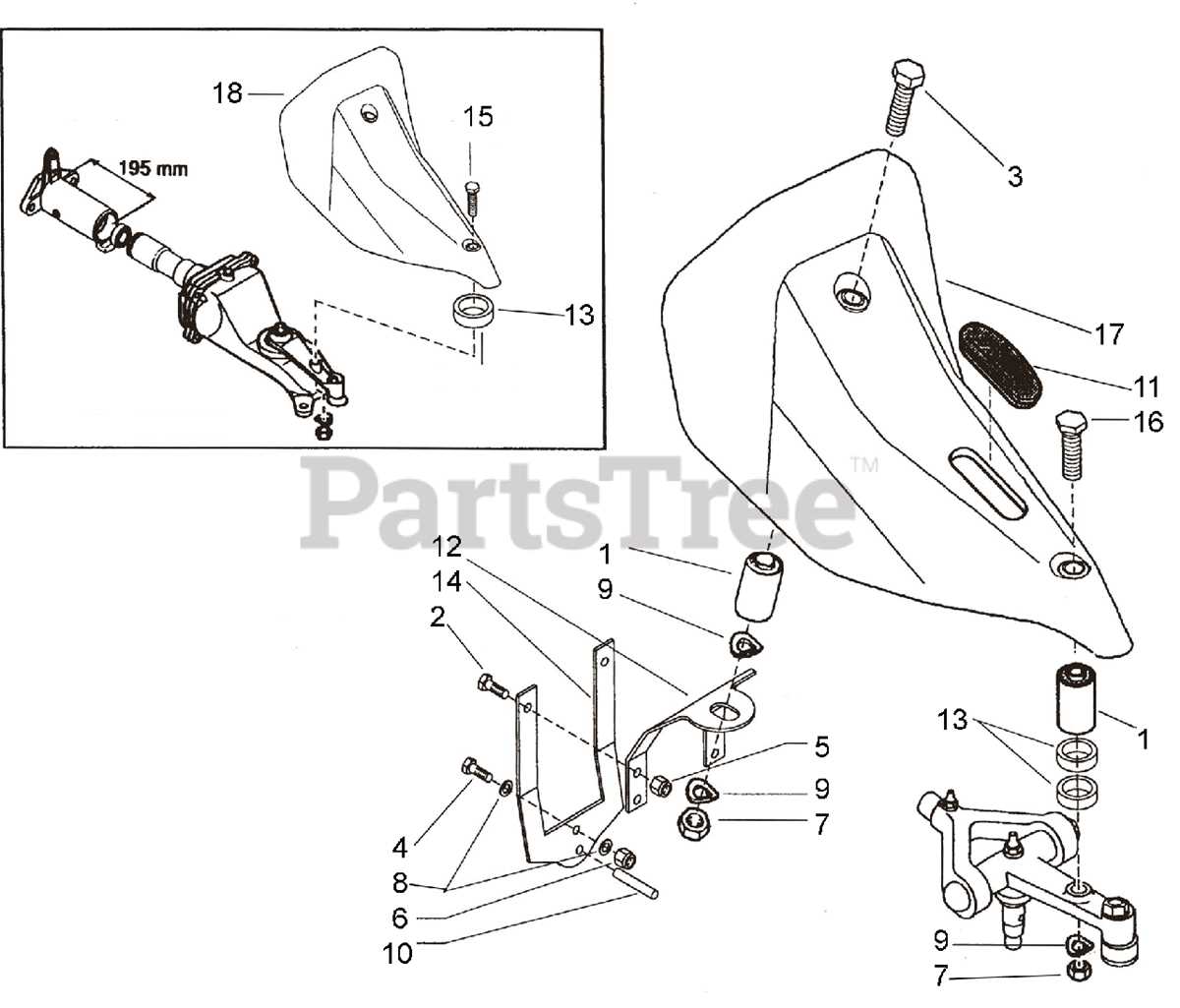
Match fastener sizes and clearances before any service. A clear layout of the reciprocating cutter assembly shows how the drive head, knife sections, wear plates, and hold-down clips align along the cutting beam. Typical knife sections use high-carbon steel with 3/8″ rivets or bolts on 1-1/4″ spacing, while hold-downs are set to maintain a 0.010–0.020″ gap above the cutting edge for clean motion without drag.
The drive end connects the wobble box or pitman to the knife head using a hardened pin sized to the machine’s stroke length, commonly 3″ or 4″. Bushings at this joint are oil-impregnated bronze; replace them when side play exceeds 0.5 mm. Guards along the beam are cast or forged steel with ledger surfaces hardened to resist rounding, spaced to match the knife pitch.
Clamp torque and alignment matter more than brand labels. Hold-down clips are tightened to 18–22 ft·lb on 3/8″ hardware, checked with a feeler gauge along the full beam. Wear plates beneath the knife are reversible; flipping them restores flat contact and extends service life. Use grade 8 fasteners at the drive head and grade 5 along the beam to balance strength and serviceability.
Use the layout as a checklist. Verify section orientation, ledger sharpness, straightness of the beam within 1/16″ across its length, and parallel travel of the knife. This approach reduces vibration, heat, and uneven cutting during hay or forage work.
Schematic Guide for a Reciprocating Cutting Assembly
Use a labeled layout that shows the cutter beam from drive end to shoe, with each element numbered and aligned to real mounting points for quick identification during service.
The cutting assembly consists of a reciprocating knife with triangular blades fastened by rivets or bolts, sliding within stationary guards that carry hardened ledger edges. Guard spacing commonly ranges from 76 to 102 mm, and ledger hardness should exceed the blade steel to preserve a clean shear.
Hold-down clips must sit 0.25–0.5 mm above the blade surface; excessive clearance causes crop pull, while zero clearance accelerates wear. A schematic should mark clip positions and shim locations to maintain this tolerance along the full beam.
The drive system typically includes a pitman arm or wobble box linked to a crank. Stroke length is often 76 mm; the layout should indicate center-to-center dimensions and bolt grades for the crank pin to avoid imbalance at operating speeds near 1,600 strokes per minute.
End shoes and wear plates control cutting height and beam alignment. A clear layout notes shoe angle, skid thickness, and adjustment slots, helping prevent toe-in that leads to guard breakage.
Registration marks on the layout show blade tip position relative to guard tips at each stroke end. Correct registration places blade points centered over ledger edges, reducing vibration and lowering power draw.
Fastener callouts belong next to each element: guard bolts often require M10 or 3/8″ hardware torqued to 40–45 Nm, while blade fasteners use lower torque to avoid distortion. Including these values in the layout speeds repairs and limits field errors.
Identifying Knife Sections, Guards, and Hold-Down Clips on a Schematic
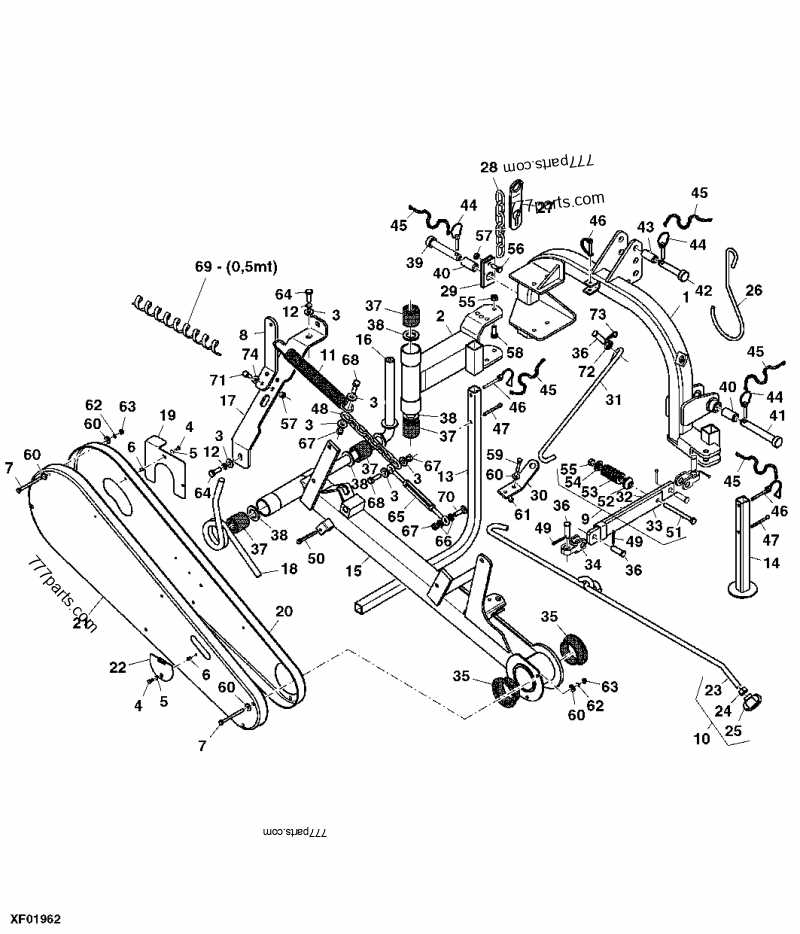
Select the cutting teeth first: genuine knife sections show uniform serrations with sharp leading edges facing the direction of travel; riveted styles have round heads flush with the tooth surface, while bolt-on styles use square-shoulder fasteners that seat tightly without rotation. Replace any tooth where the serration depth is reduced by more than one-third or the mounting holes show elongation.
Confirm the finger-like guards next: each unit carries a hardened ledger surface aligned parallel to the cutter rail. A straightedge placed across adjacent fingers should reveal no step greater than 0.5 mm; larger offsets signal bending or wear. Ledger faces with polishing only at the tip indicate poor alignment, while even wear across the length confirms correct set.
Check hold-down clips by measuring clearance between the clip shoe and the moving tooth edge. Target 0.25–0.5 mm across the stroke; adjust by shimming or reshaping the clip foot rather than forcing downward pressure. Excess gap causes chatter, while zero gap leads to heat and galling.
Verify spacing relationships on the layout: tooth centers must match finger pitch exactly, and clip locations should sit directly above the ledger midpoint. Mixed patterns–such as fine-serrated teeth paired with coarse ledger faces–reduce cut quality and accelerate wear.
Finish by cycling the reciprocating cutter by hand: smooth travel without lift at the clips and consistent scissor action at each finger confirms correct identification and placement of these components.
Interpreting Drive Components: Pitman Arm, Wobble Box, and Crank Assembly in the Diagram
Identify motion transfer first: follow the path from the rotating source to the reciprocating cutter rail, then verify alignment and stroke length against the schematic view.
The pitman arm converts rotary movement into a straight-line push–pull. On the illustration, confirm these specifics:
- Attachment points sit square to the crank pin and knife head; skewed joints signal vibration risk.
- Rod length matches the specified stroke; a mismatch shortens travel and leaves uncut strips.
- Bushing wear appears as oval holes; replace when clearance exceeds 0.5 mm.
The wobble box replaces the rod on many modern assemblies and reduces side load. Read it correctly by checking:
- Input shaft orientation aligns with the drive pulley centerline.
- Output yoke shows equal angular swing left and right; uneven angles indicate bearing fatigue.
- Lubrication ports face upward in the illustration; reversed mounting starves gears.
The crank assembly sets timing and stroke geometry. Use the drawing to validate:
- Crank radius equals half the required knife travel; measure from shaft center to pin center.
- Counterweights oppose the pin at 180°; missing balance causes oscillation at speed.
- Keyway placement locks phase; a slipped key retards motion and raises load.
Cross-check interaction points: the pitman arm or wobble box output must reach full extension exactly at crank dead center. Adjust shims or linkage length until the illustration’s reference marks coincide.
Before reassembly, torque fasteners to spec, grease sliding interfaces, and rotate by hand to confirm smooth reciprocation without binding.
Using the Schematic to Match Component Numbers with Machine Variants and Replacement Orders
Verify the machine’s exact variant code against the schematic reference table before selecting any component ID; mismatched revisions often share shapes but differ in mounting pitch, tooth count, or drive-side orientation.
Cross-check the numeric callouts on the schematic with the manufacturer’s index to confirm handedness (left/right), material grade, and heat treatment. For cutting assemblies, confirm alloy type and edge profile; for drive elements, confirm spline count and shaft diameter.
Match the serial range printed on the chassis plate to the schematic revision letter. A single letter change can indicate altered bolt spacing by 2–4 mm or a revised hub offset, which invalidates older IDs.
Use the exploded view to trace fastener stacks in sequence. Record washer thicknesses and spacer order, then compare with the bill-of-materials list to avoid ordering a correct item that fails due to missing shims.
Confirm compatibility notes tied to regional builds. North American and EU variants frequently differ in guard spacing and bearing seals; the schematic annotations flag these differences with suffix codes.
For repeat orders, store a verified set of IDs per machine variant. Include torque specs and recommended consumables from the notes panel so procurement includes lock nuts, cotter pins, and lubricants in the same shipment.
Before checkout, validate superseded IDs. Many catalogs map legacy numbers to updated equivalents; check the replacement chain to prevent obsolete stock from entering inventory.
After delivery, dry-fit components against the schematic callouts. Measure critical dimensions–center-to-center spacing, bore size, and thickness–to confirm conformity before final assembly.