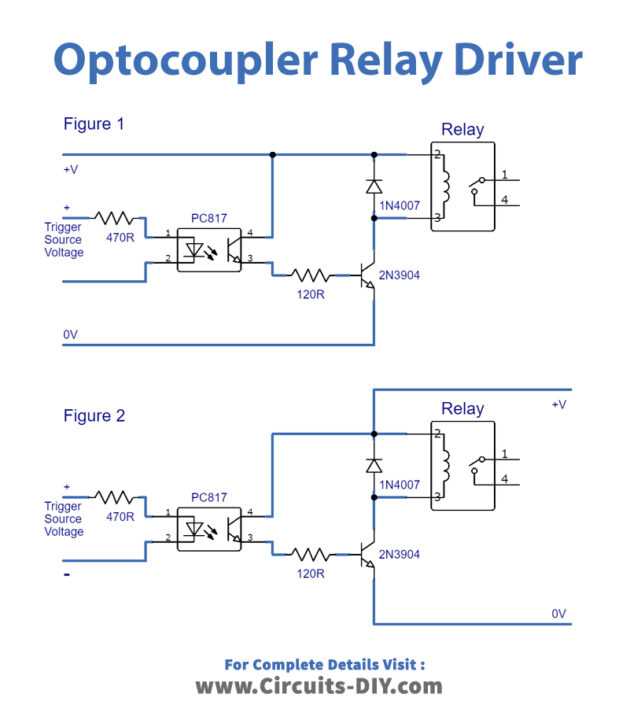
Use a transistor-driven LED approach to transfer signals between high-voltage and low-voltage sections. Connect the LED anode through a current-limiting resistor directly to the control voltage, ensuring forward current remains below 20 mA to maintain safe operation and prevent thermal stress.
On the receiving side, pair the phototransistor with a pull-up resistor matched to the supply voltage. This setup guarantees clear logic-level transitions without inducing unwanted leakage currents. For 5V systems, a 10 kΩ pull-up is typically adequate, while 12V or higher may require 4.7 kΩ or lower for stable switching.
Place decoupling capacitors near the power pins of the phototransistor stage to suppress voltage spikes and prevent false triggering. A 0.1 μF ceramic capacitor across the supply lines is sufficient for most low-power applications.
For bidirectional isolation or interfacing with microcontrollers, consider adjusting the series resistor on the input LED according to the driving voltage and desired switching speed. A lower resistor accelerates response time but increases power consumption, while a higher resistor reduces current without significantly compromising switching if signal frequency is low.
Ensure correct polarity during installation: the LED cathode must align with the control return path, and the phototransistor collector should face the positive supply line. Reversing connections can prevent proper conduction and may damage the semiconductor junctions.
Pin Configuration and Connection Guide for Signal Control
Connect the LED input correctly to the control source: the anode should link to the positive voltage through a series resistor, and the cathode goes to ground. This ensures consistent illumination and predictable switching of the phototransistor.
Identify the four terminals carefully:
- Pin 1: LED anode
- Pin 2: LED cathode
- Pin 3: Transistor collector
- Pin 4: Transistor emitter
For logic-level interfacing, connect the collector to the microcontroller input through a pull-up resistor. The emitter should return to the ground of the microcontroller, allowing clean signal transmission without voltage spikes.
Series resistor calculation depends on the control voltage. For 5V inputs, a 220–330 Ω resistor limits the current to approximately 15 mA, maintaining safe LED operation. For higher voltages, increase the resistor proportionally to prevent overheating.
Isolate high-voltage sections by using the transistor side to switch loads. This configuration allows signal transfer while protecting sensitive low-voltage electronics from potential surges.
Switching Speed Optimization
Reducing series resistance on the LED side improves response time but increases current draw. Choose a resistor that balances speed and thermal limits based on the application frequency.
Practical Wiring Tips
- Verify polarity before soldering to prevent reverse biasing.
- Place a small decoupling capacitor across the collector-emitter path to filter transient noise.
- Keep connecting traces short to minimize parasitic capacitance and improve switching precision.
Use this configuration guide for safe, reliable control of both digital and analog signals while maintaining electrical separation between control and output sections.
Identifying Pins and Their Functions
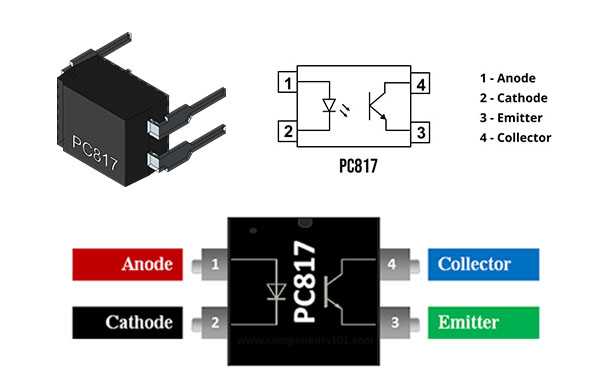
Pin 1 connects to the LED anode and should be linked through a resistor to the control voltage. This limits current to safe levels, typically 10–20 mA, and prevents thermal stress on the semiconductor junction.
Pin 2 serves as the LED cathode, completing the low-voltage side. It must return to the ground of the controlling source for proper signal activation.
Pin 3 acts as the transistor collector, which can interface with microcontroller inputs or switching circuits. Using a pull-up resistor ensures that voltage transitions are sharp and reliable, avoiding floating states that can trigger erratic responses.
Pin 4 functions as the emitter, connecting to the load or system ground. This configuration isolates the control input from the output, enabling safe switching of higher voltages without exposing sensitive components.
LED polarity must be verified before powering the module. Reversing the anode and cathode can prevent conduction and may cause permanent damage to the junction, especially at higher input voltages.
For signal-level applications, short traces between the collector and microcontroller input minimize parasitic capacitance. This improves response time and reduces voltage spikes induced by fast switching.
Series resistors on the LED side determine both current and speed. Lower resistance allows faster activation but increases power dissipation. Higher resistance limits current but may slow response, so select based on operating frequency and thermal constraints.
Use this pin mapping for precise wiring: anode to control voltage via resistor, cathode to ground, collector to input through pull-up, emitter to system ground. Following this layout ensures stable, isolated signal transfer across voltage domains.