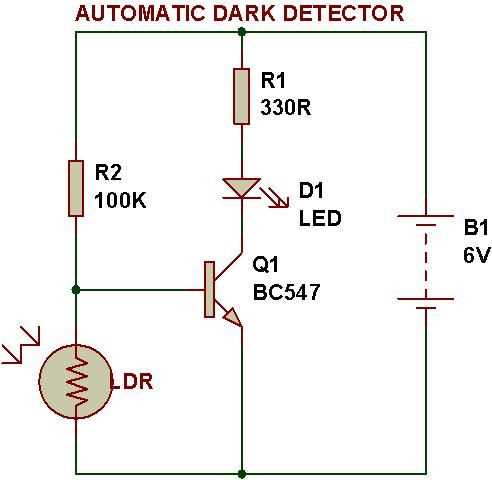
Use a photoresistor (LDR) paired with a voltage divider and NPN transistor as the most practical configuration for automatic illumination-triggered switching. A typical setup places the LDR in series with a 10 kΩ–47 kΩ resistor between VCC (5–12 V) and ground. The midpoint feeds the base of a transistor such as 2N2222 or BC547 through a base resistor near 1 kΩ. When ambient brightness drops, the LDR resistance rises from roughly 1 kΩ in strong illumination to 100 kΩ or more in darkness, shifting the divider voltage and activating the transistor stage.
The wiring scheme should include a collector load–for example a relay module, LED indicator, or MOSFET gate driver. Connect the collector to the load and the emitter to ground. A flyback diode (1N4148 or 1N4007) must be placed across relay coils to block voltage spikes. With a 12 V supply and a relay drawing 70–90 mA, the transistor remains within safe limits when the base current reaches approximately 3–5 mA.
Threshold tuning relies on resistor selection in the divider. Replacing the fixed resistor with a 50 kΩ trimming potentiometer allows precise response adjustment. Turning the potentiometer shifts the activation point so the switching event occurs at a chosen brightness level–useful for outdoor lamps, greenhouse shading systems, or display dimming modules.
Stable operation improves when a 100 nF capacitor is placed between the transistor base and ground. This small filter suppresses rapid fluctuations caused by passing shadows or electrical noise. The resulting electronic network reacts smoothly to gradual illumination change rather than short spikes, producing predictable activation of the connected device.
Illumination Detection Wiring Scheme
Use a photoresistor paired with a 10 kΩ resistor as a voltage divider connected to a 5 V supply; the midpoint feeds an analog input of a microcontroller or a comparator stage. Under strong illumination the photoresistor may drop to 1–2 kΩ, producing about 0.8 V at the divider node, while dim conditions can raise resistance beyond 100 kΩ, shifting the node toward 4 V. This measurable voltage swing enables automatic switching for lamps, alarms, or display brightness regulation.
A photodiode arrangement provides faster response than a photoresistor. Connect the photodiode in reverse bias with a 100 kΩ load resistor. The generated current, typically 1–10 µA under moderate illumination, produces a voltage across the resistor that can be amplified with an operational amplifier such as LM358 configured with a gain near 50. This configuration reacts within microseconds, suitable for optical counters or beam interruption detectors.
Component Arrangement
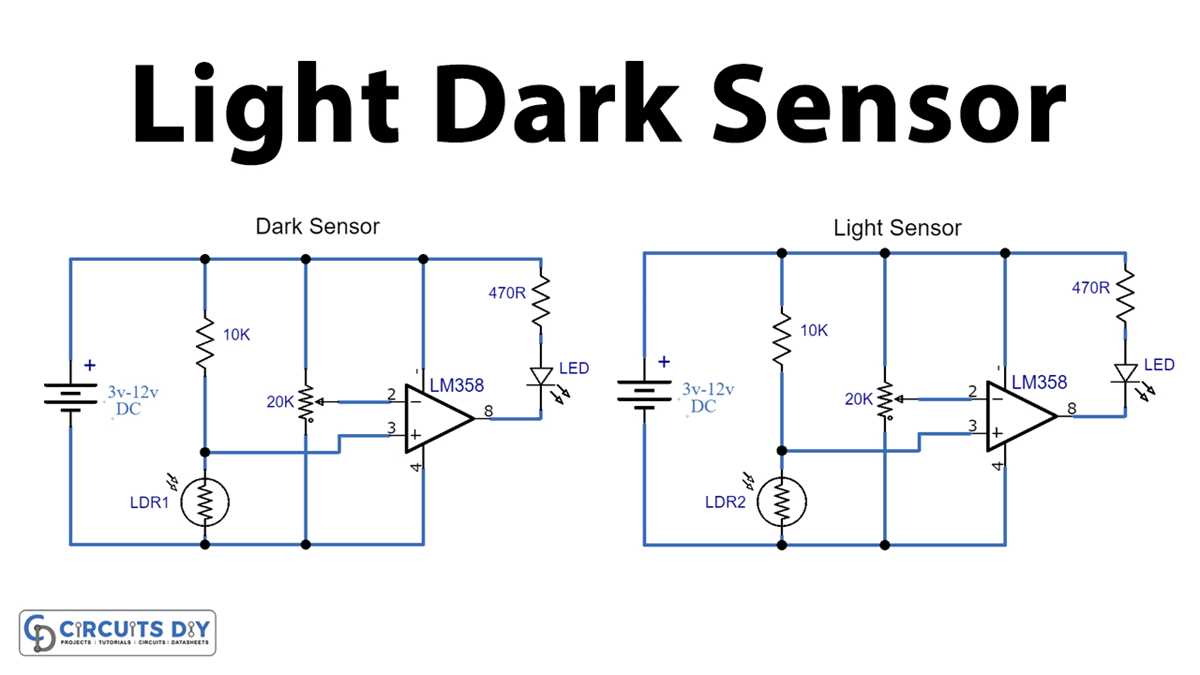
Place the illumination-sensitive element at the front of the network and isolate it from electrical noise with a 0.1 µF capacitor near the amplifier input. A comparator like LM393 can monitor the divider voltage and toggle a transistor stage when the threshold is crossed. The threshold level is adjusted with a 50 kΩ trimmer, allowing activation at a specific brightness level measured in lux; practical values range from 20 lux for dusk detection to 300 lux for indoor automation.
A transistor stage often follows the comparator output. A common configuration uses an NPN device such as 2N2222 with a 1 kΩ base resistor. When the comparator output reaches about 3 V, the transistor saturates and drives loads like relays or LEDs. Relay coils typically require 70–100 mA, so include a flyback diode across the coil to prevent voltage spikes from damaging the switching stage.
Calibration and Practical Values
Calibration requires measuring node voltage while adjusting the trimmer under known brightness conditions. For example, with a 5 V supply and a 10 kΩ reference resistor, dusk detection often occurs near 2.2 V at the divider node. Recording these values helps maintain consistent activation across multiple assemblies.
Physical placement strongly influences performance. Shield the photo-sensitive element from direct glare and mount it facing the monitored area. A small opaque tube around the element narrows the viewing angle to about 20–30 degrees, preventing false triggers from nearby lamps or reflections.
For battery-powered devices, reduce current draw by increasing divider resistance to 100 kΩ and sampling the voltage intermittently through a microcontroller ADC. With this adjustment, standby consumption may drop below 50 µA while maintaining reliable brightness detection.