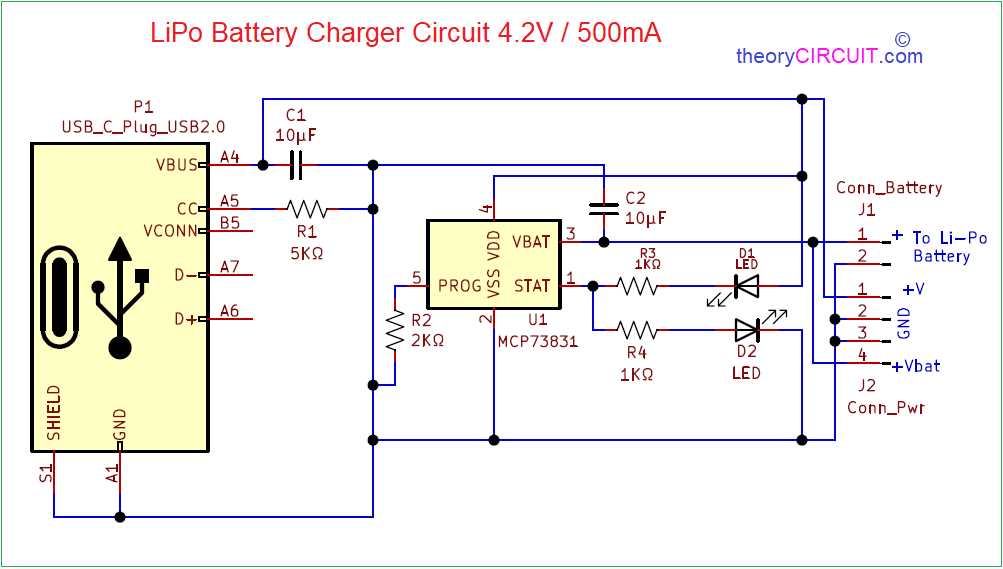
Use a regulated voltage source rated at 4.2 volts per cell to prevent overcharging and extend lifespan. Include a current-limiting resistor to control peak charging current, typically set at 0.5C of the cell capacity for safe operation.
Integrate a thermal cutoff switch near the energy storage pack to avoid overheating during rapid charging cycles. This ensures the protective mechanism triggers before cell temperatures exceed 60°C, reducing fire risk.
Arrange the positive and negative terminals clearly with distinct color-coded connectors. Confirm polarity using a multimeter before applying voltage, as reversed connections can permanently damage the storage units.
Include an indicator LED across the output lines with a 220-ohm series resistor to show active charging status. This provides visual confirmation without the need for additional measurement tools, enhancing user safety and monitoring accuracy.
Assembly and Connection Guide for Rechargeable Cell Power Units
Mount the control module on a non-conductive base and secure all resistors and regulators firmly. Connect the positive lead of the energy storage pack to the current-limiting terminal, ensuring the polarity is correct to prevent reverse flow. Use heat-shrink tubing over exposed leads and maintain at least 5 mm spacing between terminals to reduce short-circuit risks.
Route the output lines to the load or main power bus with clearly marked connectors and fuses rated at 1.2 times the maximum current. Verify continuity and measure voltage at each junction before applying full input. Include an LED or small voltmeter for monitoring charge state, and keep thermal sensors in place to cut off supply if temperature exceeds 60°C, maintaining safe operation throughout multiple cycles.
Selecting Components and Voltage Requirements
Use voltage regulators rated slightly above the maximum pack output to prevent overvoltage stress. Capacitors should have at least 25% higher voltage tolerance than the nominal supply, and resistors must handle continuous current without significant heating. Prioritize components with low temperature coefficients to maintain stability during prolonged operation.
For switching elements, select MOSFETs or transistors with drain-source voltage ratings at least 30% higher than the peak input. Ensure control ICs are compatible with the input range and include under-voltage lockout to prevent damage. Diodes in the flow path should have fast recovery times to minimize loss and avoid voltage spikes.
When calculating load current, use the maximum expected draw plus 10% margin to determine conductor thickness and fuse ratings. Include thermistors or temperature sensors near high-current points for real-time monitoring. Maintaining these tolerances and selecting components carefully ensures reliable performance and longevity of the assembled power supply unit.