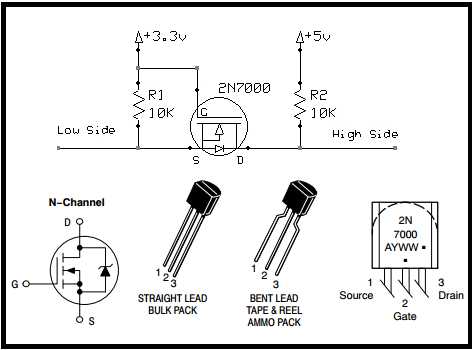
Use MOSFETs with low threshold voltage to ensure reliable transitions between 3.3V and 5V lines, minimizing propagation delay below 20 nanoseconds and avoiding signal distortion.
Incorporate pull-up resistors of 10kΩ on the high voltage side to stabilize idle states and prevent unintended toggling during fast switching operations.
Maintain separate ground planes for the low and high domains to reduce noise coupling and prevent voltage spikes that can damage microcontrollers or sensors.
Route traces under 5 cm wherever possible to limit parasitic capacitance, especially in setups where frequency exceeds 1 MHz. This ensures clear and consistent signal edges.
Test signal integrity with an oscilloscope across both domains to verify clean rising and falling edges, checking for overshoot above 0.2V or ringing that could trigger false logic states.
Level shifter setup and signal adjustment guide
Connect low voltage lines directly to the gate inputs of MOSFETs rated for 3.3V logic, ensuring that threshold voltage is below 1.8V to guarantee proper toggling without missed transitions.
Attach high voltage rails to the drain terminals, using 4.7kΩ pull-up resistors to maintain clear logic highs and prevent floating states when no active signal is present.
Verify signal edges with an oscilloscope, checking that rise and fall times stay below 15 nanoseconds at frequencies up to 5 MHz, reducing the chance of misinterpretation by downstream devices.
Balance pull-up values between low and high domains; increasing resistance above 10kΩ may slow transitions, while lower than 2kΩ can increase current draw and heating on MOSFETs.
Isolate ground planes for both voltage domains using separate traces or planes, connecting them at a single point near the reference source to limit noise coupling and reduce cross-talk.
Test bidirectional operation by sending data from high to low domains and vice versa, confirming that no logic inversion occurs and signal integrity remains stable under continuous switching at maximum expected frequency.
Choosing components and voltage thresholds for level conversion
Select MOSFETs with a gate threshold voltage significantly below the lowest logic level in the system, ideally 1.5V or lower for 3.3V to 5V translation, to ensure consistent switching without misfires. Resistors should be rated to handle expected current while maintaining minimal propagation delay, typically between 2kΩ and 5kΩ for standard applications.
Verify voltage tolerance for both high and low domains, confirming all components can withstand transient spikes up to 10% above nominal levels. Capacitive loading should be minimized on signal lines to maintain edge speed, and bidirectional configurations require MOSFETs capable of passing full voltage swings without clamping or leakage affecting the opposite domain.