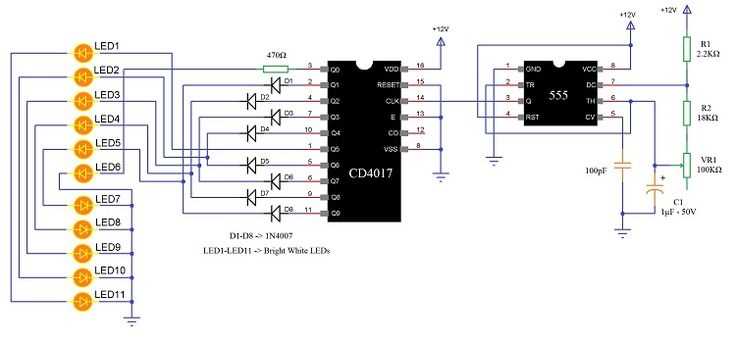
Use a pulse generator connected to a decade counter to create sequential activation of a row of semiconductor emitters. A timer IC such as NE555 produces square-wave pulses that advance the CD4017 counter one step at a time, lighting each diode in sequence for a moving visual effect.
Select appropriate current-limiting resistors for each emitter. Red and yellow types typically have a forward voltage drop around 1.8–2.2 V, while blue and white types reach 3.0–3.3 V. With a supply near twelve volts, resistors between 560 Ω and 1 kΩ keep current around 10–15 mA. Assigning one resistor per emitter ensures uniform brightness along the row.
Adjust the stepping speed using the RC network attached to the timer. A 100 kΩ resistor with a 10 µF capacitor yields roughly one pulse per second, producing a slow progression. Reducing resistance to 47 kΩ approximately doubles the rate, increasing the sequence speed for faster motion effects.
Arrange the power source, timer, counter, resistors, and emitters in a structured layout. Clearly label output pins, polarity, and supply lines. Proper organization prevents wiring mistakes, simplifies testing, and protects emitters from reversed connections or excessive current during assembly and operation.
LED Running Light Circuit Diagram With Sequential Control and Wiring Layout
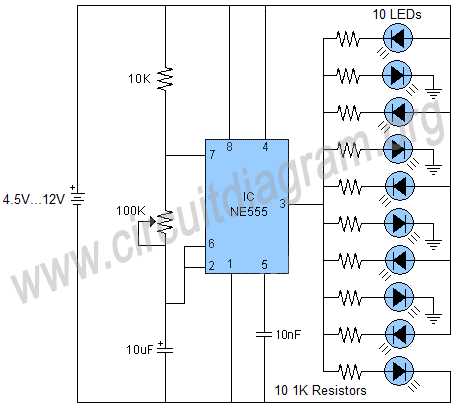
Start with a stable pulse generator such as an NE555 timer configured in astable mode. Connect its output to the clock input of a CD4017 decade counter to advance outputs sequentially. Each output pin will drive a diode emitter or a small group for a moving illumination effect.
Use a separate resistor for each emitter to control current. Red and yellow types usually drop 1.8–2.2 V, while blue and white reach 3.0–3.3 V. With a twelve-volt supply, resistors between 560 Ω and 1 kΩ maintain 10–15 mA per emitter and ensure uniform brightness along the row.
Adjust the speed of the sequence by changing the resistor or capacitor in the timer stage. For example, a 100 kΩ resistor with a 10 µF capacitor produces one step per second. Lowering resistance to 47 kΩ approximately doubles the pulse rate for a faster moving effect.
Arrange all components clearly. Place the timer, counter, resistors, and emitters on a breadboard or PCB with short connections. Label each output and mark polarity on all diodes to prevent miswiring, which can damage emitters or cause the sequence to fail.
Wiring Layout for Sequential Outputs
Connect the positive supply to the timer VCC and the counter VDD, while grounding both devices properly. Each counter output goes through a resistor to an emitter, then returns to the negative supply rail. Ensure that the emitter array is arranged in a linear or curved pattern depending on the visual effect desired.
Include a switch or control line before the timer input to enable or disable the sequence. This allows the pattern to be paused or turned off without disconnecting the power supply, which helps protect components during maintenance or testing.
Troubleshooting and Testing
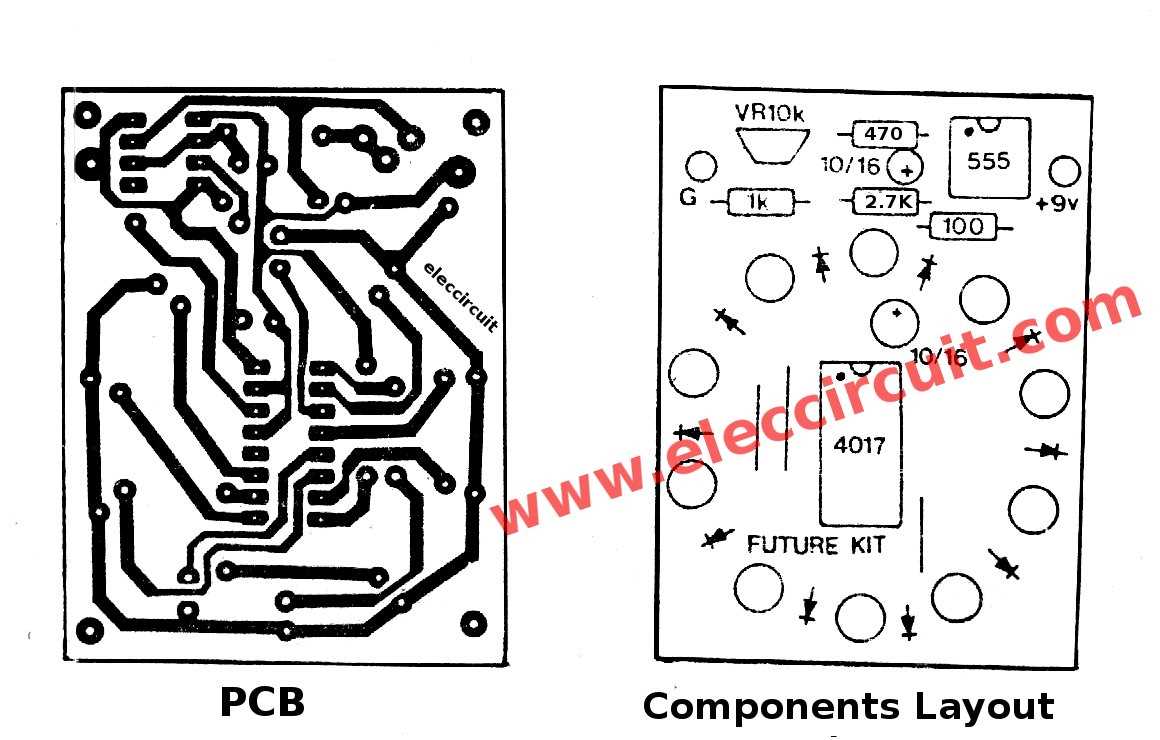
Measure voltage at the counter outputs to verify correct sequencing. Each pin should receive nearly the full supply voltage during its active phase. If an output remains off or multiple outputs are active simultaneously, check for wiring errors, incorrect resistor values, or faulty components.
Final testing should include observing the emitter array in low ambient light to confirm uniform brightness and correct sequential motion. Adjust resistor values or the timer RC network to fine-tune speed and visual effect. Ensure no emitter exceeds its maximum rated current to avoid overheating or reduced lifespan.
Component Selection for LED Running Light Circuit Using IC 4017 Timer and Resistors
Select a CD4017 decade counter for sequential output control. This IC can handle currents up to 10 mA per output, making it compatible with most small diode emitters. Ensure the supply voltage matches the emitter array, typically 12 V, to prevent overloading the chip.
Use an NE555 timer in astable mode to generate clock pulses for the counter. Choose resistor and capacitor values to control pulse frequency. For example, a 100 kΩ resistor with a 10 µF capacitor produces approximately one pulse per second, while reducing resistance to 47 kΩ increases the rate for faster progression.
Include current-limiting resistors for each emitter output. Red and yellow types require about 1.8–2.2 V forward drop, and white or blue types need 3.0–3.3 V. With a 12 V supply, resistors from 560 Ω to 1 kΩ maintain 10–15 mA per emitter, ensuring uniform brightness along the array.
Choose a decoupling capacitor near the power pins of the CD4017 to stabilize the supply and reduce noise. A 0.1 µF ceramic capacitor is sufficient for most setups and prevents erratic switching caused by voltage spikes or transient pulses from the timer IC.
For longer emitter rows, consider using buffer transistors. NPN transistors like the BC547 can amplify outputs from the CD4017, allowing higher current to multiple emitters without exceeding the IC’s rated output. Each transistor base should include a resistor of 1–2 kΩ to limit current from the IC.
Use a toggle or push-button switch on the power line to control the sequence. This allows the emitter array to be safely powered down for adjustments or testing without disconnecting the supply. Label all connections and polarities to avoid miswiring and protect components during assembly.