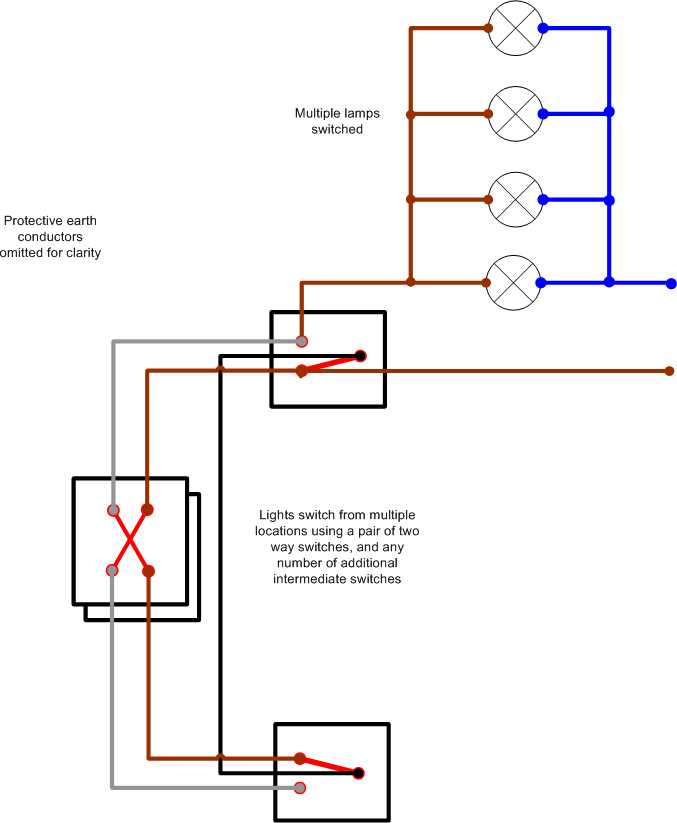
Focus on organizing components with clear power and signal pathways. Use color-coded conductors to distinguish between voltage levels and ground lines, which reduces errors during assembly and troubleshooting. Ensure resistors, capacitors, and transistors are positioned to minimize interference and signal loss.
Apply consistent labeling for each node and connector point. Incorporate decoupling capacitors near integrated circuits to stabilize voltage fluctuations. Position diodes and LEDs with polarity indicators visible, preventing reverse current issues.
Prioritize compact yet accessible routing. Maintain adequate spacing between high-current traces to prevent overheating, while keeping signal paths short to preserve waveform integrity. Include test points at critical junctions for easy measurement and diagnostics.
Use modular sub-sections for complex assemblies. Group related components and provide clear linkages between sections with labeled connectors. This approach simplifies upgrades and fault isolation while maintaining signal clarity across the board.
Verify the layout against expected load and voltage requirements. Cross-check all paths for potential shorts or unintentional loops. Document all connections with precise annotations to assist in maintenance and future modifications.
Intermediate Circuit Diagram
Use a regulated power rail of 5V for the microcontroller node and ensure decoupling capacitors of 0.1µF are positioned within 2 mm of each IC pin to prevent voltage dips during switching events.
Place resistors in series with LED indicators at 220 Ω for 5V supply systems. This limits current to approximately 20 mA, preserving both the LEDs and driver transistors from thermal stress.
Integrate a low-pass filter using a 10 kΩ resistor and a 100 nF ceramic capacitor at the analog sensor input. This reduces high-frequency noise without introducing significant signal delay.
For MOSFET switching, connect the gate to a logic-level output with a 150 Ω resistor to reduce ringing. Add a 10 kΩ pull-down resistor to guarantee the device remains off during microcontroller startup.
Trace width for power lines carrying 2 A should be at least 1 mm if using standard FR4 PCB material. Thermal vias near heat-generating components enhance conduction and prevent hotspots.
Label all connector pins clearly and maintain consistent spacing of 2.54 mm for headers. This prevents misalignment during assembly and simplifies troubleshooting if modifications are required.
Selecting Components for Reliable Signal Flow
Choose resistors with a tolerance of 0.1% for feedback loops to minimize voltage drift, and pair them with low-noise metal film types for sensitive analog paths. For capacitors, use C0G/NP0 ceramics in high-frequency sections and polypropylene film capacitors for power line filtering to maintain signal integrity. Inductors should have a high Q-factor above 50 at the operating frequency to reduce parasitic losses and prevent unwanted coupling between traces.
Opt for operational amplifiers with a slew rate exceeding 10 V/µs when handling fast transitions, and select devices with input bias currents below 1 nA for low-leakage signal nodes. Connect each active element with decoupling capacitors of 0.01–0.1 µF placed within 5 mm of the pins, and use short, wide traces for high-current paths to minimize voltage drops and ringing. For connectors, prioritize gold-plated contacts with insertion force under 2 N to ensure repeatable contact and minimal resistance variation over repeated cycles.