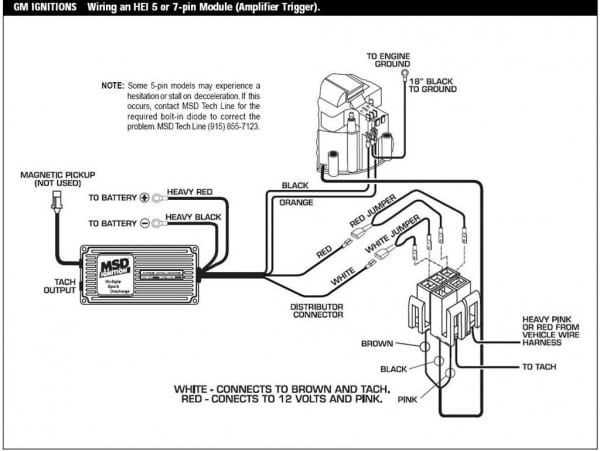
Start by identifying all terminals on the ignition module and coil. Red leads carry battery voltage, black leads connect to ground, and orange or pink leads supply ignition signal to the distributor.
Ensure all connections are tight and free of corrosion. Loose or oxidized contacts can cause misfires, weak sparks, or failure to start the engine.
Use color-coded markings and reference numbers to match each lead to its corresponding point. Consistent labeling prevents mistakes during installation and simplifies future troubleshooting.
Check the main power feed and ground paths with a multimeter before completing the setup. Verifying continuity and proper voltage ensures that the system will function correctly once the engine is running.
Secure each conductor to prevent vibration from loosening terminals. Routing leads along protective channels reduces wear and avoids accidental contact with hot engine surfaces or moving parts.
GM HEI Wiring Diagram
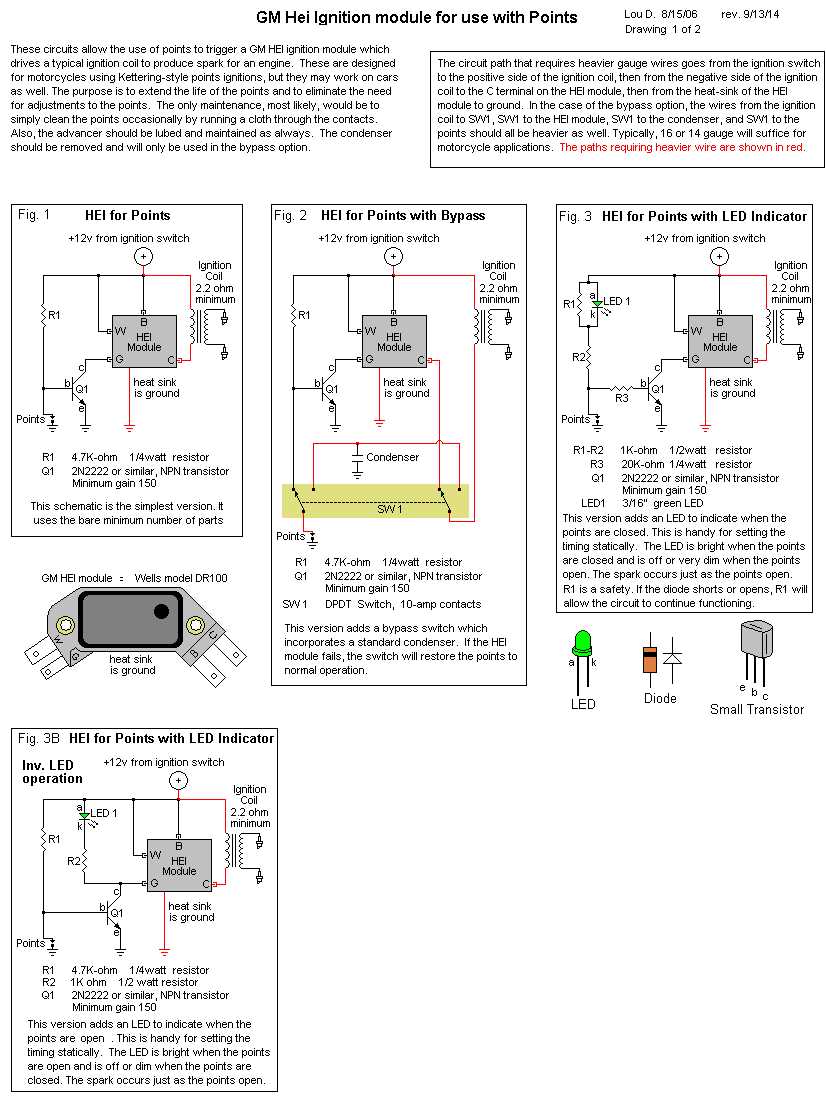
Connect the ignition coil’s positive terminal directly to the switched 12-volt source from the fuse panel. Ensure the negative side aligns with the distributor’s pickup coil output for proper spark timing. Avoid using splices in this critical path to maintain voltage stability under high RPM conditions.
Use a 10-gauge wire for the main power feed to prevent voltage drop over longer runs. Route it away from high-heat areas like the exhaust manifold. Incorporate a dedicated fusible link rated at 20 amps to protect the coil and electronic module from overloads.
Signal Routing and Connections
Connect the tachometer signal wire directly to the negative coil terminal. Some models require a resistor inline to match signal amplitude. Confirm wire colors against your specific year and engine variant: most late-model GM systems use a pink wire for switched 12V and a dark green for tach output.
For vehicles with external ballast resistors, bypass them when using a full-voltage feed from the fuse box. This prevents under-voltage conditions at startup and improves idle stability. Always verify continuity between the distributor connector and coil to prevent misfires caused by intermittent contact.
Grounding and Safety
Ensure the module and coil share a solid chassis ground. Scrape paint at mounting points and use star washers to reduce resistance. Avoid grounding through body panels with corrosion, as this can induce erratic spark timing and reduced engine performance.
Identifying Terminals and Power Connections
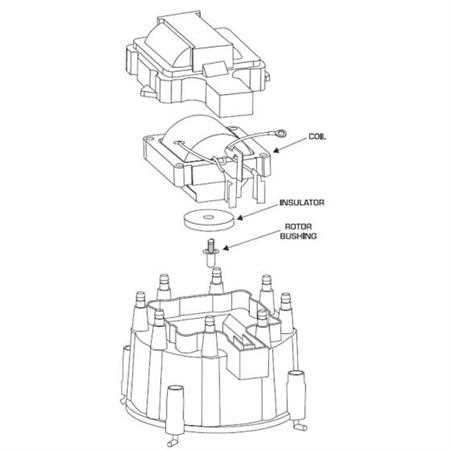
Connect the positive post on the coil directly to a switched 12-volt source. Avoid tapping into accessory circuits, as voltage fluctuation can cause weak or inconsistent spark. Use a clearly labeled inline fuse rated at 20 amps to prevent damage from short circuits.
The negative post of the coil must attach to the distributor module’s output. Confirm continuity with a multimeter before starting the engine to prevent misfires. If multiple wires share the same connector, check color codes carefully: dark green is usually the tach signal, and black is ground.
Pin Identification
- Terminal A: Switched power feed, typically pink or red.
- Terminal B: Module control, often a black or white wire.
- Terminal C: Tachometer signal, dark green in most late-model GM units.
- Terminal D: Optional ballast bypass for high-voltage feeds.
Verify each connection visually and mechanically. Loose terminals can cause intermittent spark, engine hesitation, or stalling at idle. Crimp connectors securely and apply dielectric grease to prevent corrosion over time.
Power Routing Tips
- Keep high-current lines away from exhaust components.
- Use a 10-gauge wire for primary coil feed.
- Ensure the module and coil share the same ground point, preferably directly on the firewall or engine block.
- Check that all inline resistors are bypassed if full voltage is supplied to the coil.
Label wires immediately after installation. Clear identification reduces troubleshooting time and avoids misrouting during future maintenance. A simple color-coded tape system can prevent errors in multi-wire connectors and ensures consistent spark delivery at high RPM.