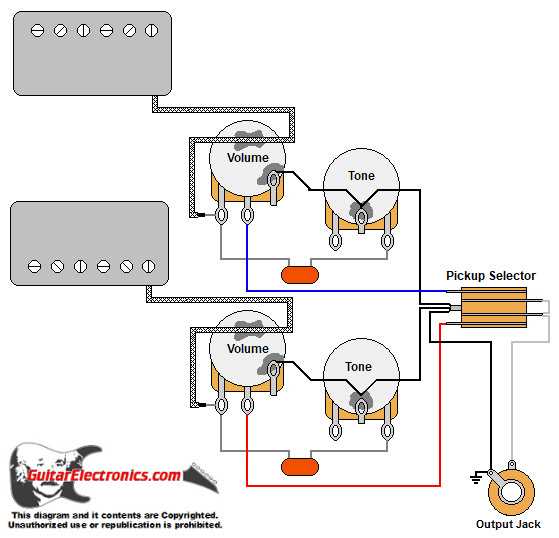
Check pickup leads and control cavity connections before replacing any components. A typical SG-style electric guitar uses two humbucking pickups, a three-position toggle selector, two volume controls, two tone controls, and a single output jack. Correct signal routing ensures that each pickup reaches the selector switch and then the output without phase loss or unwanted noise.
Each pickup normally connects to a dedicated volume potentiometer rated at 500 kΩ. The middle terminal of the pot sends signal toward the selector switch, while the outer terminal connects to the pickup hot lead. The remaining terminal is tied to ground. Shielded cable between the pickup cavity and the control area helps reduce interference from stage lighting and power supplies.
Tone shaping relies on a capacitor connected between the tone control and ground. Common values include 0.022 µF for humbucker pickups, which allows gradual treble reduction as the knob turns. Larger values such as 0.047 µF produce a deeper high-frequency roll-off, often used by players seeking a darker sound profile.
The three-position toggle switch selects neck pickup, bridge pickup, or both together. Each pickup signal enters separate switch terminals, and the center lug routes the chosen signal toward the output jack. When both pickups are active, their signals combine in parallel before reaching the amplifier input.
Ground connections run through the backs of all potentiometers and continue toward the output jack sleeve. The bridge grounding wire attaches to the same point, preventing hum when the player touches metal hardware. Clean solder joints and short ground paths help maintain stable signal flow inside the control cavity.
Gibson SG Wiring Diagram With Humbucker Pickups 3 Way Switch and Control Pots
Connect each humbucker hot lead to the input lug of its dedicated 500 kΩ volume potentiometer. The center lug of the pot carries the signal toward the three-position selector, while the remaining lug attaches to ground on the pot casing. Shielded pickup cable reduces noise pickup inside the control cavity, especially under stage lighting and near power transformers.
The selector toggle uses three terminals plus a common output contact. Each pickup signal reaches one outer terminal. The center output terminal sends the chosen signal to the output jack through the master signal path. Position selection works as follows:
- Position 1 – bridge pickup active
- Position 2 – bridge and neck pickups combined in parallel
- Position 3 – neck pickup active
Tone controls connect through capacitors attached between the tone pot and ground. A common setup uses 0.022 µF capacitors paired with 500 kΩ tone potentiometers. Turning the knob reduces high-frequency content by sending treble energy through the capacitor path to ground.
Ground connections link the backs of all four potentiometers, the pickup shields, bridge ground wire, and the sleeve terminal of the output jack. Keep ground leads short and solidly soldered. This layout maintains stable signal flow from pickups through the selector and controls before reaching the amplifier input.
Gibson SG Wiring Diagram With Two Humbuckers Connected to 3 Way Toggle Switch Lugs
Connect the hot lead from the bridge humbucker to one outer lug of the three-position selector and route the neck pickup hot lead to the opposite outer lug. The center lug of the selector carries the combined signal toward the volume control path and then to the output jack. This arrangement allows independent pickup selection while maintaining a short signal route.
Each humbucker normally sends its signal through a dedicated 500 kΩ volume potentiometer before reaching the selector. The pickup hot wire attaches to the first lug of the pot, the middle lug sends signal to the switch, and the third lug connects to ground. This layout allows each pickup level to be adjusted without affecting the other.
The toggle switch uses a mechanical lever that shifts a metal contact between two input terminals. In the forward position the neck pickup connects to the output path. In the rear position the bridge pickup connects instead. The center position links both pickup inputs to the output terminal simultaneously.
When both pickups operate together, their signals combine in parallel. Parallel connection keeps output impedance low and maintains clarity. Many SG-style instruments produce a balanced tone in this position because the neck pickup captures a warmer portion of string vibration while the bridge unit captures a brighter harmonic range.
The selector switch usually sits in a cavity above the control area. A shielded conductor runs from the selector output terminal to the first volume control or directly to the output jack depending on the layout used. Shielding prevents hum pickup from nearby stage power lines.
Ground connections tie together pickup shields, potentiometer casings, and the bridge grounding wire. All these points normally join at the back of a volume pot. The sleeve terminal of the output jack connects to the same ground point, forming a single reference path for the instrument electronics.
Keep lead lengths short and avoid routing signal wires parallel to ground wires for long distances inside the cavity. Clean solder joints and stable connections at the selector lugs help maintain consistent signal flow from both humbuckers to the amplifier input.