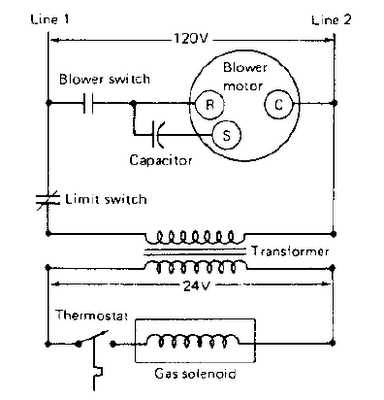
Disconnect electrical power at the service switch and breaker before examining any heating unit control connections. Most residential warm air heaters operate with a 24-volt control circuit supplied by a step-down transformer that converts 120 V or 240 V line power into low voltage used by the thermostat and control board.
The thermostat cable usually contains five colored conductors connected to terminals labeled R, W, Y, G, C. Terminal R carries 24-volt supply from the transformer. Terminal W calls for heat. Terminal G activates the blower fan. Terminal Y controls the outdoor cooling unit in systems with air conditioning, while C acts as common return.
Inside the heating appliance cabinet, the control board distributes signals to the inducer motor, ignition module, blower relay, and safety devices. High-temperature limit switches and rollout switches sit in series with the heat call path. If any safety device opens, the control board stops burner operation immediately.
The blower motor often includes several speed taps labeled high, medium, low. Cooling mode usually connects to the high-speed lead, while heating mode uses a lower speed to allow the heat exchanger to reach operating temperature. Unused speed leads must remain insulated and secured to avoid contact with metal parts.
Always confirm terminal labels printed on the control board and service panel. Manufacturers may use slightly different layouts, though the 24-volt thermostat control path and safety switch chain remain similar across most residential warm air heating units.
Gas Furnace Wiring Diagram With Thermostat Control Board and Blower Motor Connections
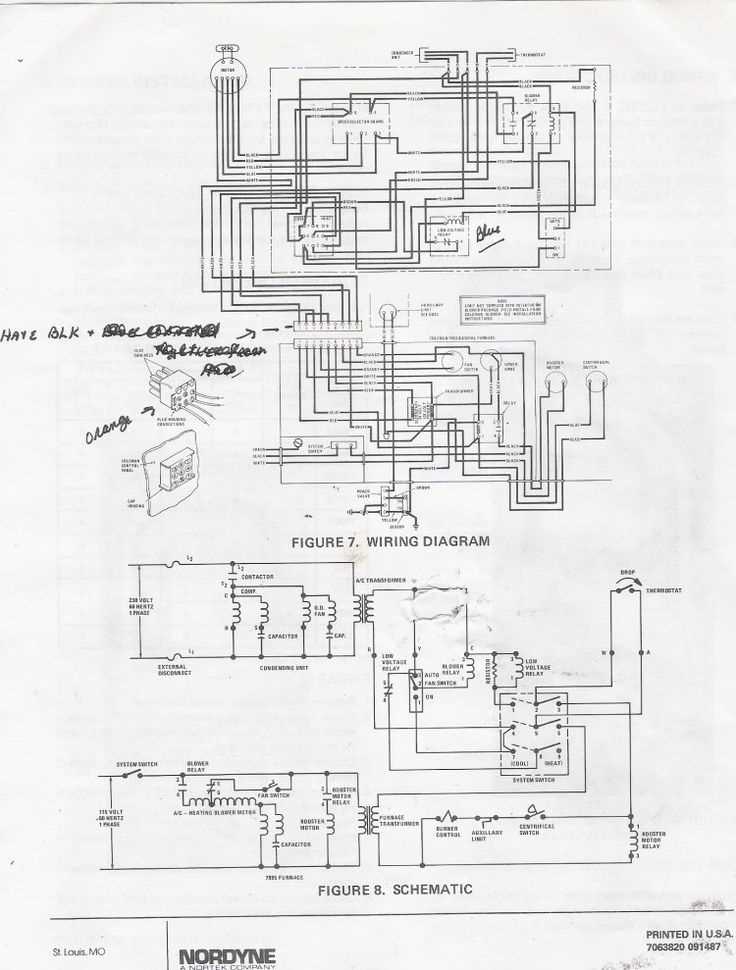
Connect the thermostat heat call lead from terminal W to the control board heat input terminal. When the thermostat closes the heat request contact, the control board receives 24-volt AC from the transformer through the R terminal and begins the heating sequence.
The ignition sequence usually starts with the inducer motor. After draft verification through the pressure switch, the control board powers the ignition module and opens the fuel valve. This sequence takes about 15–45 seconds depending on the model and ignition system type.
Thermostat and control board link
The thermostat cable normally carries five conductors connected to labeled terminals:
R – 24-volt supply from the transformer
W – heat request signal
G – indoor fan command
Y – outdoor cooling compressor control
C – common return path
The indoor air circulation motor connects to the control board through several speed taps. Heating mode commonly uses the medium or low speed lead, while cooling mode connects the high speed lead. Unused leads should be capped and secured to prevent electrical contact with the cabinet.
High-temperature limit switches and rollout protection devices sit in series with the heat control path. If heat exchanger temperature exceeds roughly 90–120°C, the limit switch opens and interrupts the burner control signal, stopping combustion until the unit cools and the switch resets.
Thermostat terminal connections R W Y G C in a gas furnace control circuit
Connect the thermostat cable to the control board using the standard R W Y G C terminal layout. These terminals carry low-voltage signals, typically 24 V AC, generated by a transformer inside the heating appliance.
Terminal functions
- R – 24-volt supply from the transformer
- W – heat call signal sent to the control board
- Y – outdoor compressor activation in cooling systems
- G – indoor air circulation motor command
- C – common return path completing the 24-volt control loop
Attach the red thermostat conductor to terminal R. When the thermostat requests heat, it connects R to W, sending voltage to the control board heat input. This signal starts the heating sequence including inducer motor startup, ignition activation, and fuel valve opening.
Terminal G controls the indoor air circulation motor. When the thermostat fan switch moves to ON, the thermostat links R to G and the control board activates the blower relay. In automatic mode, the control board engages the fan only after the heat exchanger reaches operating temperature.
The C terminal provides a continuous return path used by digital thermostats that require constant power. Without this connection many modern thermostats cannot power their display, internal processor, or wireless communication module.