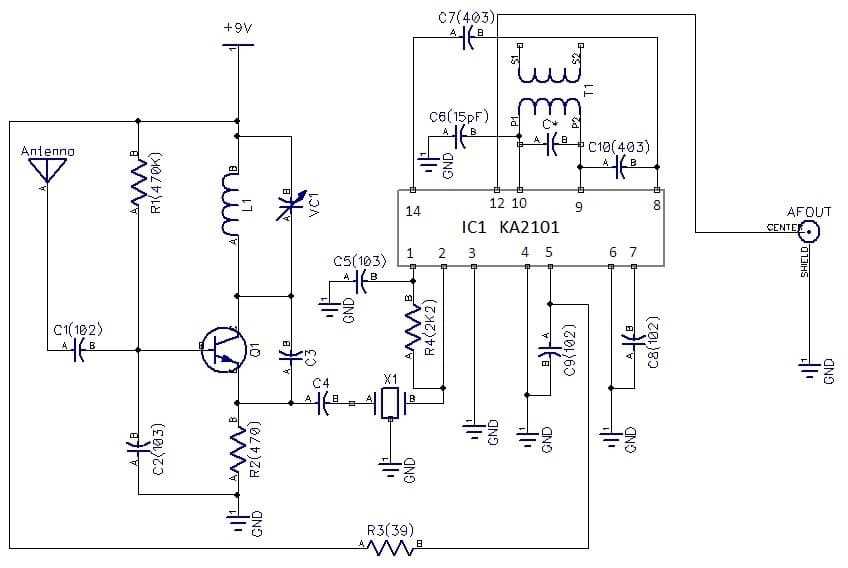
Use a high-Q inductor paired with a variable capacitor to achieve precise frequency selection in the 88–108 MHz band. This setup improves sensitivity, allowing weak transmissions to be captured without introducing unwanted noise.
A low-noise transistor configured as a preamplifier enhances signal clarity before processing, ensuring that modulation details remain intact. Positioning the transistor close to the antenna reduces signal loss caused by lead capacitance.
Integrate a discriminator stage to convert frequency variations into voltage fluctuations suitable for audio output. Choosing a ratio detector over a quadrature type provides better stability and lower harmonic distortion for stereo applications.
Couple a buffer amplifier between the detection stage and audio driver to prevent loading effects that can degrade fidelity. Using a complementary pair of transistors allows higher output without excessive power consumption.
Employ a simple LC tuning network for station selection, but include trimmer capacitors to fine-tune resonance. This combination ensures accurate alignment with the desired broadcast and minimizes interference from adjacent signals.
FM Signal Pickup Layout and Functional Guide
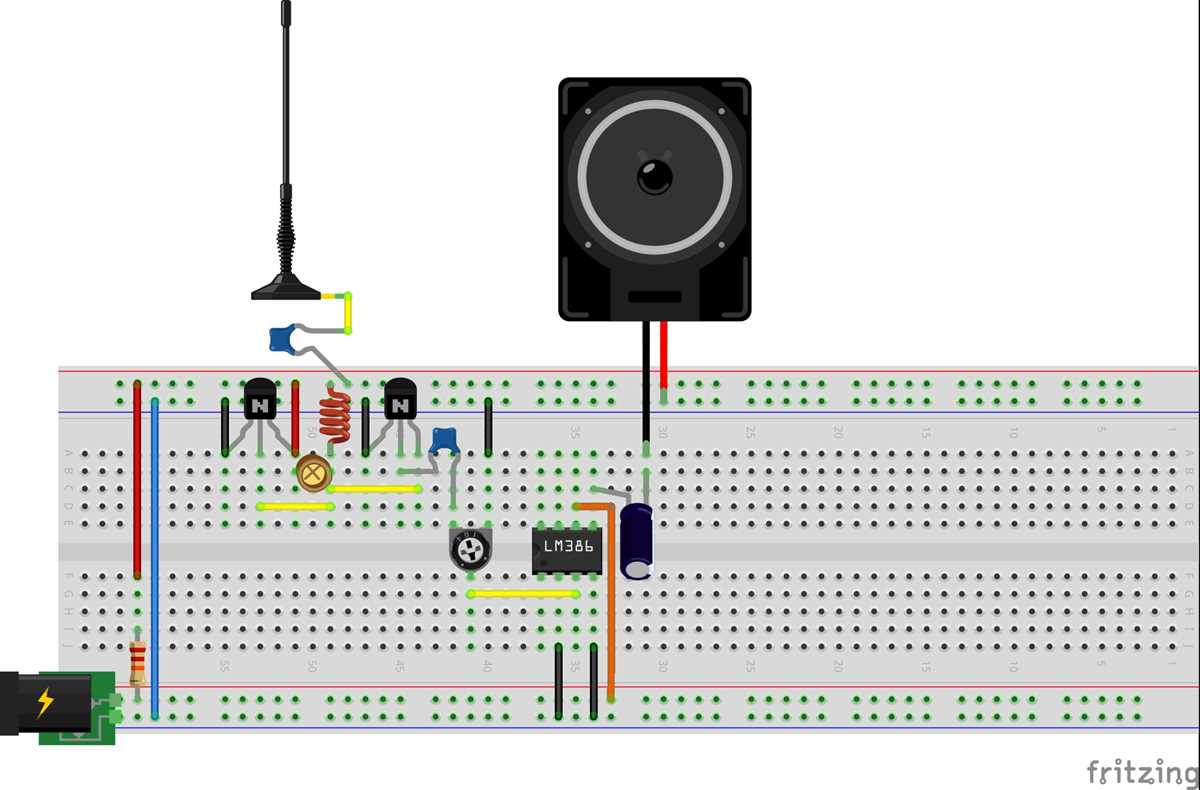
Use a high-gain antenna connected to a tuned LC section with a 10–100 pF variable capacitor for optimal signal capture between 88–108 MHz. Incorporate a low-noise transistor stage, such as a BC547, for initial amplification before feeding a ceramic discriminator that converts frequency shifts into voltage variations. Place a 10 kΩ resistor and 100 nF capacitor across the detector to smooth output and minimize distortion.
Feed the demodulated audio through a simple emitter-follower stage using a BC557 to drive an 8 Ω speaker. Add a 470 μF coupling capacitor to prevent DC from reaching the load. Fine-tune the LC network to adjust selectivity and signal clarity, ensuring minimal adjacent-channel interference. Proper grounding of the PCB and short leads for high-frequency paths significantly reduces unwanted noise and oscillations.
Designing the Tuning and Oscillator Section for FM Reception
Use a variable capacitor in series with a high-Q inductor to define the resonant frequency precisely between 88 MHz and 108 MHz. Ensure the inductor has at least 15 turns of 24 AWG wire on a 5 mm diameter ferrite core for optimal selectivity.
Stability of the local oscillator can be improved with a small parallel trimmer, around 2–5 pF, allowing fine adjustment without detuning neighboring signals. Avoid using low-quality ceramic capacitors, as their temperature coefficient can shift the frequency noticeably during operation.
Oscillator Configuration Options
- Colpitts design: Use two capacitors forming a voltage divider with the inductor. It provides low phase noise and minimal drift.
- Hartley approach: Employ a tapped inductor with a single capacitor. This setup allows easier frequency sweeping but may require buffer amplification to prevent loading.
- Clapp variant: Insert a series capacitor to the inductor for extended frequency stability, especially in high-temperature environments.
Shield the oscillator section with a grounded metal enclosure to reduce stray coupling. Keep the leads short and avoid routing audio wiring nearby, which can induce unwanted modulation or oscillations.
Check the tuning range with a frequency counter or an FM signal generator. Adjust the trimmer and variable capacitor until the oscillator covers the entire FM band smoothly, without dead spots or jumps in frequency. Use a buffer stage if the oscillator directly drives a mixer to maintain consistent amplitude across the band.