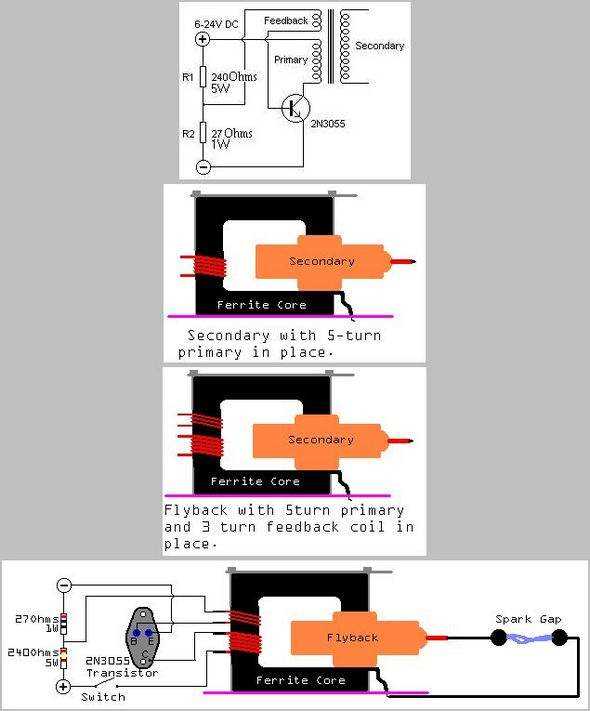
Use a single switching stage with an energy-storage magnetic coil and a rectifying output path when designing an isolated pulse power supply. This configuration stores magnetic energy while the transistor conducts and releases it to the secondary winding once the switch turns off. Such architecture appears in many AC-DC adapters delivering 5–24 V at power levels from 5 W to about 150 W.
The magnetic component inside this topology works as both an inductor and an isolation element. During the transistor conduction phase, current rises linearly through the primary winding and builds a magnetic field in the ferrite core. When the switch stops conducting, the polarity of the secondary winding reverses and the stored energy moves through a fast recovery diode into the output capacitor. This transfer method allows voltage conversion and galvanic isolation within a compact power stage.
A typical implementation includes a power MOSFET or bipolar transistor, a ferrite-core coil with two or more windings, a high-speed rectifier, and an electrolytic or low-ESR capacitor at the output. Switching frequency usually ranges from 20 kHz to 200 kHz. Higher frequency reduces magnetic size but increases switching loss, so designers select a value that balances heat generation, core saturation limits, and electromagnetic noise.
Stable output voltage requires feedback control. Many power supplies use an auxiliary winding combined with an optocoupler and a PWM controller. This arrangement samples the output level and adjusts the switching duty cycle. With correct winding ratio selection, such a power stage can step down 325 V DC from a rectified mains input to low-voltage rails used in chargers, LED drivers, and standby power units.
Flyback Transformer Circuit Diagram With Component Roles and Energy Transfer Cycle
Use a switching transistor that can handle peak current at least 2–3 times higher than the average primary current. In this power stage, energy first accumulates in the magnetic core and then moves to the output side after the transistor stops conducting. The switching element–often a MOSFET rated for 600–900 V in mains-powered supplies–controls how long current flows through the primary winding. A PWM controller sets the duty cycle, typically between 30% and 50% at switching frequencies from 40 kHz to 130 kHz.
Roles of the main elements
- Primary winding – stores magnetic energy while the switching device conducts.
- Power MOSFET or bipolar transistor – opens and closes the current path according to the PWM signal.
- Secondary winding – receives stored magnetic energy after the switch turns off.
- Fast rectifier diode – allows current flow toward the output capacitor while blocking reverse conduction.
- Output capacitor – smooths pulsating current and maintains a stable DC level.
- Snubber network – limits voltage spikes caused by leakage inductance.
During the conduction interval, input voltage drives current through the primary coil and builds magnetic flux inside the ferrite core. Current increases almost linearly, often reaching several amperes in compact power adapters. Once the transistor switches off, magnetic polarity reverses across the secondary winding. The rectifier becomes forward biased, allowing stored energy to move into the output capacitor and load. Output voltage level depends on the turns ratio between windings and the switching duty cycle.
Energy transfer cycle sequence
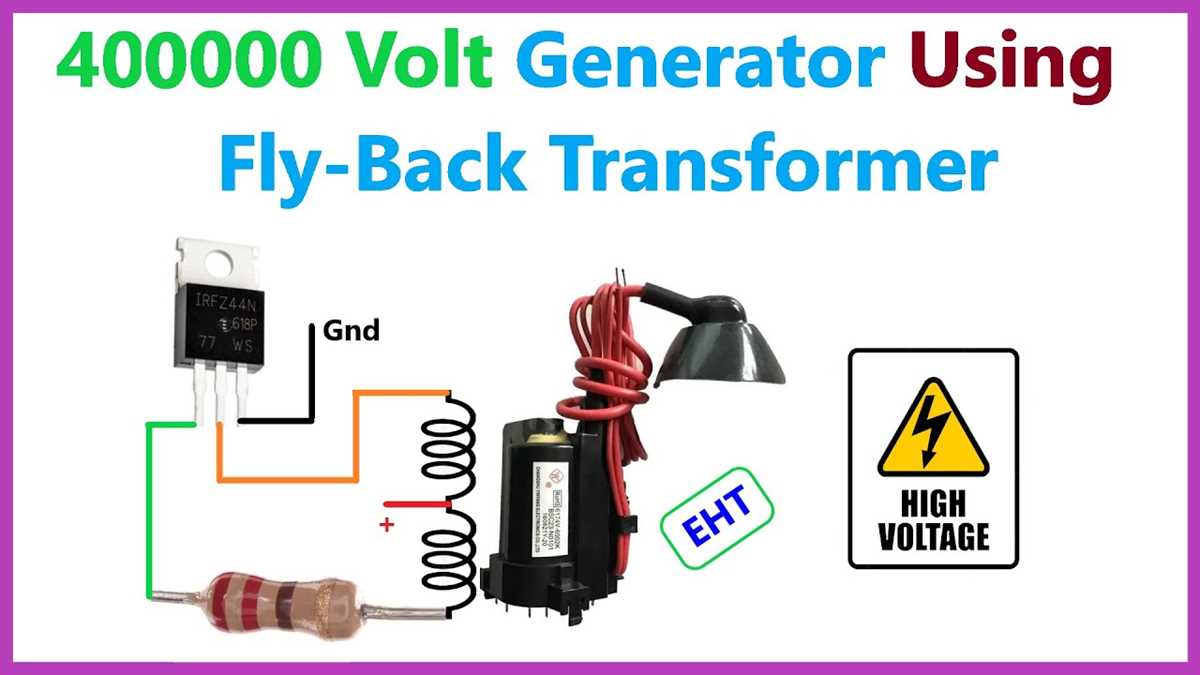
- Switch turns on and current rises through the primary coil.
- Magnetic field accumulates energy in the ferrite core.
- Switch turns off and the magnetic field collapses.
- Voltage polarity reverses across the secondary winding.
- Rectifier conducts and energy flows into the output filter capacitor.
- The cycle repeats thousands of times per second.
For stable operation, designers limit core flux density to about 0.2–0.3 tesla in ferrite materials such as N87 or PC40. Exceeding this range drives the core toward saturation, which increases current sharply and may damage the switching device. Proper turns ratio, peak current sensing, and a clamp network maintain safe operation across load and input voltage variations.
Identification of Primary Switch Secondary Diode and Output Capacitor in a Flyback Circuit
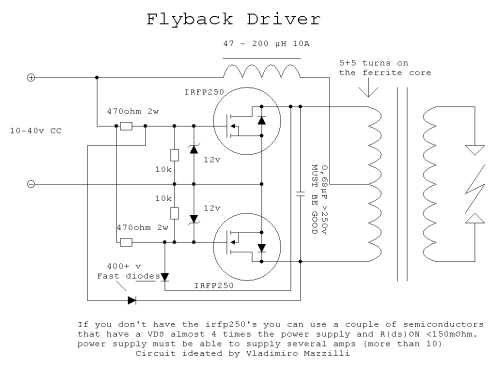
Locate the power switching device first; it connects directly to the primary winding of the magnetic coil and usually sits near the PWM controller. In mains-powered supplies this component is commonly a MOSFET rated for 600–900 V. Its drain connects to the primary winding, while the source links to current sensing or ground reference. The gate receives a pulse signal that determines conduction time, typically within a switching range of 50–120 kHz.
The secondary rectifier appears on the isolated output side and connects to the secondary winding. Its orientation shows the energy flow direction: the anode links to the winding, while the cathode points toward the output filter capacitor. Designers choose fast or ultrafast rectifiers with reverse recovery times below 50–75 ns. For low-voltage outputs such as 5 V or 12 V, Schottky devices rated between 30 V and 100 V reduce switching loss and heat.
Visual identification clues
Several layout patterns help identify these components quickly. The switching element usually attaches to a heatsink or large copper area because it handles peak current and switching stress. The rectifier often sits close to the output filter capacitor and secondary winding pins. PCB traces between these parts remain short to reduce stray inductance and voltage spikes during the energy release phase.
The output capacitor sits immediately after the rectifier and stabilizes the DC rail delivered to the load. Values typically range from 220 µF to 2200 µF depending on output current and ripple limits. Low-ESR electrolytic or polymer capacitors reduce voltage ripple generated by pulsed energy delivery from the magnetic stage. Designers often place a small ceramic capacitor in parallel, usually 0.1–1 µF, to filter high-frequency noise produced during rapid switching transitions.