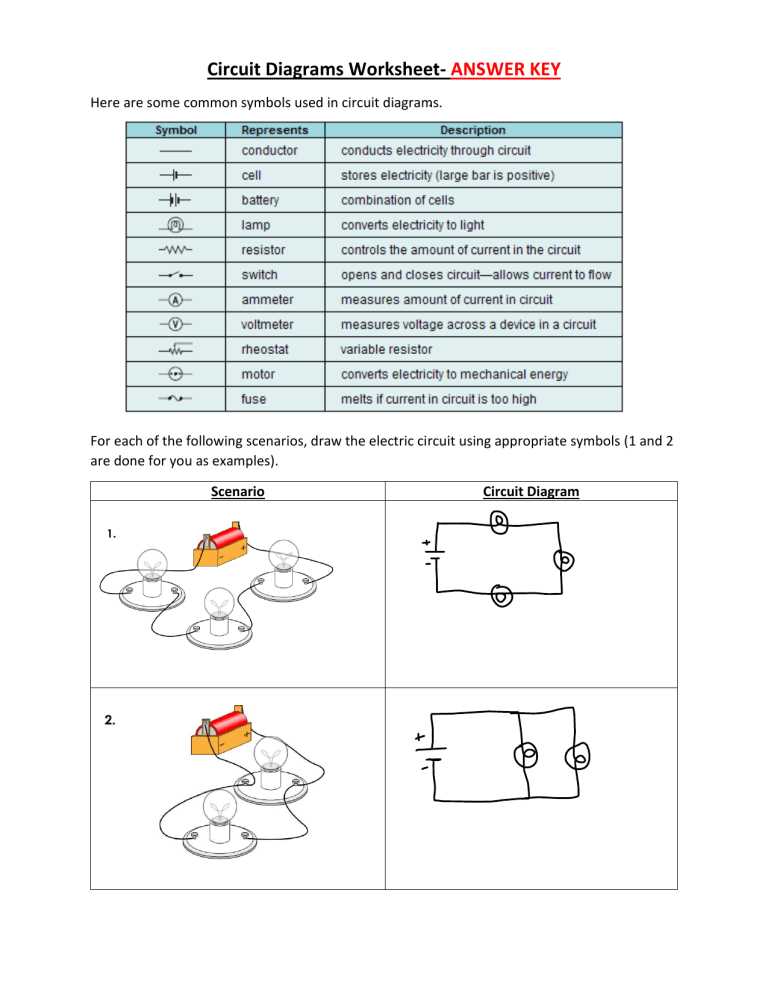
Start by mastering the symbols for electronic components. Clear recognition of resistors, capacitors, and transistors is fundamental for any schematic design. It’s important to know how each symbol reflects its function within the system.
Next, focus on the correct way to position components and connect them. Use straight lines for connections, ensuring no overlaps or ambiguity. Neatness makes it easier to spot mistakes and troubleshoot later.
Finally, always label each part clearly. Mark voltage sources, ground points, and any special conditions like polarized components. Accurate labeling helps both in assembling the physical circuit and when troubleshooting any issues that may arise.
Circuit Diagram Practice
Begin by ensuring you understand the different symbols used for components. Each symbol represents a specific element, such as a resistor or a power source. Recognizing these symbols is key to accurate designs. For example, a resistor is often depicted as a zigzag line, while a capacitor may appear as two parallel lines. Consistent use of these symbols helps avoid confusion.
Use a grid or paper with precise measurement for more controlled drawings. This step allows you to maintain symmetry and avoid overlaps, which can lead to mistakes. Proper spacing between elements makes the entire layout more readable and easier to follow when building the system.
Next, focus on the connections. Lines should be drawn clearly and without unnecessary intersections. When creating paths, use straight lines and avoid curved or angled ones, as they can make the design harder to interpret. Also, avoid using too many lines in close proximity to one another. Each path should have a clear start and end point.
Double-check the polarity of components. Pay attention to the orientation of diodes and electrolytic capacitors, as connecting them the wrong way can cause malfunctions or even damage the circuit. Using clear markings for positive and negative terminals is crucial, especially in complex systems with multiple components.
When placing power sources, make sure to indicate both the voltage and current type (AC or DC). Specify these details clearly to prevent confusion. For instance, label a 12V DC power supply with its correct polarity, making it easy for anyone reviewing the system to understand its requirements.
Proper labeling of each component is another critical step. Label resistors with their resistance value, capacitors with their capacitance, and transistors with their type. This detail helps when assembling or troubleshooting the system later. Clear labels reduce errors, ensuring the designer can easily reference parts and understand their function.
Check for design errors regularly. Ensure there are no short circuits or unintentional connections between unrelated components. Always test the design in smaller sections, verifying that each part functions before moving on to the next. This methodical approach can help spot issues early.
Lastly, review the overall layout for clarity and consistency. Avoid overcrowding any section of the layout. The design should flow logically, with components placed in a way that reflects their role in the system. A clean, well-organized layout will make future modifications easier and more efficient.
Understanding Common Circuit Symbols and Their Usage
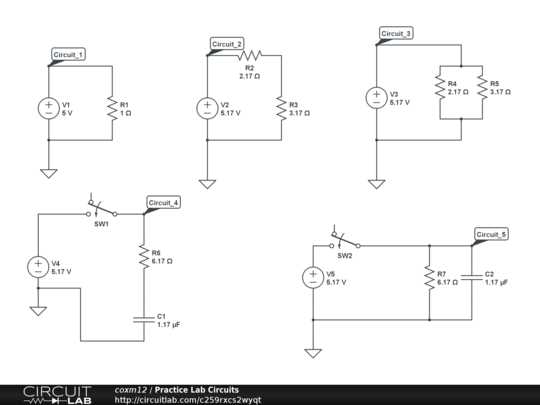
Begin by mastering the symbol for a resistor. A resistor is typically represented by a zigzag line, indicating resistance in the flow of current. In more complex designs, it’s important to label the resistor with its value, such as 220Ω, so others can easily identify the component’s specifications.
The symbol for a capacitor looks like two parallel lines with a small gap between them. This component stores electrical energy. In designs, you’ll often see different types of capacitors indicated by specific symbols – for example, an electrolytic capacitor will have a curved line on one side, distinguishing it from a non-polarized one.
For diodes, the symbol typically features a triangle pointing toward a line. This represents the direction of current flow. An important note: diodes only allow current to pass in one direction, so knowing their orientation in a system is critical to the design’s functionality.
Another important symbol to recognize is the transistor. It can be depicted in two common forms: NPN and PNP. The NPN transistor has an arrow pointing out of the base, while the PNP type points toward the base. Understanding how these components work and their role in amplification is key to using them correctly in designs.
Finally, ensure you are familiar with power sources. A simple battery symbol, often drawn as two short parallel lines (one longer than the other), indicates the power supply in a design. For AC power, a sine wave symbol is used to represent alternating current. Accurate labeling of power sources, including voltage and polarity, prevents confusion during both design and construction.