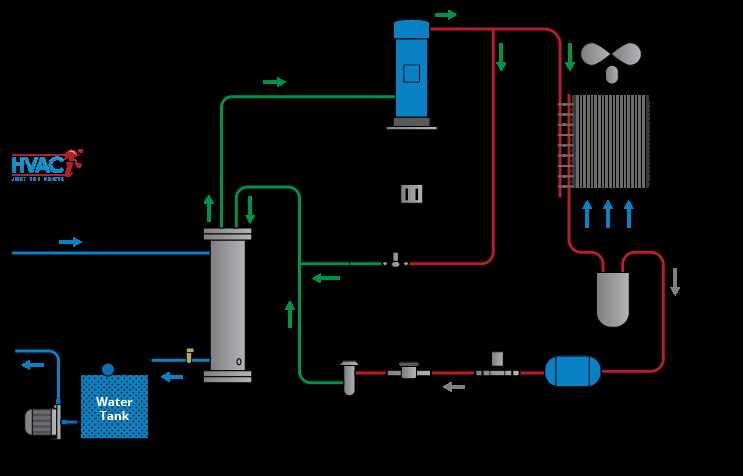
Specify the flow path before selecting hardware: a liquid cooling unit should route coolant from the heat exchanger through the compressor assembly, then toward the condenser block and back via the expansion device, keeping pressure drops under 30–50 kPa per section. Clear identification of each assembly on the layout reduces commissioning time and prevents mismatched pipe diameters that cause cavitation.
The compressor assembly raises refrigerant pressure from roughly 200–300 kPa at the suction side to 1,200–1,800 kPa at discharge, depending on refrigerant type. Pair it with vibration isolators and oil separators rated for the same pressure class. The condenser block then rejects heat to air or water; fin density near 12–16 FPI suits air-cooled setups, while water-cooled shells benefit from velocities of 1.5–2.5 m/s to limit fouling.
Metering accuracy hinges on the expansion device. Electronic valves maintain superheat within ±1 K, outperforming thermostatic options under variable loads. Downstream, the evaporator bundle absorbs thermal energy; plate designs handle tight approach temperatures of 2–3 K, whereas shell-and-tube variants tolerate higher fouling factors.
Ancillary elements anchor reliability: flow sensors set alarms below 80% nominal rate, pressure transducers track suction and discharge trends, and control modules coordinate staging. Label these items on the schematic with service clearances and isolation points to simplify maintenance without system shutdown.
Chiller Diagram Parts
Verify the refrigerant circuit first: trace the flow from the compression stage to the heat rejection zone and then to the expansion device, because pressure drops outside nominal ranges signal mis-sizing or fouling.
The compressor assembly raises vapor pressure and temperature; scroll and screw variants favor stable load control, while centrifugal machines demand precise inlet guide vane calibration to prevent surge.
The condenser section transfers heat to air or water; copper tubes with aluminum fins suit air-cooled layouts, whereas shell-and-tube exchangers with removable bundles simplify mechanical cleaning in water-cooled setups.
The metering device regulates mass flow; thermostatic valves react to superheat changes, while electronic valves provide tighter modulation under variable load profiles and low ambient conditions.
The evaporator vessel absorbs thermal energy from the process loop; flooded shells deliver uniform heat pickup for large capacities, and brazed plate exchangers reduce footprint with higher approach sensitivity.
Circulation pumps maintain stable flow through the process loop; select variable-speed drives to match demand, target 8–12 ft/s velocity in piping to limit erosion and noise.
Control sensors monitor temperature, pressure, and flow; place leaving-fluid probes within 2 pipe diameters of the outlet to reduce stratification error and improve control stability.
Safety devices include high-pressure cutouts, freeze stats, and relief valves; set cutout thresholds 10–15% above normal operating pressure and test interlocks during commissioning cycles.
Insulation and isolation hardware reduce thermal gain and vibration transfer; closed-cell elastomeric insulation with sealed joints prevents condensation, while spring isolators tuned to operating frequency limit structural transmission.
Compressor Section: Identification of Suction Line, Discharge Line, and Motor Housing in Schematics
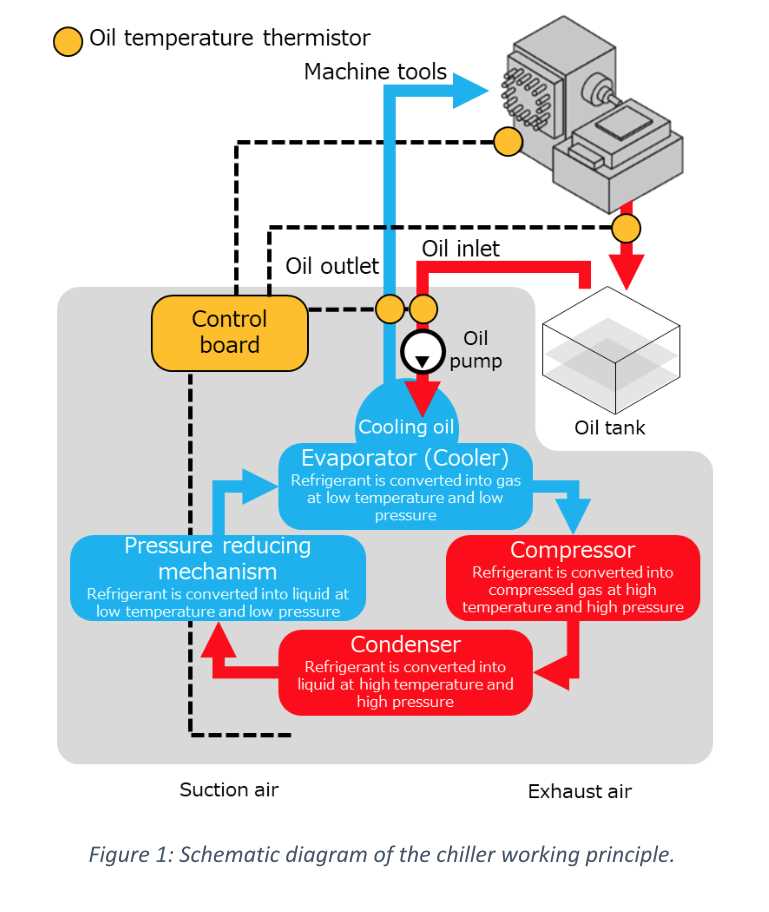
Identify the low-pressure vapor path by tracing the largest-diameter conduit entering the compressor casing from the heat exchanger side; this intake conduit is typically labeled with pressure values below evaporation conditions and marked by insulation symbols.
The discharge conduit exits the compression chamber with a reduced cross-section and leads toward the condenser block; on schematics it is paired with elevated pressure annotations, temperature rise indicators, and often a check valve symbol placed immediately downstream.
Differentiate the suction conduit from auxiliary return paths by verifying flow direction arrows pointing toward the compression element and by the absence of oil injection branches near the entry point.
Locate the motor housing as a concentric enclosure surrounding or adjacent to the compression chamber; electrical terminals, winding identifiers, and thermal protector icons confirm this zone on technical drawings.
When dealing with hermetic or semi-hermetic assemblies, the motor compartment shares the same enclosure as the compression mechanism; schematics depict this with a single boundary line and internal partition marks.
For open-drive configurations, the motor housing appears as a separate block connected via a shaft coupling; alignment symbols and bearing references distinguish it from fluid-carrying conduits.
Cross-check pressure sensor placements: sensors tied to the intake conduit validate suction identification, while those positioned after the compression outlet verify the discharge path.
Use line weight conventions as a final check–primary refrigerant conduits are drawn thicker than control or lubrication paths, while the motor enclosure outline remains uniform and unbroken.
Evaporator Assembly: Refrigerant Flow Path, Water Inlet/Outlet, and Heat Transfer Surfaces
Set the refrigerant entry at the lowest pressure zone of the vessel and route it through evenly distributed channels to prevent localized boiling and oil trapping.
The refrigerant flow path should progress from the expansion device into the shell side, spreading across the tube bundle via baffles that regulate velocity between 0.5–1.5 m/s, limiting erosion while sustaining uniform phase change.
Maintain counterflow between the refrigerant and the circulating liquid: the water inlet must align with the region of highest refrigerant superheat, while the outlet exits near the saturated vapor zone, tightening the temperature approach to 1–2 K.
Position water nozzles tangentially to reduce dead zones and scale adhesion; target liquid velocities of 1.0–2.4 m/s inside tubes to curb fouling without inducing vibration.
Heat transfer surfaces perform best with enhanced copper or stainless steel tubes featuring internal rifling or microfins, increasing surface area by 30–60% compared with smooth bores.
Apply tube wall thickness based on pressure class and corrosion allowance; 0.7–1.2 mm suits most comfort cooling duties, while industrial fluids may demand heavier gauges.
Segmented baffles with 20–25% cut guide refrigerant distribution and suppress bypassing, keeping shell-side pressure drop below 30 kPa.
Integrate vent and drain ports at high and low points to purge non-condensables and evacuate residual liquid during service, preserving stable heat exchange over extended operation.
Control and Protection Elements: Sensors, Valves, and Interlock Connections Shown in Schematics
Specify sensor placement directly on suction and discharge lines to capture real operating values rather than averaged data from headers.
Measurement devices displayed in system schematics should be selected by signal type and accuracy class:
- Temperature probes with ±0.2 °C tolerance for leaving and entering fluid lines.
- Pressure transmitters rated for 1.5× maximum working pressure on refrigerant circuits.
- Flow switches calibrated to trip at 70–80 % of nominal circulation.
Isolation and modulation hardware must be shown with clear actuation logic to avoid ambiguous service states.
- Motorized shut-off units tied to fault logic for compressor protection.
- Solenoid-controlled bypass units sized for 30–40 % of nominal flow.
- Pressure-regulating units installed upstream of heat exchangers to stabilize load response.
Interlock connections illustrated in control drawings should define hard stops between mechanical and electrical subsystems.
- Low-pressure cutouts wired in series with motor starters.
- Freeze protection contacts linked to pump operation feedback.
- High-temperature alarms configured to disable capacity steps rather than full shutdown.
Use distinct line symbols and reference tags for each interlock path so commissioning teams can trace cause-and-effect chains without field testing.
Group sensors, valves, and interlocks by function on the schematic view, not by physical proximity, to simplify fault isolation during operation.