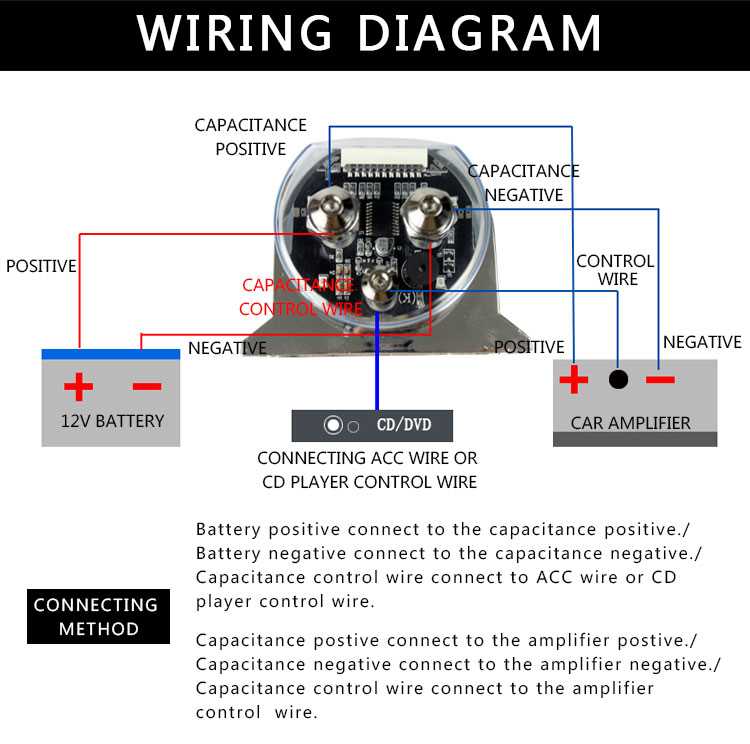
Install a storage module close to the amplifier to maintain consistent voltage during peak demand. Choose a unit rated for at least one farad per 1,000 watts of total system output to prevent dips that can distort sound or damage components.
Use thick gauge leads to minimize resistance and heat buildup. Connect the positive terminal to the battery through an inline fuse rated slightly higher than the module’s maximum current to ensure safety under sudden load spikes.
Mount the module on a flat, vibration-resistant surface to avoid loose connections. Secure terminals with lock washers and insulated connectors to reduce the risk of short circuits and maintain stable performance over time.
Verify polarity before energizing the system. Reversing connections can instantly damage both the storage unit and the amplifier. After installation, measure voltage across the terminals under load to confirm proper operation.
Step by Step Guide for Installing a Vehicle Power Storage Module
Disconnect the negative terminal of the main battery immediately to prevent sparks. Use insulated tools and confirm that all circuits are de-energized before handling high-current connections.
Select a mounting spot close to the amplifier but away from heat sources and moving components. Secure the module on a flat surface to minimize vibration and ensure stable operation under load.
Use appropriately sized leads for connections and install an inline fuse on the positive line rated slightly above the module’s peak current.
- Run the negative lead to a clean chassis ground point.
- Ensure terminals are tight and free from corrosion to maintain low resistance.
Double-check all polarity markings before energizing the system. Incorrect polarity can instantly damage both the storage unit and connected devices. Use torque-specified connectors and insulated tools for all attachments.
Charge the module gradually using a low current source before full operation. Monitor voltage under typical load to verify the unit maintains stable output and prevents sudden drops when the amplifier draws peak current.
Choosing the Correct Storage Module Size for Your System
Match the unit’s capacity to the amplifier’s peak current draw. A general guideline is 1 farad per 1,000 watts RMS of system power to prevent voltage drops during intense output peaks.
Consider the number of high-demand components connected. Multiple subwoofers or midrange drivers may require a larger unit to stabilize voltage and maintain clean signal delivery under load.
Check the vehicle’s alternator output and battery condition before selecting a module. Modules cannot compensate for a weak power supply, so upgrading the alternator or battery may be necessary for high-capacity systems.
Allow for future expansion when choosing size. Installing a slightly higher-capacity unit ensures the system can handle additional amplifiers or speakers without overloading the storage component.