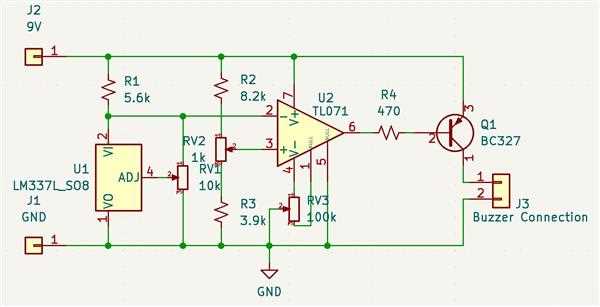
Use a regulated power supply to prevent voltage spikes that could damage the speaker or transistor stages. Ensure the source provides stable 5 to 12 volts depending on the module specifications and check polarity before connecting to prevent reverse current flow.
Position resistors and capacitors accurately to control current and smooth transitions. Use a 220-ohm resistor for the input trigger and 100nF capacitor for noise suppression. Correct placement reduces false triggers and maintains consistent sound output.
Verify transistor orientation and gain ratings for switching stages. NPN transistors like BC547 or equivalent work for low-current setups, while MOSFETs may be required for higher power loads. Confirm base resistor values to match input signal voltage for reliable activation.
Test the output with a multimeter or LED indicator before connecting to the speaker. Ensure the activation threshold matches the intended input signal and observe the module response for stability. Minor adjustments in resistor or capacitor values can fine-tune the timing and volume of the sound pulse.
Buzzer Alarm Wiring and Component Guide
Use a regulated 5 to 12-volt power source to prevent damage to switching elements and sound transducers. Verify polarity before connecting to avoid reverse current that could destroy semiconductors or capacitors.
Install resistors at the input trigger to control base current for transistors. For most low-power modules, a 220-ohm resistor ensures reliable switching without overheating. Adjust resistance for higher or lower input voltage to maintain safe operation.
Place decoupling capacitors near power pins to reduce voltage spikes and high-frequency noise. Typical values are 100nF ceramic across supply lines, which stabilizes the module during rapid switching events.
Check transistor orientation and ratings before soldering. NPN types like BC547 are suitable for standard 20mA loads, while MOSFETs may be required for loads exceeding 50mA. Confirm that the collector-emitter voltage rating exceeds the supply voltage.
Wire the speaker output correctly to avoid short circuits. Connect the positive terminal to the transistor collector or MOSFET drain and the negative to the ground rail. Add a flyback diode for inductive load suppression if the transducer is magnetic.
Label all connections and test each stage individually. Use a multimeter to confirm voltage at the trigger input, base, and collector points, ensuring that switching thresholds match the intended signal levels.
Use short, direct signal paths to minimize interference. Keep input, switching, and output lines separated, especially in high-gain sections, to prevent crosstalk and false activation.
Perform final testing under load to observe real operation. Monitor the module response for timing consistency and sound amplitude. Minor adjustments in resistor or capacitor values allow fine-tuning of pulse duration and volume for the connected transducer.
Identifying Key Components and Their Roles
Use standard NPN transistors like BC547 for low-current switching stages. Ensure the collector-emitter voltage rating exceeds the supply voltage, and the base resistor matches the input signal to prevent overdriving the transistor.
Install resistors to control current in both input and output paths. A 220-ohm resistor at the trigger input protects the transistor, while a 1k-ohm resistor in series with the transducer limits current and prevents thermal stress.
Capacitors act as stabilizers and filters. Place a 100nF ceramic near the supply pins to suppress high-frequency spikes, and a 10µF electrolytic at the power line helps maintain voltage stability during rapid switching events.
Select diodes for protection across inductive components. Use a standard 1N4148 for low-current suppression or 1N4007 for higher load inductive elements to prevent back EMF from damaging semiconductors.
Use connectors or headers for modular assembly to simplify replacement and testing. Label input, output, and power connections clearly, ensuring each component can be isolated and measured without disturbing the rest of the setup.
Choose the transducer according to load and voltage requirements. Magnetic types require flyback diodes, while piezo elements operate directly with high-frequency pulses. Confirm rated voltage and current to avoid distortion or failure.
Keep wires short and organized to reduce parasitic capacitance and crosstalk. Maintain separation between high-current and low-level trigger lines, and route power lines along a stable path to minimize interference.
Test each stage before final assembly using a multimeter and signal generator. Confirm voltage levels at the trigger, switching, and output points, ensuring each component performs within specification before connecting the transducer for full operation.