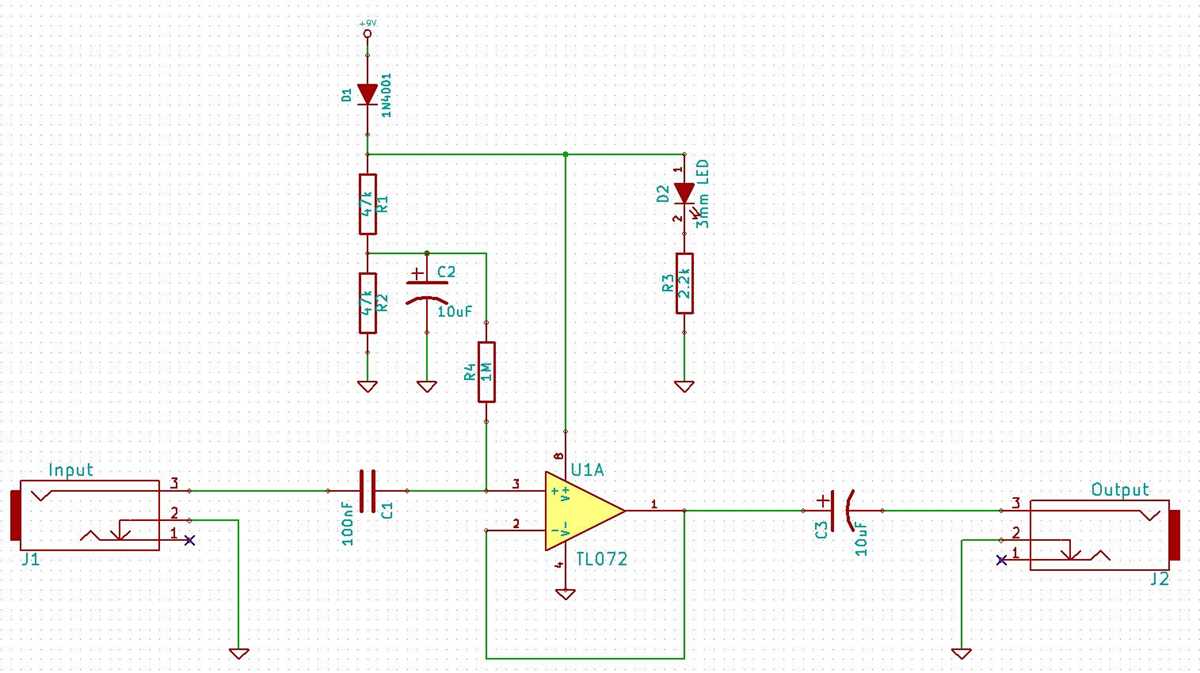
Connect the output of the operational amplifier directly to its inverting input. This unity-gain follower layout keeps voltage at the output nearly identical to the signal applied to the non-inverting input while allowing the device to drive heavier loads.
Use common integrated devices such as TL071, TL072, LM358, or NE5532. These components provide high input resistance, often above 1 MΩ, which prevents loading of sensors, guitar pickups, or high-impedance sources. The output stage can typically deliver 10–40 mA, enough to feed the next stage of an audio or measurement system.
Power the device from a ±12 V dual supply or a single 9–12 V source depending on the design. Place a 100 nF ceramic capacitor close to each supply pin and add a 10 µF electrolytic capacitor across the supply rails. These parts stabilize voltage and prevent oscillation during rapid signal changes.
Keep signal traces short and route the feedback path directly between the output pin and the inverting input. Long paths increase stray capacitance and may lead to high-frequency oscillation. For audio applications, a small resistor between 50 Ω and 100 Ω at the output pin can isolate capacitive loads such as long cables.
Buffer Op Amp Circuit Diagram With Unity Gain Configuration and Signal Path
Connect the output pin of the operational amplifier directly to the inverting input. This feedback path sets voltage gain to 1, meaning the output follows the input voltage with minimal difference while the device provides higher current capability.
Feed the signal into the non-inverting input through a short trace or shielded wire. Typical input resistance of devices such as TL071, TL072, NE5532, or LM358 exceeds 1 MΩ, which prevents loading of high-impedance sources like guitar pickups, piezo sensors, or measurement probes.
Arrange the signal path in a simple sequence so each stage is easy to read on the schematic drawing.
- Input signal enters the non-inverting terminal
- Output pin connects straight back to the inverting terminal
- Power supply pins link to positive and negative rails
- Output node drives the next stage or external load
This configuration keeps voltage unchanged while improving current drive and isolation between stages.
Typical supply arrangement
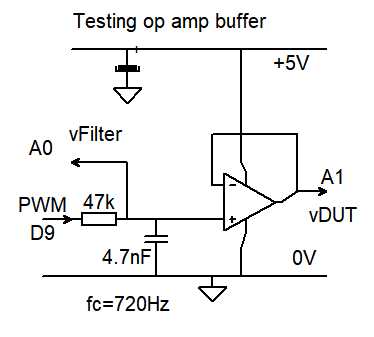
Operate the integrated device from ±12 V or ±15 V rails for audio equipment. Portable designs often run from a single 9 V battery. With a single supply, create a midpoint reference around 4.5 V using two equal resistors such as 100 kΩ and 100 kΩ. The input signal is then biased around that midpoint.
Place supply decoupling components close to the device pins.
- 100 nF ceramic capacitor between each supply pin and ground
- 10 µF electrolytic capacitor across supply rails
- Short traces between capacitors and device pins
These parts reduce oscillation and noise during fast signal transitions.
Output stage layout
Insert a small resistor between 50 Ω and 100 Ω at the output if the stage drives long cables or capacitive loads. This resistor prevents high-frequency instability caused by cable capacitance. Keep the feedback trace short and routed away from high-current paths to maintain stable operation.
Connecting an operational amplifier as a unity gain voltage follower
Link the output terminal directly to the inverting input. This feedback connection forces the device to adjust its output until both input pins reach nearly the same voltage, producing a gain of 1.
Apply the incoming signal to the non-inverting input through a short trace or shielded conductor. Devices such as TL071, TL072, NE5532, or LM358 present input resistance often above 1 MΩ, which keeps sensors, pickups, and measurement probes from being loaded.
Use a stable supply configuration. Audio and measurement equipment often runs from ±12 V or ±15 V rails. Portable designs operate from a single 9–12 V source, where a midpoint reference around 4.5–6 V is created with two equal resistors such as 100 kΩ.
Place decoupling capacitors close to the supply pins. A 100 nF ceramic capacitor between each rail and ground reduces high-frequency noise, while a 10 µF electrolytic capacitor stabilizes slower voltage changes.
Keep the feedback trace between the output and the inverting input extremely short. Longer paths add stray capacitance and may cause high-frequency oscillation in fast devices such as OPA2134 or AD8066.
Add a small output resistor between 50 Ω and 100 Ω when the stage drives long cables or capacitive loads. This resistor isolates the output stage from cable capacitance and maintains stable operation.
Check output swing limits. With a ±12 V supply many devices deliver about ±10 V peak before clipping, while single-supply units may reach within 1–2 V of the rails depending on the model.
Verify operation using a signal generator and oscilloscope. Apply a sine wave around 100 mV to 1 V at frequencies between 100 Hz and 10 kHz. The output trace should match the input shape and amplitude with minimal delay.