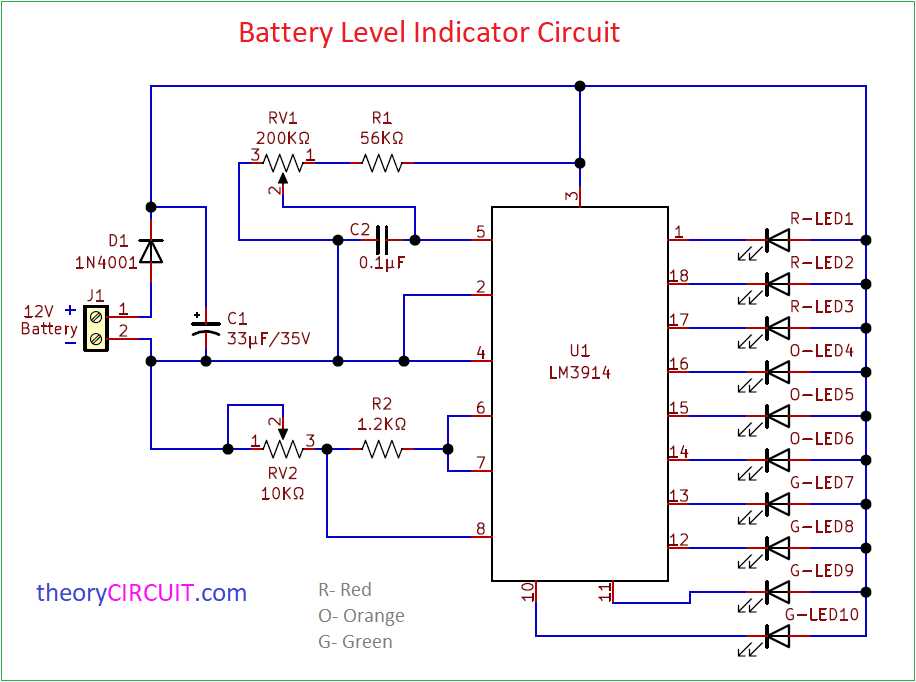
Connect a voltage monitoring module across the power source terminals so the device continuously measures output voltage. A simple build often uses an LM3914 driver chip paired with ten LEDs that represent charge condition from low to full. The chip converts analog voltage into a sequential LED display.
Set the measurement range by adjusting two reference resistors attached to the driver IC. For a typical 12V lead acid unit, configure the lower reference near 10.5V and the upper reference close to 12.6V. When voltage rises through this range, LEDs illuminate step by step along the display bar.
The measurement network normally includes a resistor divider placed between the power source and the IC input. This divider scales the voltage so it fits the chip’s input range. For example, a 10kΩ and 2.2kΩ resistor pair can reduce higher supply voltage to a safe sensing value.
Place LEDs in a straight row or bar arrangement on a small board panel. Each LED corresponds to a voltage step determined by the internal comparator array of the LM3914. As voltage increases, more LEDs illuminate, giving a visual representation of stored charge remaining in the power source.
Battery Level Indicator Circuit Diagram with LED Scale and Voltage Monitoring Layout
Connect the sensing input directly across the power source terminals and route the signal through a resistor divider network before it reaches the monitoring IC. This divider reduces the measured voltage so the chip input remains within a safe operating range. A common configuration uses 10kΩ and 2.2kΩ resistors which scale a 15V maximum source down to roughly 2.7V at the sensing pin.
Use an LM3914 LED driver to convert analog voltage into a visual LED bar. The chip contains ten comparators that activate LEDs sequentially as voltage rises. Each LED corresponds to a defined voltage step determined by the internal reference and external resistor values.
Mount LEDs in a straight horizontal row so each light represents a step of stored energy remaining in the power unit. A typical arrangement assigns the first LED to about 10.5V and the last LED near 12.6V for a 12-volt lead acid pack. When voltage increases across this range, the display gradually fills from left to right.
Adjust the measurement window using two resistors attached to the reference pins of the driver IC. One resistor defines the lower threshold while the second sets the upper limit. For example, pairing 1.2kΩ and 12kΩ resistors produces a span suitable for small 12-volt storage packs used in vehicles or backup power modules.
Place a 0.1µF ceramic capacitor close to the IC supply pin. This small component filters high-frequency noise from the power rail and stabilizes LED transitions so lights switch cleanly rather than flickering when voltage fluctuates slightly.
Arrange the layout so the sensing divider sits near the input pin and LED lines run parallel along the board edge. Short traces reduce noise pickup and simplify assembly, while a single ground plane linking LEDs, driver chip, and power return improves measurement stability across the entire monitoring module.
Battery Level Indicator Circuit Using LM3914 LED Driver and Resistor Network Connections
Connect the LM3914 LED driver input pin to the monitored power source through a resistor divider so the sensed voltage falls within the IC input range of roughly 0–5V. A practical divider uses 12kΩ and 2.7kΩ resistors, which scale a 0–15V supply to about 0–3V at the signal pin. This allows the internal comparator array to activate LEDs sequentially as voltage rises across the measurement span.
Set the display thresholds by configuring the reference pins of the LM3914 with two resistors connected between the reference output and ground. A common setup places 1.2kΩ between REF OUT and REF ADJ and 10kΩ from REF ADJ to ground. This network defines the LED current and establishes the upper voltage boundary of the LED bar display. Each LED then corresponds to a fixed voltage increment across the monitored source.
Route LED outputs from pins 1–10 of the LM3914 to individual light emitters arranged in a straight bar. Use series resistors only when higher brightness control is required, since the IC already regulates current internally. Keep the sensing divider close to the input pin and place a 0.1µF bypass capacitor near the supply pin to stabilize operation and reduce fluctuations caused by noise on the power line.