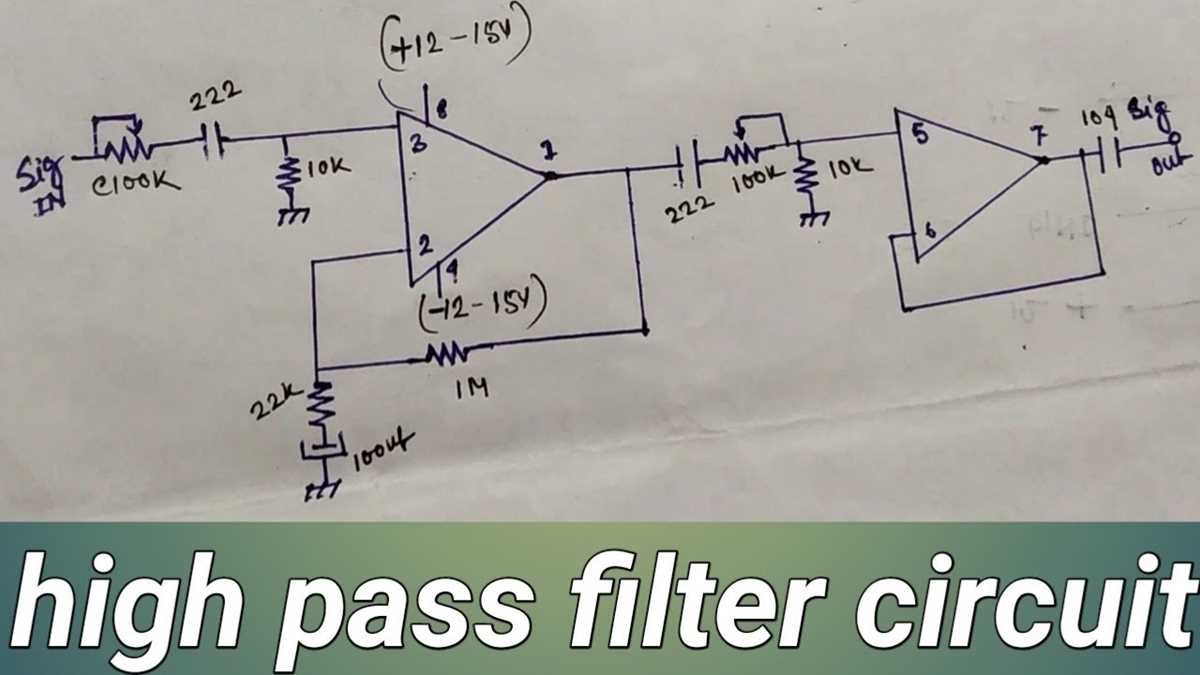
Use a 10kΩ resistor with a 0.1µF capacitor for low frequency suppression to achieve a cutoff around 160 Hz. This combination reduces unwanted bass signals while maintaining clarity in midrange tones.
For high frequency attenuation, pair a 1kΩ resistor with a 0.01µF capacitor. This setup allows frequencies above approximately 16 kHz to be softened, preventing harshness in headphone or speaker output without affecting the primary tonal range.
When constructing band-limiting modules, combine series and parallel networks using values such as 4.7kΩ and 0.047µF to center the passband near 1 kHz. Adjusting resistor ratios fine-tunes the bandwidth, allowing precise control over midrange emphasis.
Always verify connections with a multimeter before powering the system to avoid component stress. Using prototyping boards with labeled traces simplifies troubleshooting and ensures consistent performance across repeated assemblies.
Integrating these elements with operational amplifiers enhances gain control and reduces signal distortion. Employing TL072 or LM358 chips provides low noise levels while keeping design compact for desktop or portable setups.
Designing Low Pass Audio Filter Circuits
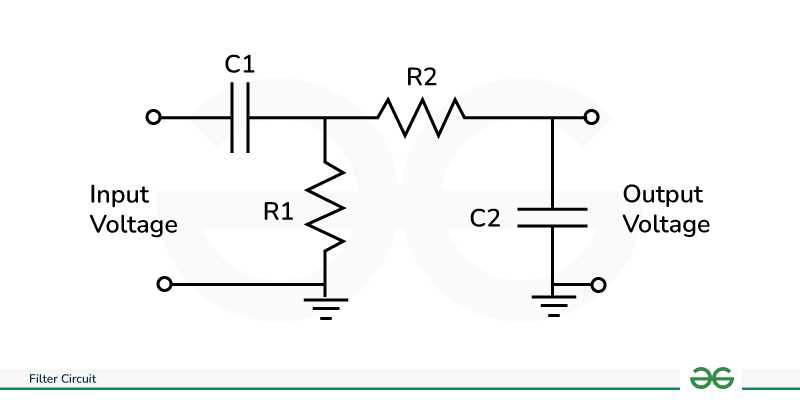
Start with a 10kΩ resistor and 0.01µF capacitor to achieve a cutoff near 1.6 kHz for smooth high-frequency reduction. Connecting the resistor in series with the signal and the capacitor to ground ensures effective attenuation above the target range.
For sharper roll-off, consider using a second stage identical to the first, creating a two-pole topology. This doubles the slope to 12 dB per octave, which is useful when preventing harsh treble in headphones or small speakers.
When placing components on a breadboard, maintain short lead lengths to reduce parasitic capacitance. Excessive wire loops can shift the cutoff frequency and introduce unintended peaks.
Incorporating an operational amplifier like TL072 allows for active control over gain while maintaining the low pass function. Buffering the signal between stages prevents loading effects from resistive and capacitive elements.
Adjusting capacitor values between 0.01µF and 0.047µF shifts the cutoff range from 1.6 kHz down to 340 Hz, which is useful for applications that require deeper bass preservation without affecting the midrange clarity.
Finally, measure the response with a signal generator and oscilloscope to confirm the attenuation slope. Small tweaks in resistor or capacitor values can fine-tune the cutoff precisely to match system requirements.
Constructing High Pass Audio Filter Circuits
Use a 1kΩ resistor with a 0.01µF capacitor to create a cutoff near 16 kHz for high-frequency emphasis. Connect the capacitor in series with the input and the resistor to ground to allow low frequencies to be attenuated efficiently.
For steeper attenuation, implement a two-stage design with identical values. This produces a slope of 12 dB per octave, making the transition between suppressed and passed frequencies more distinct.
- Place resistors and capacitors as close together as possible to minimize stray inductance.
- Use an op-amp like LM358 for buffering to prevent signal loading.
- Measure the response with a signal generator to verify the cutoff.
- Adjust capacitor values from 0.01µF to 0.047µF to shift the threshold between 16 kHz and 3.4 kHz.
When combining multiple stages, ensure each stage is decoupled to maintain stable gain and prevent oscillations. Small variations in resistor ratios allow fine-tuning of the high-frequency range without affecting lower bands.
- Start with series capacitor and grounding resistor.
- Add second stage identical to the first for sharper roll-off.
- Buffer output with op-amp to maintain consistent amplitude.
- Check frequency response and adjust component values as needed.
- Finalize layout with short connections to reduce parasitic effects.
Building Band Pass Audio Filter Circuits
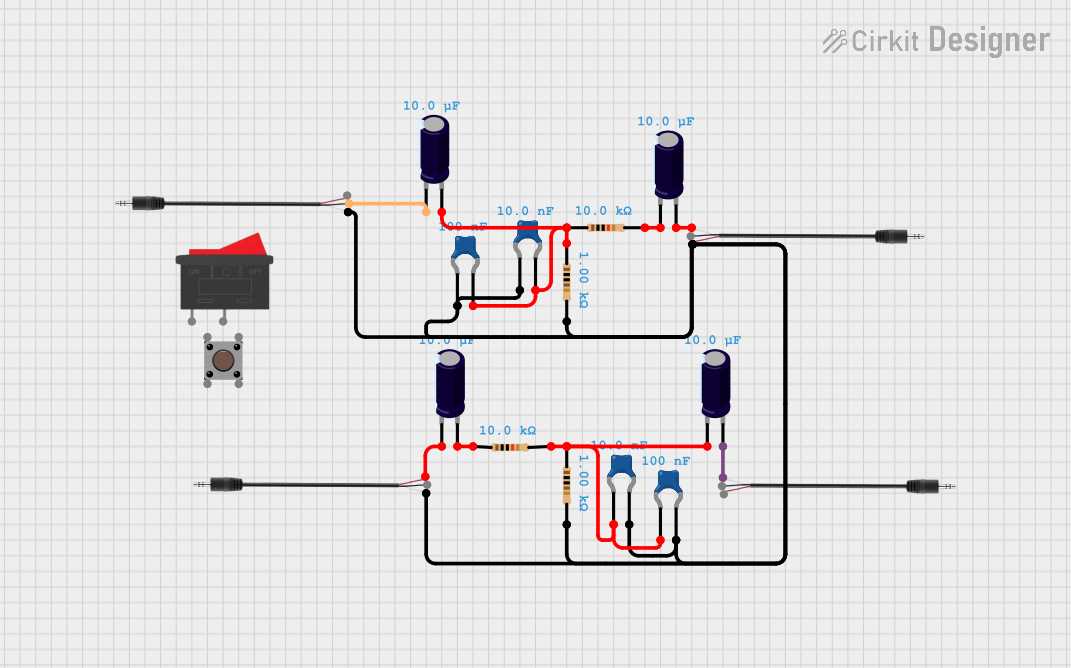
Select a series capacitor of 0.01µF and a parallel resistor of 4.7kΩ to center the passband near 1 kHz. Pair this with a second stage using a 0.047µF capacitor and 10kΩ resistor to widen the bandwidth while maintaining the target frequency range.
Component Selection Table
| Stage | Capacitor | Resistor | Center Frequency |
|---|---|---|---|
| 1 | 0.01µF | 4.7kΩ | 1 kHz |
| 2 | 0.047µF | 10kΩ | 340 Hz |
| 3 | 0.022µF | 6.8kΩ | 700 Hz |
Buffer each stage with an LM358 op-amp to prevent loading effects and maintain consistent amplitude across the band. Test with a signal generator to confirm that attenuation occurs outside the desired range and fine-tune resistor values for precise frequency targeting.