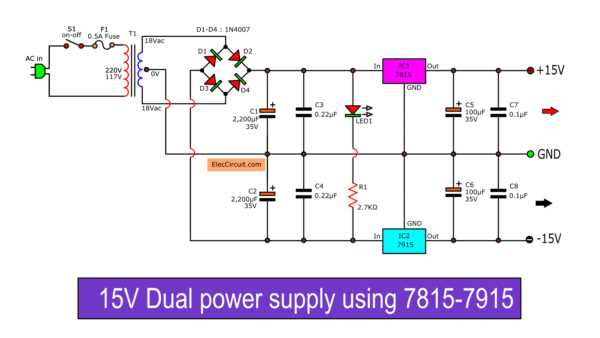
Use a bridge rectifier with at least 1A rating to convert mains voltage to stable direct current. Ensure input capacitors are rated for 400V or higher to handle voltage spikes safely.
Choose a voltage regulator IC that matches your desired output, such as 7805 for 5V or 7812 for 12V. Place a 0.33µF capacitor on the input and 0.1µF on the output to reduce high-frequency noise.
Keep wiring short and insulated between the transformer and rectification stage to minimize heat generation. Use heat sinks on regulators when output exceeds 500mA to prevent thermal shutdown.
Test the assembly with a multimeter before connecting sensitive devices. Measure both no-load voltage and load voltage to confirm the supply remains stable under operational conditions.
AC DC Power Supply Assembly and Layout
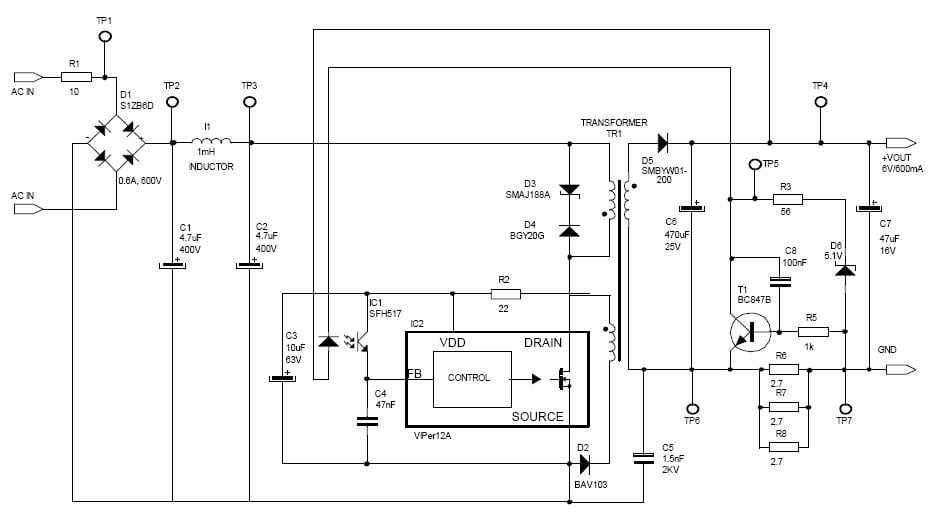
Use a full-wave bridge with at least 1A capacity to convert mains voltage into stable direct current. Ensure diodes are rated for 1000V to handle voltage spikes safely.
Install a large electrolytic capacitor immediately after the rectification stage. A 2200µF, 25V capacitor smooths voltage fluctuations and reduces ripple effectively.
Select a voltage regulator suitable for the output requirement. For 12V, a 7812 IC works well, and include a 0.33µF capacitor at the input and a 0.1µF at the output to minimize high-frequency interference.
Keep transformer wiring short and insulated to avoid heat accumulation. Use wires with at least 18AWG rating for currents up to 2A to prevent voltage drops and overheating.
Include a fuse on the primary side rated slightly above the expected current. This protects components from sudden surges and prevents damage to the power supply during faults.
Test voltage under load before connecting sensitive devices. Measure both no-load and full-load voltages to ensure stability and adjust resistor values if necessary for fine-tuning output.
Selecting Components for AC DC Power Supplies
Choose a transformer that matches the required input and output voltage. A 230V to 12V step-down transformer is common for small devices. Ensure its current rating exceeds the maximum load by 20% to avoid overheating.
Pick diodes carefully for the rectification stage. Fast-recovery types rated at least 1A and 1000V prevent voltage spikes from damaging downstream components.
Electrolytic capacitors stabilize voltage. Use a capacitance of 1000–2200µF for low-voltage outputs under 12V. For higher voltage, increase capacitance proportionally and choose capacitors with voltage ratings 50% above the peak AC voltage.
Select voltage regulators according to output needs:
- 5V output: 7805 series
- 12V output: 7812 series
- Adjustable output: LM317 with appropriate resistors
Include protective components such as fuses and varistors. Fuses rated 1.5× the maximum current prevent overload damage. Metal-oxide varistors protect against voltage spikes from the mains supply.
Check passive components like resistors and small ceramic capacitors. Place a 0.33µF capacitor at the regulator input and 0.1µF at the output to reduce high-frequency noise. Use resistors rated at 0.5W or higher for voltage dividers or load testing.