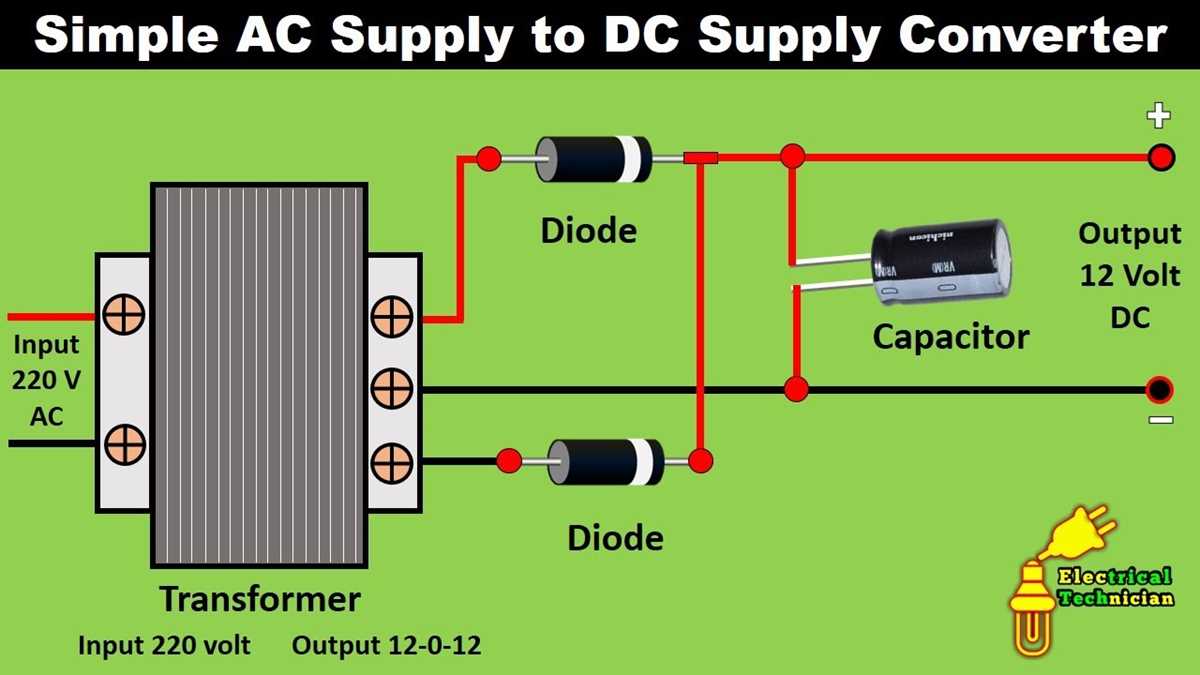
Use a four-diode bridge layout with a smoothing capacitor if stable direct current is required from a 50 or 60 Hz alternating source. A bridge arrangement allows both halves of the AC waveform to contribute to output, producing higher average voltage compared with a single-diode setup.
A typical small power supply begins with a step-down transformer that reduces mains voltage from 120 or 230 volts to a safer range such as 9, 12, or 24 volts. The alternating output from the secondary winding then passes through a diode network that converts the oscillating waveform into pulsating DC. Each diode blocks current in one direction while allowing flow in the other, shaping the output waveform.
After conversion, the output still contains ripple. Adding a filter capacitor across the load stores charge during voltage peaks and releases it during drops. For low-current electronics, capacitance values between 470 µF and 2200 µF are common. Higher current loads require larger values or additional filtering stages.
Correct component orientation determines whether the power stage works reliably. Diodes must align with their cathode bands forming the bridge structure, while the capacitor polarity must match the DC output terminals. Reverse polarity or incorrect diode placement leads to overheating, blown fuses, or unstable output voltage.
AC DC Rectifier Circuit Diagram With Half Wave Full Bridge and Filter Capacitor
Choose a four-diode bridge arrangement with a filter capacitor if steady direct current is required from a sinusoidal source. This configuration uses both halves of the AC waveform and raises the average output voltage. A typical layout includes a step-down transformer feeding four diodes arranged in a bridge shape, followed by a capacitor connected across the load terminals.
Half Wave Layout Using Single Diode
A single-diode arrangement is simple and requires fewer components, though ripple is higher and output power is lower.
- Transformer secondary connected to one diode
- Diode cathode linked to the positive load terminal
- Load resistor connected between positive output and return line
- Optional capacitor placed across the load for basic smoothing
Full Bridge Layout With Capacitor Filter
A bridge arrangement produces smoother output and uses both halves of the AC waveform.
- Four diodes arranged in a diamond configuration
- AC input connected to opposite bridge corners
- Positive and negative DC output taken from remaining corners
- Electrolytic capacitor connected across the output terminals
- Typical capacitor values range from 470 µF to 4700 µF depending on load current
The capacitor stores charge at waveform peaks and releases energy between peaks, reducing ripple. For example, a 12-volt supply feeding a 500 mA load often uses a capacitor around 2200 µF to keep ripple below about 1 volt.
Half wave rectifier circuit diagram with single diode transformer connection and output voltage path
Connect the secondary winding of a step-down transformer to a single diode placed in series with the load. The anode should face the transformer output while the cathode points toward the load terminal that provides positive DC. During the positive half of the AC waveform, current flows through the diode and the load resistor, producing pulsating direct voltage.
The return path runs from the load back to the opposite side of the transformer secondary. During the negative half cycle the diode blocks current, which leaves the load with zero voltage until the next positive half cycle begins. This arrangement results in a waveform consisting of spaced pulses at the same frequency as the input supply, typically 50 Hz or 60 Hz. Average output voltage equals approximately 0.318 × the peak AC voltage minus the diode drop, which is around 0.7 volts for a silicon diode.
A smoothing capacitor may be placed across the load terminals if lower ripple is required. For small loads drawing 50–100 mA, capacitance values between 470 µF and 1000 µF reduce voltage drop between peaks. Larger loads demand higher capacitance or a different conversion topology that uses both halves of the AC waveform.