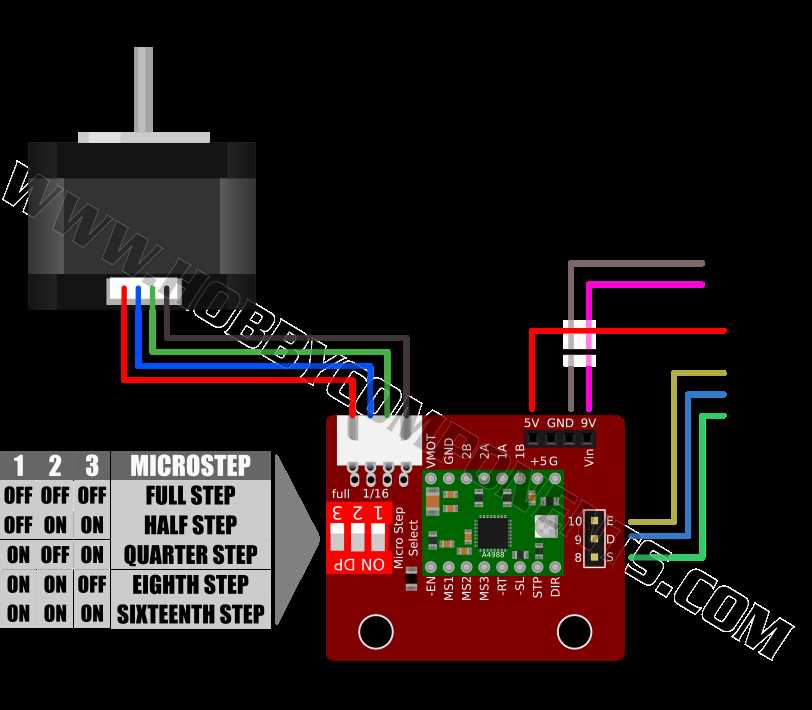
Connect the stepper driver module to the controller board using dedicated step and direction signal lines. These two digital inputs determine rotation pulses and movement orientation. A microcontroller such as an Arduino or STM32 sends a pulse stream through the STEP input while the DIR input defines clockwise or counter-clockwise motion. Use short signal leads under 20 cm to reduce electrical noise and maintain clean logic transitions.
The driver module operates with two separate voltage domains. Logic pins normally receive 3.3 V or 5 V supplied by the controller board, while the motor supply requires a higher voltage between 8 V and 35 V. Connect the motor power source directly to the VMOT and GND terminals and place a 100 µF electrolytic capacitor across these terminals. This capacitor absorbs voltage spikes generated by coil switching inside the motor windings.
Stepper motors contain two electromagnetic coil pairs. Each pair must connect to a separate output channel on the driver board. Identify coil pairs with a multimeter by measuring resistance between leads; wires belonging to the same coil typically show 1–10 Ω. Attach the first coil to outputs labeled 1A and 1B and the second coil to outputs 2A and 2B. Reversing a pair only changes rotation direction and does not damage the hardware.
Motor current control relies on a small adjustable reference potentiometer located on the driver board. Turning the screw modifies the internal current limit used by the driver chip. Measure the reference voltage on the VREF test point using a multimeter while adjusting the potentiometer. For many NEMA 17 motors, values between 0.5 V and 0.9 V keep coil current within safe thermal limits.
Microstepping configuration uses three digital pins labeled MS1, MS2, and MS3. Connecting these pins to logic high or ground selects stepping resolution. Lower step sizes reduce vibration and produce smoother motion in precision positioning systems such as 3D printers or CNC machines.
Typical microstepping selections include:
Full step – all mode pins low
Half step – MS1 high
Quarter step – MS1 and MS2 high
Sixteenth step – all three pins high
Install a heat sink on the driver chip when operating above 1 amp per coil. Continuous operation without thermal management may trigger internal shutdown protection or reduce lifespan of the silicon package.
Secure the driver board close to the controller board and keep motor supply cables twisted together. Twisted leads reduce electromagnetic interference produced during rapid coil switching while step pulses remain stable during high-speed motor movement.
A4988 Stepper Motor Driver Circuit Diagram With Pin Connections and Power Setup
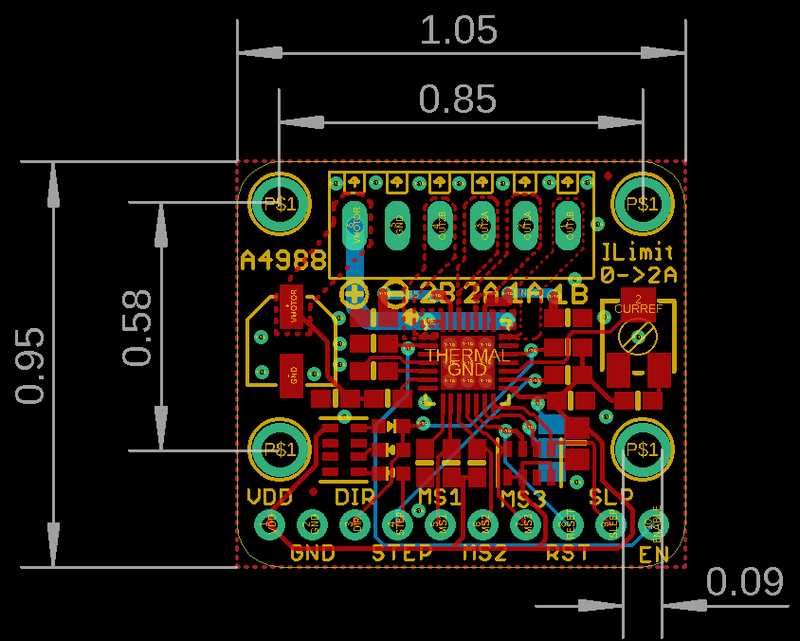
Connect the driver module logic pins to the microcontroller before attaching motor power. STEP and DIR inputs receive digital signals that define pulse count and rotation direction. STEP accepts a rising edge pulse; each transition advances the rotor one microstep or full step depending on the mode configuration. DIR sets clockwise or counter-clockwise motion and should remain stable several microseconds before the pulse signal arrives.
Provide two separate voltage sources. Logic pins typically receive 3.3 V or 5 V from the control board through VDD and GND. Motor supply enters through VMOT and the adjacent ground terminal and usually ranges from 8 V to 35 V. Install a 100 µF electrolytic capacitor between VMOT and ground directly at the module header. This component absorbs voltage spikes produced when current in the stepper coils switches rapidly.
Attach the two motor coil pairs to the four output terminals labeled 1A, 1B, 2A, and 2B.
Identify the correct pairs with a multimeter. Measure resistance between leads; wires belonging to the same winding show a low value, commonly between 1 Ω and 10 Ω. Connect the first coil to outputs 1A and 1B and the second coil to 2A and 2B. Reversing a pair only changes rotation orientation and does not damage the driver module.
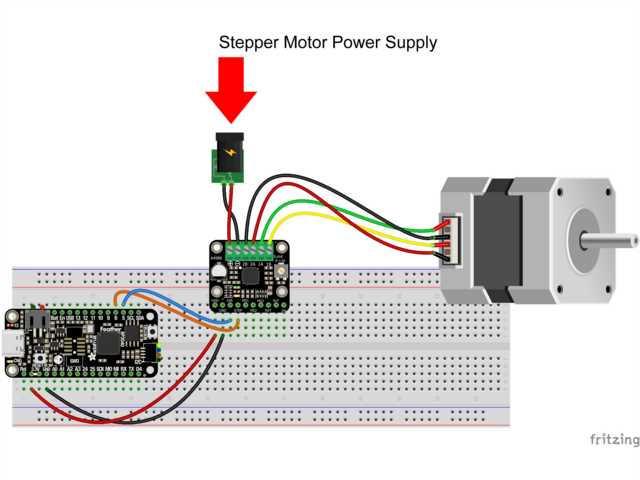
Adjust the current limit before running the motor. A small trimmer potentiometer on the module sets the reference voltage controlling peak coil current. Measure the VREF test point with a multimeter while turning the screw slowly. For many NEMA-17 units rated around 1 A per phase, a reference level between 0.5 V and 0.8 V keeps the silicon within thermal limits.
Microstep resolution uses three configuration inputs labeled MS1, MS2, and MS3. Pulling these pins high or low selects the stepping mode. Lower step angles create smoother mechanical movement and reduce vibration during positioning tasks such as CNC motion systems or 3D printing.
Typical resolution settings include full step with all pins low, half step with MS1 high, quarter step with MS1 and MS2 high, and one-sixteenth step when all three pins receive a high logic signal.