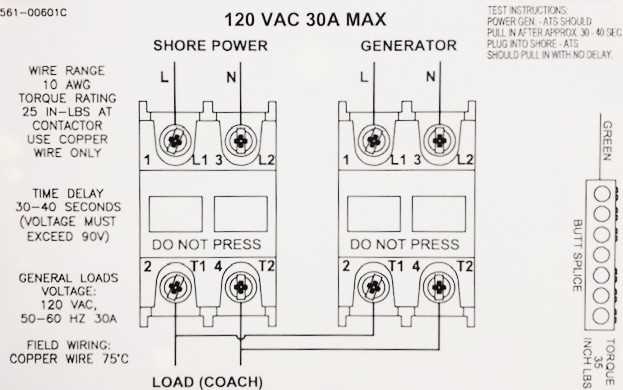
Ensure all main and auxiliary lines are de-energized before handling connections. Use a reliable tester to confirm voltage absence on each terminal to prevent accidental shocks or short circuits.
Label all incoming and outgoing feeds clearly to distinguish between utility and generator sources. This prevents misconnection and ensures that the control unit directs power flow correctly during outages.
Follow manufacturer torque specifications when securing conductors to terminals. Loose connections can cause arcing, excessive heat, and damage to both the control module and connected appliances.
Maintain consistent wire color coding for live, neutral, and ground lines. Use green for grounding, black or red for live feeds, and white for neutral to match standard electrical safety practices.
Plan conductor routing to avoid crossing signal lines with high-current cables. Physical separation reduces electromagnetic interference that could trigger false switching or delays in activation.
Verify the control unit’s operation after connections by simulating a power loss scenario. Confirm that the system transfers loads from the primary to backup source without interruption and resets correctly when main power returns.
Connection Guide for Backup Power Control Units
Disconnect all primary power feeds before handling any connections to the control panel. Use a voltage tester on every terminal to confirm complete de-energization and prevent electrical hazards.
Identify the main and auxiliary lines accurately using labels or colored markers. Distinguishing these inputs ensures that the system reroutes power correctly during an outage and avoids backfeeding the utility supply.
Secure conductors to terminal points using manufacturer-specified torque. Loose connections can create arcing, overheating, and premature failure of the control device.
Organizing Line Routing and Grounding
Separate high-current conductors from low-voltage signal lines to reduce electromagnetic interference. Route grounding cables directly to the unit’s grounding bus using short, straight paths to maintain safe operation.
Verify sequence of operation by simulating a loss of primary power. Ensure the control system directs energy from the backup source to all critical loads without interruption and resets automatically when main power resumes.
Double-check line colors and terminal orientation before restoring power. Black or red typically indicates live feeds, white for neutral, and green for ground. Correct color matching minimizes misconnection risks and ensures reliable performance.
Identifying Live Neutral and Ground Terminals
Test each terminal with a multimeter before making connections. Confirm that the primary feed is live by checking voltage between the line and neutral points, and ensure no unexpected voltage appears on the ground terminal.
Follow color codes carefully: black or red wires usually indicate live feeds, white denotes neutral, and green or bare copper represents ground. Consistent adherence to these codes reduces errors during installation.
Sequence for Safe Identification
- Turn off the main breaker to isolate all power sources.
- Use a non-contact voltage detector to locate active conductors.
- Measure voltage between suspected live and neutral terminals to confirm readings.
- Verify grounding points by continuity test to the main grounding bus.
Mark terminals immediately with labels or tape after identification. This prevents mix-ups when connecting multiple feeds and allows future maintenance to proceed without additional testing.
Double-check orientation before energizing. Live terminals must align with input feeds, neutral must remain isolated from ground, and grounding connections should remain secure to maintain safe operation and prevent backfeed hazards.