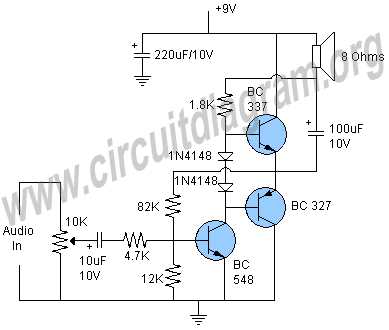
Use matched silicon switches with gain values around 100 to 120 for stable amplification across all four stages. Ensure resistors are within 1% tolerance to prevent voltage drops that distort output. Capacitors of at least 100µF for coupling provide smooth signal transfer between each stage.
Arrange the transistors in a cascade layout to maintain consistent power handling. Position heat sinks close to the devices rated for 0.5W dissipation to avoid thermal drift. Wire the input through a 10kΩ resistor to reduce noise and preserve signal fidelity.
Check voltage supply levels carefully at each junction point; a 12V regulated source produces balanced peaks without clipping. Include a 0.01µF bypass near each stage to filter high-frequency interference. Connect the output to a 32Ω load first to test performance before attaching larger speakers.
Monitor current draw per stage to ensure it does not exceed 20mA, which can destabilize gain. Small adjustments to emitter resistances can fine-tune the linearity, producing cleaner sound. Always solder connections firmly and avoid long wiring loops to minimize signal loss and crosstalk.
Components Required for a 4-Stage Signal Booster
Select four NPN switches with hFE between 100 and 120 for uniform amplification. Include a set of resistors: two 1kΩ for biasing, one 470Ω for emitter stabilization, and one 10kΩ for input conditioning. Capacitors should include two 100µF electrolytic units for stage coupling and one 0.01µF ceramic for high-frequency bypassing.
Use a regulated 12V DC supply rated for at least 200mA to maintain stable operation. Small components such as a 1N4148 diode for reverse protection and a 100Ω trimmer resistor allow fine adjustments. A small heatsink for each switch is recommended to prevent thermal shifts that could affect performance.
Additional materials include:
- A 32Ω test load for initial signal verification
- Insulated hookup wire, preferably 22 AWG
- Solder and flux for secure connections
- PCB or perforated board for mounting all components neatly
These items ensure a compact, reliable assembly that produces clear, consistent sound output.
Step-by-Step Wiring of the 4-Stage Signal Booster
Connect the first stage by linking the collector of the initial NPN device to the positive supply through a 1kΩ resistor. Attach the emitter to ground with a 470Ω stabilizing resistor, ensuring solid solder joints to minimize resistance variations.
Wire the second stage by connecting its base to the coupling capacitor from the first stage. Include a 10kΩ input resistor to limit current flow and maintain linear response. Confirm that the capacitor polarity matches the direction of signal flow.
Integrate the third stage with the same pattern: base connected through a 100µF coupling component and collector linked to the supply via another 1kΩ resistor. Keep leads short to reduce parasitic inductance that could affect high-frequency performance.
Attach the fourth stage following identical steps, but use a 0.01µF bypass near the emitter to filter high-frequency noise. Ensure the output connection is ready for a test load before final wiring.
Include protection components such as a small diode in series with the positive supply to prevent reverse voltage. Add heat sinks to each NPN switch to maintain stable operation during extended use.
Verify continuity after each stage is wired, checking that no shorts exist between supply rails or ground. Use a multimeter to measure voltage drops across resistors to ensure expected values and uniform gain across all stages.
Finalize connections by attaching the output to a 32Ω resistor for initial testing. Observe signal clarity and adjust emitter trimmers slightly to fine-tune linearity. Secure all components on the board with minimal wire loops to reduce interference and maintain a clean, compact assembly.
Testing and Troubleshooting the Signal Booster for Clear Output
Begin testing with a 32Ω resistive load before connecting any speakers. Measure voltage at each stage; values should match predicted drops across bias resistors. Listen for distortion or hum, and if present, check coupling capacitors for correct polarity and tight soldering. Adjust emitter resistances slightly to balance gain and minimize clipping.
For troubleshooting high-frequency noise, place a 0.01µF bypass close to each switch. Confirm all supply connections are stable and that the current does not exceed 20mA per stage. Recheck leads for short circuits and ensure minimal wire loops. Fine-tuning these parameters produces smooth, undistorted signal output across all four stages.