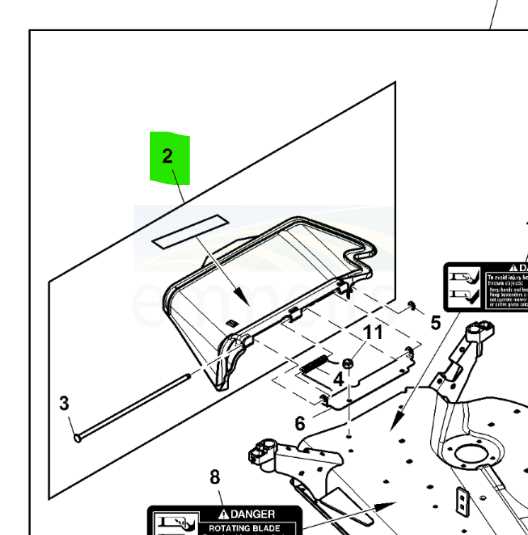
Use the reference layout to confirm fastener sizes, shaft alignment, and belt paths before removing any assembly. This approach reduces rework during service tasks such as spindle replacement, steering adjustment, or deck leveling.
The machine is built around a welded steel chassis with a front-mounted cutting platform, a rear transaxle, and dual control levers. The visual layout separates the cutting system, drive train, and control hardware, allowing quick identification of wear points like idler arms, pulleys, and linkage pins.
Focus on subsystem boundaries when reviewing the layout. The cutting platform uses three blade carriers driven by a routed belt, while the propulsion system relies on a vertical engine shaft connected to a transmission via tensioned idlers. Clear separation between these groups helps trace vibration sources or uneven cut issues.
Accurate orientation matters. Hardware such as spacers, bushings, and springs must return to their original positions to maintain tracking and response. Keeping the visual map nearby during disassembly ensures correct reassembly without guesswork.
Component Layout Guide for Service and Mechanical Work
Verify bolt torque values and belt routing against the visual layout before removing the cutting deck or drive components. This model uses metric fasteners across the chassis, with deck spindle hardware typically tightened to 45–55 Nm and pulley retaining bolts closer to 60 Nm.
The reference layout separates the cutting assembly, propulsion system, and operator controls into distinct zones. Use this separation to isolate faults faster, such as tracing uneven cut height to deck hangers or identifying steering drift caused by worn control link joints.
During repair tasks, match each removed item to its exact position in the layout, paying close attention to spacer orientation and washer stacking order. Reversed spacers on idler arms or control pivots often lead to belt misalignment or delayed lever response.
For routine service, the layout highlights recurring wear items like blade carriers, tension springs, and control cables. Inspect these areas every 50 operating hours to catch elongation, cracking, or loosened mounts before they affect handling or cut quality.
Deck Assembly Layout with Blades Spindles and Belt Routing
Confirm blade orientation and spindle height alignment before reinstalling the cutting shell, as this platform relies on a staggered edge setup to maintain an even cut across the full width. Blade bolts are typically secured between 115–125 Nm, and uneven torque often leads to vibration.
The cutting shell supports three rotating hubs mounted through reinforced housings. Each hub sits on sealed bearings pressed into the shell, and any axial play beyond 0.5 mm signals bearing wear that should be addressed before belt refitting.
Belt routing follows a fixed path around the drive pulley, tension arm, and idler wheels, with the tension spring calibrated to maintain constant load during engagement. Misrouting over the idler shoulder rather than the groove causes rapid edge fraying and heat buildup.
After reassembly, rotate the belt by hand and verify that all hubs spin freely without lateral wobble. Clearance between blade tips and shell edges should remain consistent across all positions, indicating correct hanger adjustment and level suspension geometry.
Engine Drive System Mapping with Pulleys Idlers and Transmission
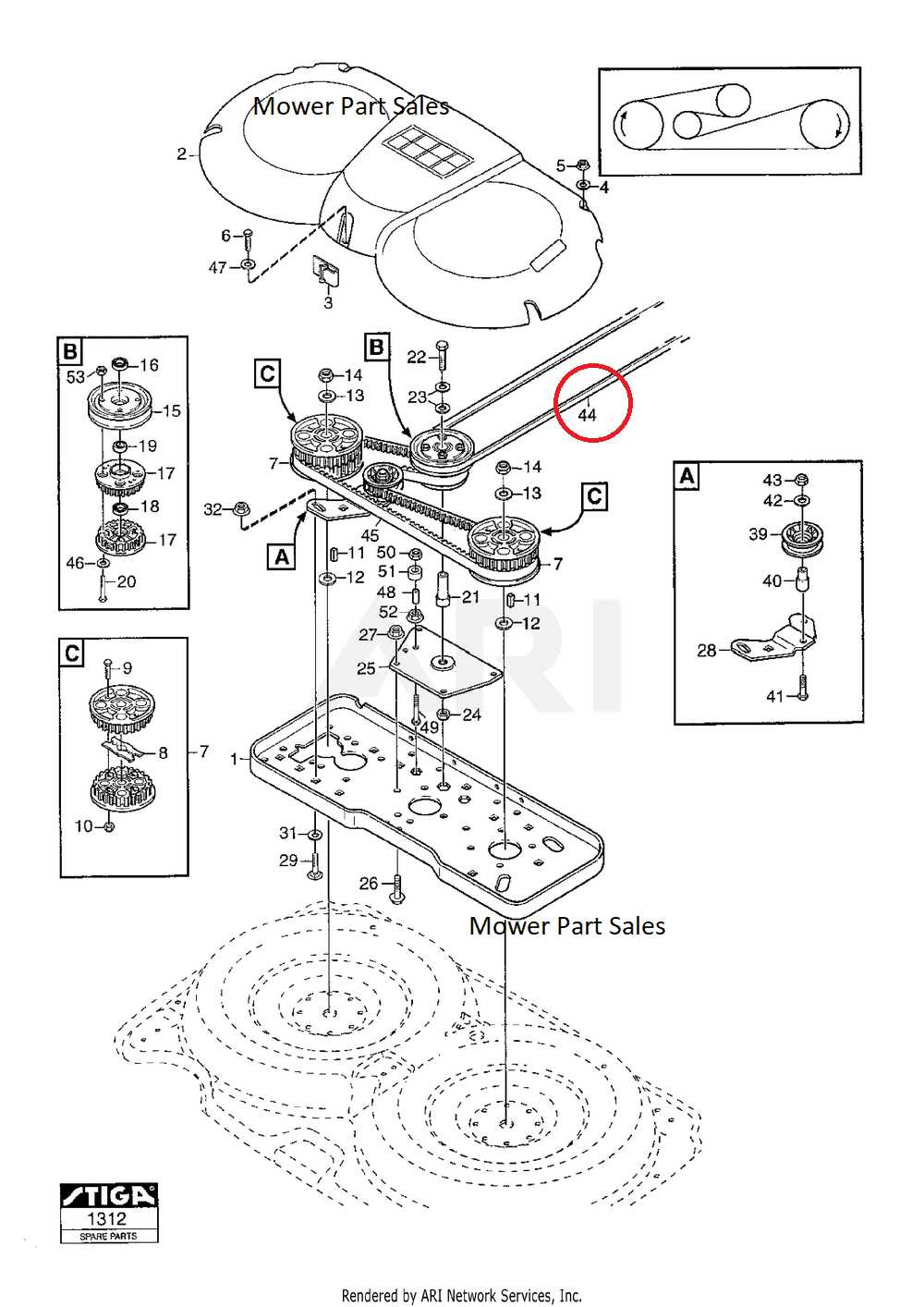
Set belt tension with the engine at idle and the parking brake released, as this chassis uses a spring-loaded idler arm that equalizes load across both drive paths. Deflection at the longest span should measure close to 10–12 mm under moderate finger pressure.
The crank pulley transfers rotation to dual idler wheels mounted on sealed bearings rated for high radial load. Any audible chirping during engagement points to bearing fatigue or misalignment at the mounting boss. Fasteners at these pivots are commonly tightened to 45–50 Nm to prevent bracket shift.
Hydrostatic gear units receive input through dedicated drive sheaves positioned parallel to the crank axis. Belt tracking must stay centered on each groove; edge contact indicates worn idler bushings or a bent keeper rod. Correct tracking reduces heat and prevents glazing along the belt surface.
After service, raise the rear frame and cycle the control levers slowly. Both drive wheels should begin rotation simultaneously, confirming balanced tension and proper engagement through the transmission path. Delayed response on one side signals unequal belt load or idler angle error.
Frame Steering and Control Linkage Identification for Levers and Wheels
Adjust both steering arms to equal length before checking wheel response, using the threaded rod ends mounted to the front control brackets. This platform relies on mirrored linkage geometry, so uneven adjustment leads to pull during straight travel.
The steering system connects hand levers to the drive wheels through a series of pivots and joints mounted along the main chassis rails. Each joint must rotate freely without lateral play, as side movement alters wheel angle under load.
- Hand levers attach to primary control arms with shoulder bolts and nylon bushings
- Intermediate links transfer motion to rear drive assemblies through heim joints
- Return springs mounted near the pivot plates center the levers at neutral
- Front caster wheels remain passive and respond only to rear wheel input
Wheel tracking should be checked on a flat surface with tire pressure matched side to side. If one wheel reacts sooner, shorten the opposite linkage by half-turn increments until response matches. Balanced linkage length keeps steering input predictable.
After adjustment, cycle both levers fully forward and back while observing joint alignment. Any binding or offset angle indicates a bent bracket or worn bushing, which should be corrected before continued use.