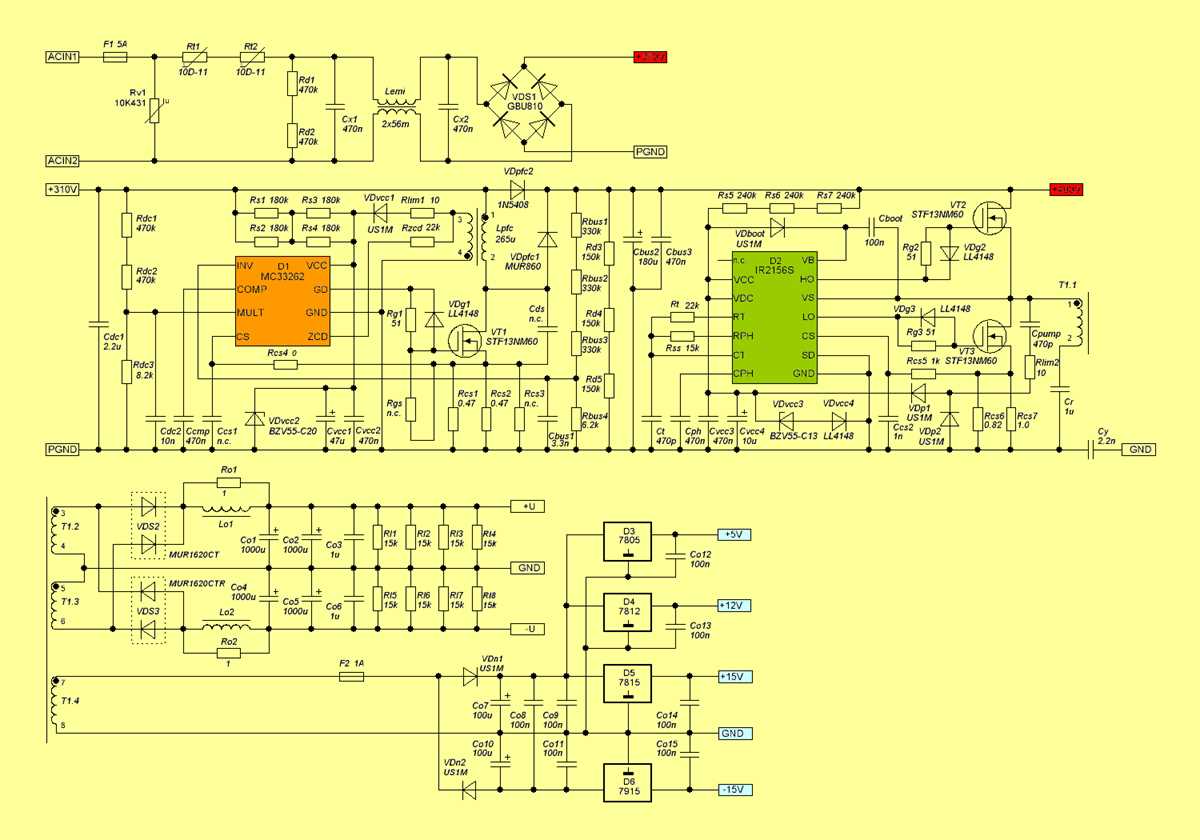
If you’re looking to understand how power conversion works in modern electronics, studying the schematic of a switch-mode power supply (SMPS) is a good place to start. This design allows for efficient voltage regulation by switching components on and off, minimizing energy loss and optimizing performance in a wide range of devices.
To interpret such a design, focus on the roles of key components like the transformer, diodes, and inductors. Each of these elements is crucial for controlling the flow of energy through the system. For instance, the transformer helps adjust voltage levels, while diodes manage current direction and prevent reverse flow, ensuring that the system remains stable.
When troubleshooting, pay close attention to the control circuit that regulates switching frequencies. Faulty connections or damaged components in this area can lead to overheating or malfunctioning, so checking continuity and signal integrity is critical to identifying problems quickly. Understanding how these parts fit together will help you diagnose issues and improve system reliability.
SMPS Circuit Diagram
To understand how this power supply works, begin by identifying its core components. The transformer, for example, plays a pivotal role in adjusting voltage levels. It ensures the system can handle different input voltages, making it versatile in a variety of applications. The rectifier, typically a diode bridge, ensures that the current flows in the correct direction, protecting the system from potential damage due to reverse polarity.
Next, pay attention to the switching elements such as MOSFETs or IGBTs. These components turn the power on and off at a high frequency, which is what makes the design efficient. High-frequency switching reduces energy loss, allowing the system to convert power with minimal heat generation. This is one of the key advantages of this type of design compared to linear power supplies.
Common Components and Their Functions
- Transformer: Steps up or steps down voltage levels.
- Rectifier: Converts AC to DC current, ensuring proper current flow.
- Inductor: Filters high-frequency noise and smooths the output.
- Capacitor: Stabilizes voltage and minimizes ripple.
- Control Circuit: Regulates switching timing and ensures proper voltage regulation.
When troubleshooting, focus on the feedback loop that controls voltage regulation. If the voltage is unstable, it could indicate an issue with the feedback components or the control circuitry. Common problems include damaged capacitors or malfunctioning transistors that prevent the system from maintaining a stable output voltage. Always verify the integrity of the control signals with an oscilloscope to detect any irregularities.
Key Components of an SMPS Circuit and Their Functions
The transformer is the first major component in any power conversion system. Its job is to adjust the input voltage to the required output level. The primary winding of the transformer receives the input voltage, while the secondary winding delivers the transformed voltage to the rest of the system. The transformer is crucial for stepping up or stepping down the voltage, depending on the design requirements.
Rectifiers, typically composed of diodes, are used to convert the alternating current (AC) into direct current (DC). This process ensures that the power can be stored and distributed correctly within the system. In a typical design, a bridge rectifier is used to maximize the efficiency of this conversion, ensuring a smoother, more stable output.
Inductors and Capacitors
Inductors play a significant role in filtering high-frequency noise and smoothing out voltage ripples. These components store energy in a magnetic field when current flows through them and release it when needed. By doing so, they stabilize the output, preventing unwanted voltage fluctuations. Inductors are particularly useful in reducing electromagnetic interference (EMI) that can occur in high-frequency switching systems.
Capacitors are used to smooth the output voltage and store energy for later use. They filter out noise and minimize ripple, ensuring a steady, stable power supply. Capacitors are also involved in voltage regulation and can be found in multiple stages of the design. They complement the inductors by providing short-term energy storage to prevent sudden drops in voltage.
The switching transistor, often a MOSFET or IGBT, is responsible for turning the power on and off at high frequencies. This high-speed switching is the key to the efficiency of the design. By rapidly switching the current, the transistor helps minimize power loss in the system, which is a significant advantage over linear power supplies.
A feedback loop regulates the operation of the switching transistor. It monitors the output voltage and compares it with the reference voltage. If there is a deviation, the feedback circuit adjusts the duty cycle of the switch, ensuring the output stays within the desired range. This constant regulation is what allows the system to maintain a steady output under varying load conditions.
Control Circuitry
The control circuitry coordinates the switching process, ensuring that the right timing is applied to the transistor. It helps manage the frequency and pulse width modulation (PWM) of the switching transistor, which in turn regulates the power flow to the load. This component is critical for maintaining stable output voltage and preventing system overloads.
Finally, the protection components, such as fuses and thermal sensors, ensure the system operates safely. These parts detect overvoltage, overcurrent, or overheating conditions, automatically shutting down the system if necessary. By protecting the system from damage, these components extend the lifespan of the power supply and improve its overall reliability.