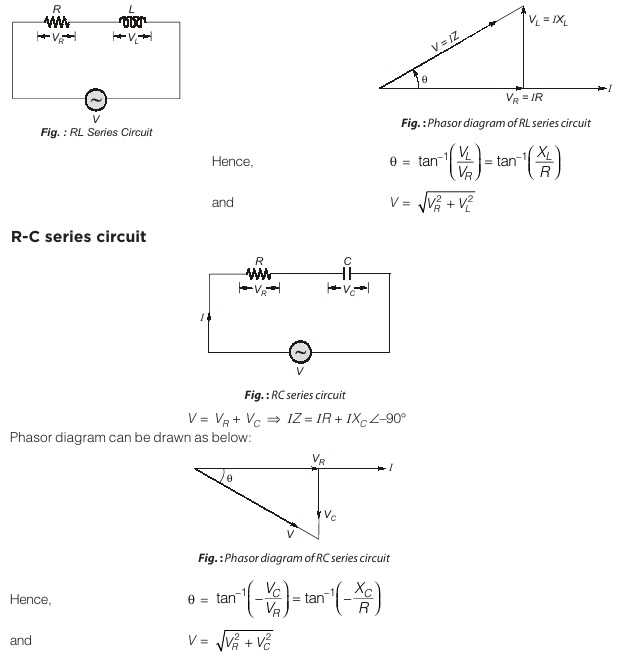
Start by plotting voltage and current vectors with the resistor along the horizontal axis and the inductor along the vertical axis. This approach clearly shows the 90-degree phase shift between resistive and inductive responses.
Measure the total impedance by combining resistance and inductive reactance using the square root of the sum of squares formula. For a 50-ohm resistor and a 30-ohm inductor, the magnitude equals √(50² + 30²) = 58.31 ohms.
Calculate the phase angle between voltage and current using arctangent of reactance over resistance. In the previous example, θ = arctan(30 / 50) ≈ 31 degrees, indicating the current lags the applied voltage.
Use vector representation to predict waveform behavior under AC supply. Align each component along its axis, then combine to determine the resultant amplitude and angle for accurate load analysis.
Phasor Diagram for RL Circuit Analysis and Applications
Align the resistor along the horizontal axis and the inductor along the vertical axis to visualize voltage drops accurately. This layout shows the phase difference between current and applied voltage.
Calculate total impedance using the formula Z = √(R² + X_L²). For a 40-ohm resistor and a 30-ohm inductive reactance, the resultant magnitude equals √(40² + 30²) = 50 ohms.
Determine the phase angle with θ = arctan(X_L / R). In this example, θ = arctan(30 / 40) ≈ 37 degrees, indicating the current lags the voltage by that amount.
Represent each component as a vector to combine resistive and inductive effects. Draw the horizontal line for the resistor and vertical line for the inductor, then use the vector sum to find total voltage.
Predict voltage across each element by projecting the total vector onto individual axes. The horizontal projection shows voltage across the resistor, while the vertical projection shows the inductor’s voltage.
Apply this method to AC motors and transformers to estimate performance under varying load conditions. Knowing the phase shift helps optimize power factor and prevent overheating.
Adjust component values and recalculate vectors when modifying the load. Increasing inductance raises the angle θ, causing greater lag between current and voltage, which affects energy efficiency.
Use vector representation in troubleshooting to detect abnormal readings. Deviations from expected angles or magnitudes can indicate a failing inductor, loose connection, or resistor drift, allowing timely corrective action.
Drawing Voltage and Current Phasors for Series RL Circuits
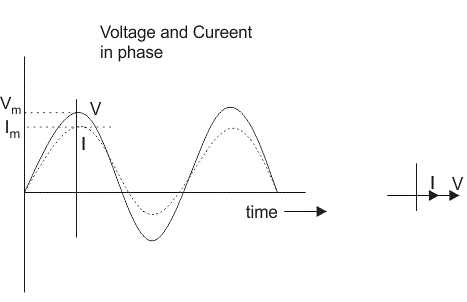
Start by placing the resistor along the horizontal axis to represent voltage drop in phase with current. Draw the inductor vector vertically to indicate the 90-degree lag of voltage across the inductor relative to current. Use a ruler to maintain proportional lengths based on actual voltage values.
Combine vectors using the tip-to-tail method to find total applied voltage. Follow these steps:
- Draw the horizontal resistor vector with length equal to its voltage.
- Draw the vertical inductor vector starting from the tip of the resistor vector.
- Connect the origin to the tip of the inductor vector to represent total voltage magnitude and angle.
- Measure the angle with a protractor to determine the phase difference between current and total voltage.