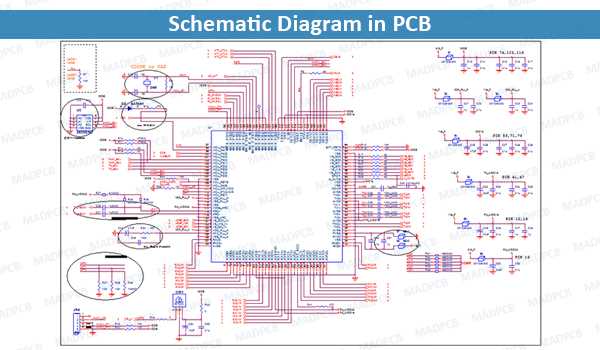
Identify the power source, ground reference, and signal flow before examining any electrical drawing. This quick scan helps determine how energy enters the system, where it returns, and how components interact along the path. Without this orientation, interpreting symbols and connections becomes confusing and time-consuming.
An electrical representation uses standardized symbols for components such as resistors, capacitors, diodes, and transistors. Each symbol reflects the physical device and its function inside the system. Lines represent conductive paths, while connection points mark electrical junctions. Understanding these graphic conventions allows a reader to translate a drawing into the physical arrangement of parts.
Accurate interpretation depends on recognizing structure. Most technical drawings follow a logical layout where energy typically moves from the left side of the page toward the right. Control stages, amplification blocks, and output sections are often grouped visually. This arrangement allows engineers and technicians to trace signals through the system and detect faults during troubleshooting.
Component labels and reference numbers also provide guidance. Designators such as R for resistors, C for capacitors, D for diodes, and Q for transistors correspond with a parts list used during assembly and repair. Matching these identifiers with component values and ratings allows precise identification of each element within the electrical design.
Schematic Circuit Diagram Symbols Layout Rules and Methods for Reading Electrical Schematics
Locate the power input and ground reference before reading any electrical drawing. These two points define how current enters and exits the system. Power sources are commonly placed near the left or top of the page, while ground symbols appear at the bottom of functional blocks. Recognizing these anchors clarifies signal direction and prevents misinterpretation of component roles.
Identify standardized graphical marks used for electronic parts. Most technical drawings follow IEC or ANSI conventions, where each component has a recognizable visual form. Typical symbols include:
- Resistor – zigzag line or rectangular block
- Capacitor – two parallel plates
- Diode – triangle pointing to a vertical line
- Transistor – three-terminal symbol with arrow marking current direction
- Battery or supply – alternating long and short parallel lines
Memorizing these shapes allows quick identification of device types without reading labels. Component reference letters such as R, C, D, or Q correspond to a parts list used during assembly and repair.
Observe the layout pattern used by engineers. Functional blocks are commonly arranged from left to right following signal movement. Input conditioning, processing stages, amplification blocks, and output sections appear sequentially across the page. This layout helps technicians trace a signal path step by step during diagnostics.
Track electrical connections by following continuous lines and node markers. Intersections with a solid dot indicate a connection between conductors, while crossing lines without a dot represent wires that pass without contact. This small graphical detail prevents incorrect assumptions about electrical links.
Use a structured reading method:
- Find the power supply and ground symbols
- Locate the input signal entry point
- Trace the path through each component stage
- Observe branching nodes and feedback loops
- Finish at the output device or load
This ordered approach allows quick interpretation of complex electrical drawings containing dozens or hundreds of components.
Pay attention to component values and annotations printed near each symbol. Examples include resistor values such as 10 kΩ, capacitor ratings like 100 nF, or transistor identifiers such as 2N3904. These labels define electrical characteristics required for correct operation.
Cross-reference part designators with a bill of materials when available. A label like R15 links the graphical mark to a specific resistor listed in documentation. Matching these identifiers helps locate components on a physical board during troubleshooting or assembly.
Common schematic symbols for resistors capacitors diodes transistors and power sources
Memorize the graphical marks used for basic electronic components before reading any electrical drawing. Recognizing shapes at a glance allows quick identification of parts and their role in the electrical network. Most technical documentation follows IEC or ANSI symbol standards, which keep representations consistent across manuals, textbooks, and design files.
Resistors and capacitors
The resistor mark usually appears as a zigzag line in American notation or a small rectangle in European standards. This element restricts current and sets voltage levels within signal paths. Reference labels normally begin with the letter R, followed by a number such as R1 or R15. Values are written nearby, for example 4.7 kΩ or 220 Ω, indicating resistance magnitude.
The capacitor symbol consists of two parallel plates. One plate may be curved when the component is polarized. Labels begin with the letter C, and capacitance values appear beside the mark, typically in pF, nF, or µF. Polarized capacitors also include polarity indicators that show the positive terminal, which prevents incorrect installation.
Diodes transistors and power sources
A diode is drawn as a triangle pointing toward a vertical line. The triangle indicates current direction through the device while the line represents the cathode. Reference identifiers begin with D, such as D3 or D12. Variants like light-emitting types include additional arrows pointing outward to show light emission.
Transistors appear with three terminals labeled base, collector, and emitter. The emitter lead includes an arrow that shows current direction. Bipolar types use designators beginning with Q, while field-effect devices may appear with gate, drain, and source terminals. Each configuration indicates switching or amplification roles within the electrical design.
Power supplies are represented by parallel lines of unequal length for batteries or by labeled voltage nodes such as +5V, +12V, or −15V. Ground references appear as stacked horizontal lines decreasing in width. These symbols define where electrical energy enters the system and where current returns.