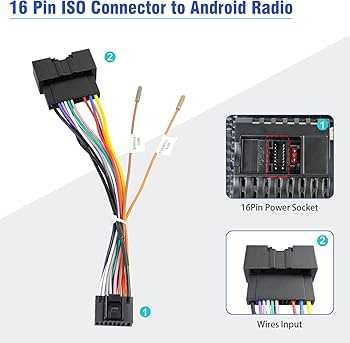
Disconnect the negative battery terminal before touching any dashboard harness. A late-90s compact pickup uses a factory plug with separate lines for constant 12V supply, switched ignition feed, ground, illumination, and four speaker channels. Identifying these leads before installing a new head unit prevents blown fuses, reversed polarity, or silent speakers.
The power feed that keeps memory settings active normally carries a yellow conductor with a green stripe in many late-1990s pickup harnesses. The ignition-controlled supply often appears as red with black trace. Ground commonly uses a solid black lead connected to the vehicle chassis behind the center dash support. Verifying voltage with a multimeter set to DC range around 20V confirms each line.
Speaker circuits exit the factory connector as paired conductors. Each pair includes a positive line with a solid color and a negative line marked by a stripe of the same color. Typical front channel pairs include white and white-black for the left side and gray with gray-black for the right. Rear channels commonly appear as green / green-black and purple / purple-black. Matching polarity keeps bass response balanced.
Dash illumination control reaches the head unit through a thin wire that often carries orange or orange-black insulation. This line dims the display when headlights activate. Connecting it incorrectly may leave the display permanently bright during night driving.
Many owners replace the factory sound unit with an aftermarket receiver. Adapter harnesses designed for late-1990s compact trucks plug directly into the factory connector and translate each conductor to standardized colors used by aftermarket equipment. This approach avoids cutting the original loom.
Before mounting the receiver in the dash cage, reconnect the battery temporarily and test each speaker channel. Play a low-volume track and confirm sound from all four doors or panels. If one side produces thin bass, the positive and negative leads for that speaker pair are reversed.
After confirming power, ground, and audio channels, secure the harness with electrical tape or heat-shrink tubing. Preventing loose conductors behind the center stack protects the head unit from intermittent power loss and audio dropouts while driving.
1999 Ford Ranger Radio Connection Layout with Wire Color Codes
Disconnect the battery and identify the factory dash harness before installing an aftermarket head unit. The late-1990s compact pickup platform uses a rectangular plug that separates power supply, lighting control, ground, and four speaker outputs. Each conductor color marks a specific electrical role, allowing quick identification with a multimeter.
Power and control conductors typically appear in the following colors:
- Yellow with green stripe – constant 12V supply that preserves clock and preset memory.
- Red with black stripe – ignition-controlled 12V line active only when the key is in ACC or ON position.
- Black – chassis ground connected to metal support brackets behind the center console.
- Orange with black stripe – illumination signal that dims the display when exterior lights activate.
- Blue – power antenna or amplifier trigger on vehicles equipped with those features.
Speaker channels leave the connector as paired conductors. Each pair includes a solid color for positive polarity and the same tone with a black stripe for the negative lead.
- White / White-Black – front left speaker pair
- Gray / Gray-Black – front right speaker pair
- Green / Green-Black – rear left speaker pair
- Purple / Purple-Black – rear right speaker pair
Check each conductor with a digital multimeter before connecting a replacement audio receiver. Constant supply should measure close to 12 volts with the key removed, while the ignition line reads zero until the key reaches the accessory position. Ground resistance between the black conductor and chassis metal should remain near zero ohms.
Secure all splices with crimp connectors or solder and heat-shrink tubing. Loose joints behind the dashboard often cause intermittent power loss, speaker crackle, or memory reset when driving over bumps.
Wire Color Codes and Pin Functions for the 1999 Ford Ranger Audio System
Check the main dashboard connector and match each conductor color with its electrical role before attaching an aftermarket head unit. The factory plug used in the 1999 compact pickup platform carries constant power, ignition supply, chassis ground, panel illumination, antenna trigger, and four speaker channels. Misidentifying these lines can damage the receiver or produce silent channels.
Power and Control Pin Roles
The constant battery feed usually appears as yellow with green stripe. This line keeps memory settings active and should measure close to 12 volts at all times. Ignition-switched power typically uses red with black stripe, delivering voltage only when the key sits in ACC or ON position. A solid black conductor connects directly to vehicle chassis metal and functions as ground. Panel lighting control commonly runs through an orange with black stripe lead, allowing the display brightness to dim with the headlight switch.
Speaker Channel Identification
Each speaker path leaves the connector as a color pair. The solid tone marks the positive lead while the same tone with a black stripe represents the negative side. Front left usually uses white and white-black; front right uses gray and gray-black. Rear channels appear as green / green-black and purple / purple-black. Maintaining polarity across these pairs keeps bass response balanced and prevents phase cancellation.
Confirm each pin with a digital multimeter before attaching the receiver harness. Voltage testing verifies the battery and ignition lines, while a simple continuity test between the black lead and exposed chassis metal confirms a stable ground path behind the center dash frame.