Identify active synapses by applying targeted staining methods to highlight excitatory and inhibitory connections within the network. This approach allows accurate tracing of signal propagation across multiple nodes.
Measure electrical activity using microelectrode arrays to capture voltage fluctuations in real time. Ensure that recordings cover both upstream and downstream neurons to map complete functional links.
Use computational modeling to simulate signal flow between interconnected neurons. Incorporate data from in vitro or in vivo experiments to adjust parameters for synaptic strength and transmission speed.
Label distinct neuron populations with fluorescent markers to distinguish excitatory circuits from modulatory pathways. This separation improves analysis and prevents cross-identification errors during imaging.
Document connectivity patterns with standardized notation that specifies pre- and post-synaptic relationships, synaptic weights, and temporal dynamics. Consistent documentation enables reproducibility and comparison across studies.
Neural Network Structures and Signal Flow Analysis
Map hierarchical layers by identifying sensory, interneuron, and motor nodes within the system. Trace connections to determine feedforward and feedback pathways that influence overall activity patterns.
Classify synaptic links into excitatory and inhibitory types, noting their distribution across layers. Use electrophysiological recordings to quantify the strength and latency of each connection for accurate modeling.
Analyze propagation sequences using stepwise stimulation protocols. Document how impulses traverse from input nodes to output targets, highlighting delays caused by modulatory or recurrent pathways.
- Measure temporal coherence across modules to detect synchronized firing patterns.
- Compare signal amplitude variations to identify high- and low-conductance pathways.
- Integrate imaging data to validate functional connectivity maps.
Mapping Connections Between Excitatory and Inhibitory Neurons
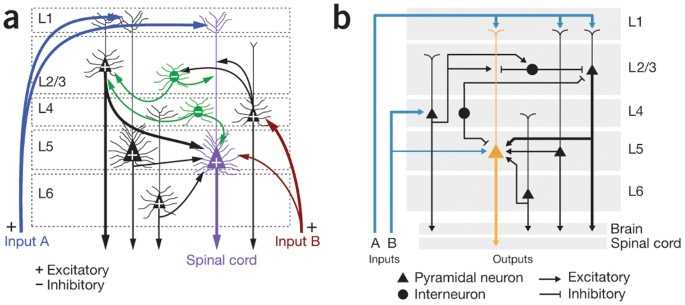
Identify cell types by applying immunostaining techniques to label excitatory and inhibitory neurons. Confirm classification with patch-clamp recordings to observe characteristic firing patterns.
Trace synaptic links using high-resolution imaging or tracer molecules to follow axonal projections. Focus on regions where inhibitory cells modulate clusters of excitatory nodes for balanced activity control.
Quantify connectivity by measuring postsynaptic potentials and calculating connection probability between cell types. Use paired recordings to determine the amplitude and latency of synaptic responses for accurate functional mapping.
- Compare input–output relationships across different network layers to detect preferential targeting by inhibitory neurons.
- Document variations in excitatory drive under controlled stimulation to reveal modulatory influences.
- Integrate electrophysiological and structural data to produce a comprehensive map of interactions between excitatory and inhibitory elements.