Connect the incoming supply conductors to the primary terminals marked on the nameplate and route the output conductors from the secondary terminals to the load. Always verify the rated input voltage before attaching conductors. Many control units accept 120 V or 240 V on the primary side and deliver 12 V, 24 V, or 48 V on the secondary side depending on coil configuration.
Inside this electromagnetic power device, two separate coil windings share a laminated steel core. The primary winding receives the incoming alternating current, creating a magnetic field in the core. That magnetic field induces voltage in the secondary winding through electromagnetic induction. A unit with a 10:1 turn ratio reduces 240 V input to approximately 24 V at the output terminals.
Choose conductor size based on current rating listed on the nameplate. Small control units delivering 24 V at 40 VA draw less than 0.4 A on the secondary side, allowing 18 AWG copper conductors. Larger power units rated above 500 VA require thicker conductors such as 12 AWG or 10 AWG. Tighten terminal screws to manufacturer torque values, commonly 12–20 lb-in for screw clamp terminals.
Verify connections with a multimeter before energizing the supply. Measure resistance across each coil to confirm continuity, then apply input voltage and check the output terminals. A stable reading near the rated output value indicates correct conductor placement and proper operation of the electromagnetic device.
Transformer Wiring Diagram with Primary Secondary Terminals and Connection Methods
Connect the incoming AC supply conductors to the primary terminals marked on the nameplate and attach the load conductors to the secondary terminals. Confirm the rated input voltage before energizing the unit. Common control units accept 120 V or 240 V on the input side and deliver 12 V, 24 V, or 48 V at the output depending on coil design.
Primary terminals usually appear as screw lugs or clamp connectors located on one side of the enclosure. Secondary terminals sit on the opposite side to separate input and output paths. Many devices include dual input coils that allow different supply configurations.
- H1 H2 input terminals for single supply connection
- H3 H4 additional input coil for series or parallel configuration
- X1 X2 output terminals delivering reduced or increased voltage
- Ground lug attached to the metal enclosure
Choose conductor size based on the power rating listed on the nameplate. A control unit rated at 100 VA with a 120 V input draws about 0.83 A, allowing 18 AWG copper. Larger power devices rated above 500 VA often require 14 AWG or 12 AWG. Tighten terminal screws to the torque value specified by the manufacturer, commonly 12–20 lb-in, and verify voltage across the output terminals using a multimeter after energizing the supply.
Transformer Wiring Diagram with Primary and Secondary Terminal Identification
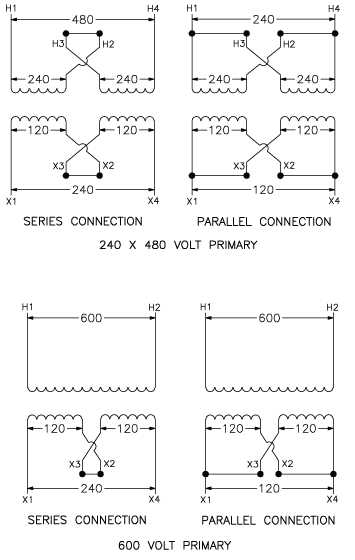
Check the nameplate markings and locate the input terminals labeled H1, H2, H3, or H4 before attaching supply conductors. These terminals connect to the incoming AC source. Typical control units accept 120 V or 240 V, and dual input coils may require series or parallel linking depending on the supply voltage.
Primary Terminal Identification
The input side usually includes two or four connection points. A two-terminal configuration accepts a single supply directly. A four-terminal layout allows flexible voltage selection.
Common arrangements include linking H1 to H3 and H2 to H4 for parallel operation on 120 V, or connecting H2 to H3 with the supply applied to H1 and H4 for 240 V input. Incorrect links may double the applied voltage on one coil and cause overheating.
Secondary Terminal Identification
Output terminals are usually labeled X1, X2, and sometimes X3 or X4. These terminals deliver the converted voltage produced by electromagnetic induction inside the laminated steel core. Control units commonly supply 12 V, 24 V, or 48 V. Measure voltage across the X terminals with a multimeter after energizing the input supply to confirm correct terminal placement and proper operation.