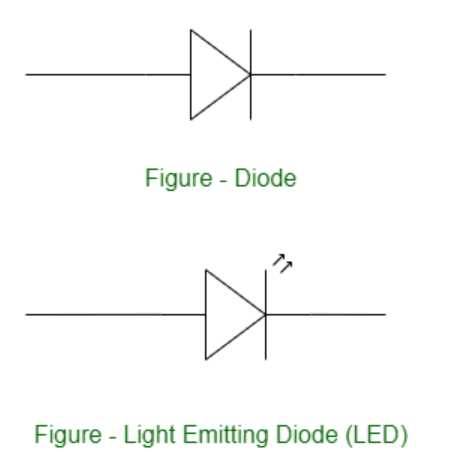
When working with electronic designs, recognizing the correct representation of an LED is crucial for accurate interpretation and implementation. This visual cue typically appears as a small arrow pointing towards a vertical line, symbolizing the direction of current flow. Its simple structure allows for quick identification and integration into various systems.
Pay attention to the polarity of the component. The long leg usually indicates the anode, while the short leg represents the cathode. Properly connecting these leads ensures the device functions as intended, emitting light when current flows in the correct direction. Mistakes here can lead to malfunction or damage.
Understanding how this element fits into a larger design is equally important. Whether it’s used for indicators, displays, or status lights, recognizing how it interacts with other components–like resistors or voltage sources–helps in assembling a reliable and functional system. Ensure that the current limiting resistor is appropriately sized to avoid overloading the component.
Understanding the LED Representation in Schematics
In electronic designs, the LED is often represented by a straightforward symbol that includes a diode with two arrows pointing outwards, indicating light emission. The direction of these arrows shows how current flows, with the longer line typically representing the anode and the shorter one the cathode. This visual representation helps distinguish this component from others in a schematic.
The primary purpose of this component is to visually indicate whether a system is on or off, though in some cases, it may serve as part of a more complex display mechanism. To avoid errors in your design, ensure that the component’s orientation is correct–reversing the polarity will prevent it from lighting up.
Proper Placement of the Resistor
A current-limiting resistor is required for the LED to function safely and efficiently. This component ensures the current passing through the LED stays within the recommended limits. Without this resistor, there is a high risk of damaging the LED due to excessive current. To calculate the appropriate resistance, use Ohm’s Law:
- R = (V_supply – V_LED) / I_LED
- Where R is resistance, V_supply is the voltage supplied to the circuit, V_LED is the voltage drop across the LED, and I_LED is the desired current.
For instance, if you’re using a 5V supply and the LED has a forward voltage of 2V with a desired current of 20mA, the calculation would be: (5V – 2V) / 0.02A = 150 ohms. This value will help protect your LED from burnout while ensuring it lights up at the appropriate brightness.
Identifying Different LED Configurations
In some designs, the LED is part of a more complex arrangement, such as a matrix or a multi-color configuration. These setups will often use the same basic representation but may include additional components to control the colors or patterns of light emitted. Understanding how to interpret these configurations is important when working on larger or more intricate designs.
Additionally, LEDs may be connected in series or parallel with other components. A series connection involves connecting the anodes in sequence, while a parallel connection has each LED sharing a common anode or cathode. Each configuration has its own set of voltage and current requirements, so check the schematic carefully before wiring components together.
One common mistake when dealing with these configurations is misinterpreting the voltage requirements. In a series setup, the total voltage required will be the sum of the individual LEDs’ forward voltages, whereas in parallel, the voltage remains the same as that of a single LED. Keeping track of this will prevent incorrect voltage from being applied to the LEDs.
For precise integration into your designs, always ensure that you’ve checked the datasheets for the specific type of LED used. These documents will provide crucial details about the forward voltage, current rating, and even the recommended resistor values.
Lastly, always double-check the polarity when working with this component. The reverse bias could lead to no current flow, rendering the LED useless in the design. Correctly identifying the orientation ensures proper functionality, avoiding potential errors during assembly or testing.
How to Identify the LED Representation in Electronic Schematics
Look for a basic diode shape with two lines: one longer (anode) and one shorter (cathode). The arrows indicate light emission. This visual is a direct indicator of a light-emitting component. Ensure the anode is connected to the positive side of the power source, and the cathode to the negative.
Polarity Indicators
The longer line represents the anode, while the shorter line corresponds to the cathode. In many cases, the anode side may be shown connected to a resistor, which limits the current flow. These markings are vital for correct polarity, as reversing them can prevent the component from functioning.
Some schematics may use additional markings, such as a small vertical line near the anode, indicating the LED is part of a specific module or setup. This helps to differentiate it from other diode-like components that may not emit light.
Note that different colors or intensities of light might be specified by the manufacturer, but in a basic schematic, this distinction is usually not visible. If needed, check the component’s datasheet for detailed information on voltage and current specifications for proper integration.
Always check the positioning of the LED within the overall setup. In some cases, it might appear as part of a more complex system, such as a display or indicator light system. Understanding its role in the design will help ensure the component is integrated properly.