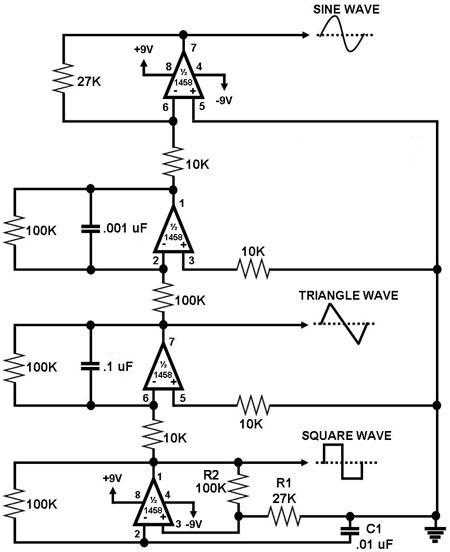
Connect the power rails carefully to ensure consistent voltage delivery and prevent fluctuations that can distort the output. Use a regulated supply rated above the minimum operating voltage of the components.
Place the waveform shaping elements in series with the main amplifier section to produce clean sine, square, and triangular outputs. High-quality capacitors reduce ripple and maintain signal integrity.
Verify all control paths for amplitude and frequency adjustments before applying a load. Fine-tuning resistive and reactive components ensures the output remains stable across the full range of settings.
Test the assembly with an oscilloscope to confirm the waveform accuracy and peak-to-peak voltage. Adjust trimming resistors if the measured signal deviates from expected levels.
Use short, direct connections between components to minimize stray inductance and capacitance, which can introduce noise and alter waveform shape.
Connection Layout and Setup for Stable Signal Output
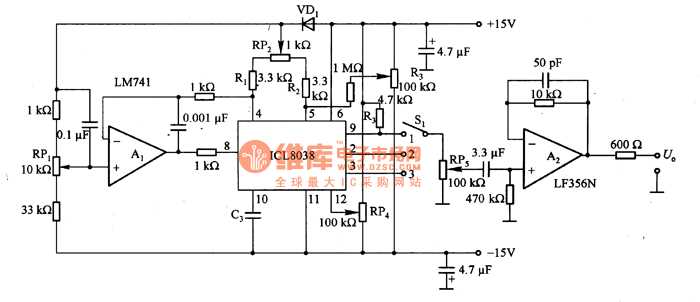
Begin by arranging the main supply lines with short, direct paths to the amplifier and shaping stages. This minimizes voltage drops and keeps waveform consistency across different loads.
Integrate the control potentiometers at accessible points for amplitude and frequency adjustments. Position them close to the active section to reduce interference and ensure precise regulation.
Use decoupling capacitors near power inputs to filter transient spikes. Capacitors rated at 100nF to 470nF are recommended to suppress high-frequency noise that could distort output signals.
Connect the output terminals with shielded leads when measuring with an oscilloscope. This prevents stray electromagnetic interference from altering the waveform shape during testing.
Check all connections for tight mechanical and electrical contact. Loose terminals in the signal path can create voltage fluctuations and irregular waveform patterns under load.
Test each section independently before applying full load. Monitor the amplitude, frequency, and waveform type to confirm each stage performs within the expected specifications.
Identifying Key Components and Their Roles in Signal Generation
Focus first on the active amplifying elements such as transistors or operational amplifiers. These components define the strength and stability of the output waveform and directly influence frequency response.
Examine timing and shaping devices like resistors and capacitors connected in feedback loops. They control oscillation periods, determine rise and fall times, and influence waveform symmetry.
Voltage reference elements are critical for maintaining consistent signal levels. Components such as Zener diodes or regulated power sections ensure the waveform amplitude remains stable under varying loads.
Observe the waveform selection mechanisms including switches and potentiometers. They direct the signal path to produce sine, square, or triangular forms and allow precise tuning of frequency and amplitude.
Document the interconnections between each section using a clear list:
- Amplifying stage – boosts signal strength
- Timing network – sets oscillation rate
- Reference voltage – stabilizes output level
- Shaping components – adjust waveform form
- Control interface – allows user adjustments